

These species can be considered as moderate halophilic
microorganisms because their optimum growth is between
3 and 15 % NaCl. Halanaerobium lacusrosei is the only
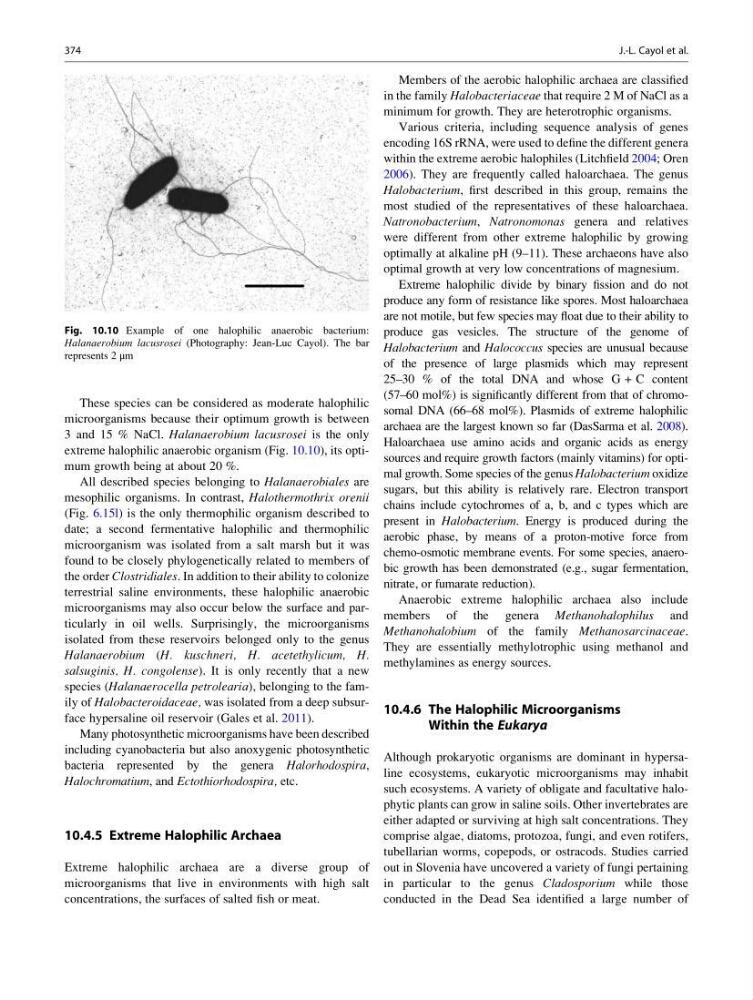
extreme halophilic anaerobic organism (Fig. 10.10), its optimum growth being at about 20 %.
All described species belonging to Halanaerobiales are
mesophilic organisms. In contrast, Halothermothrix orenii
(Fig. 6.15l) is the only thermophilic organism described to
date; a second fermentative halophilic and thermophilic
microorganism was isolated from a salt marsh but it was
found to be closely phylogenetically related to members of
the order Clostridiales. In addition to their ability to colonize
terrestrial saline environments, these halophilic anaerobic
microorganisms may also occur below the surface and particularly in oil wells. Surprisingly, the microorganisms
isolated from these reservoirs belonged only to the genus
Halanaerobium (H. kuschneri, H. acetethylicum, H.
salsuginis, H. congolense). It is only recently that a new
species (Halanaerocella petrolearia), belonging to the family of Halobacteroidaceae, was isolated from a deep subsurface hypersaline oil reservoir (Gales et al. 2011).
Many photosynthetic microorganisms have been described
including cyanobacteria but also anoxygenic photosynthetic
bacteria represented by the genera Halorhodospira,
Halochromatium, and Ectothiorhodospira, etc.
10.4.5 Extreme Halophilic Archaea
Extreme halophilic archaea are a diverse group of
microorganisms that live in environments with high salt
concentrations, the surfaces of salted fish or meat.
Members of the aerobic halophilic archaea are classified
in the family Halobacteriaceae that require 2 M of NaCl as a
minimum for growth. They are heterotrophic organisms.
Various criteria, including sequence analysis of genes
encoding 16S rRNA, were used to define the different genera
within the extreme aerobic halophiles (Litchfield 2004; Oren
2006). They are frequently called haloarchaea. The genus
Halobacterium, first described in this group, remains the
most studied of the representatives of these haloarchaea.
Natronobacterium, Natronomonas genera and relatives
were different from other extreme halophilic by growing
optimally at alkaline pH (9–11). These archaeons have also
optimal growth at very low concentrations of magnesium.
Extreme halophilic divide by binary fission and do not
produce any form of resistance like spores. Most haloarchaea
are not motile, but few species may float due to their ability to
produce gas vesicles. The structure of the genome of
Halobacterium and Halococcus species are unusual because
of the presence of large plasmids which may represent
25–30 % of the total DNA and whose G + C content
(57–60 mol%) is significantly different from that of chromosomal DNA (66–68 mol%). Plasmids of extreme halophilic
archaea are the largest known so far (DasSarma et al. 2008).
Haloarchaea use amino acids and organic acids as energy
sources and require growth factors (mainly vitamins) for optimal growth. Some species of the genus Halobacterium oxidize
sugars, but this ability is relatively rare. Electron transport
chains include cytochromes of a, b, and c types which are
present in Halobacterium. Energy is produced during the
aerobic phase, by means of a proton-motive force from
chemo-osmotic membrane events. For some species, anaerobic growth has been demonstrated (e.g., sugar fermentation,
nitrate, or fumarate reduction).
Anaerobic extreme halophilic archaea also include
members of the genera Methanohalophilus and
Methanohalobium of the family Methanosarcinaceae.
They are essentially methylotrophic using methanol and
methylamines as energy sources.
10.4.6 The Halophilic Microorganisms
Within the Eukarya
Although prokaryotic organisms are dominant in hypersaline ecosystems, eukaryotic microorganisms may inhabit
such ecosystems. A variety of obligate and facultative halophytic plants can grow in saline soils. Other invertebrates are
either adapted or surviving at high salt concentrations. They
comprise algae, diatoms, protozoa, fungi, and even rotifers,
tubellarian worms, copepods, or ostracods. Studies carried
out in Slovenia have uncovered a variety of fungi pertaining
in particular to the genus Cladosporium while those
conducted in the Dead Sea identified a large number of
Fig. 10.10 Example of one halophilic anaerobic bacterium:
Halanaerobium lacusrosei (Photography: Jean-Luc Cayol). The bar
represents 2 μm
374
J.-L. Cayol et al.
microorganisms because their optimum growth is between
3 and 15 % NaCl. Halanaerobium lacusrosei is the only
extreme halophilic anaerobic organism (Fig. 10.10), its optimum growth being at about 20 %.
All described species belonging to Halanaerobiales are
mesophilic organisms. In contrast, Halothermothrix orenii
(Fig. 6.15l) is the only thermophilic organism described to
date; a second fermentative halophilic and thermophilic
microorganism was isolated from a salt marsh but it was
found to be closely phylogenetically related to members of
the order Clostridiales. In addition to their ability to colonize
terrestrial saline environments, these halophilic anaerobic
microorganisms may also occur below the surface and particularly in oil wells. Surprisingly, the microorganisms
isolated from these reservoirs belonged only to the genus
Halanaerobium (H. kuschneri, H. acetethylicum, H.
salsuginis, H. congolense). It is only recently that a new
species (Halanaerocella petrolearia), belonging to the family of Halobacteroidaceae, was isolated from a deep subsurface hypersaline oil reservoir (Gales et al. 2011).
Many photosynthetic microorganisms have been described
including cyanobacteria but also anoxygenic photosynthetic
bacteria represented by the genera Halorhodospira,
Halochromatium, and Ectothiorhodospira, etc.
10.4.5 Extreme Halophilic Archaea
Extreme halophilic archaea are a diverse group of
microorganisms that live in environments with high salt
concentrations, the surfaces of salted fish or meat.
Members of the aerobic halophilic archaea are classified
in the family Halobacteriaceae that require 2 M of NaCl as a
minimum for growth. They are heterotrophic organisms.
Various criteria, including sequence analysis of genes
encoding 16S rRNA, were used to define the different genera
within the extreme aerobic halophiles (Litchfield 2004; Oren
2006). They are frequently called haloarchaea. The genus
Halobacterium, first described in this group, remains the
most studied of the representatives of these haloarchaea.
Natronobacterium, Natronomonas genera and relatives
were different from other extreme halophilic by growing
optimally at alkaline pH (9–11). These archaeons have also
optimal growth at very low concentrations of magnesium.
Extreme halophilic divide by binary fission and do not
produce any form of resistance like spores. Most haloarchaea
are not motile, but few species may float due to their ability to
produce gas vesicles. The structure of the genome of
Halobacterium and Halococcus species are unusual because
of the presence of large plasmids which may represent
25–30 % of the total DNA and whose G + C content
(57–60 mol%) is significantly different from that of chromosomal DNA (66–68 mol%). Plasmids of extreme halophilic
archaea are the largest known so far (DasSarma et al. 2008).
Haloarchaea use amino acids and organic acids as energy
sources and require growth factors (mainly vitamins) for optimal growth. Some species of the genus Halobacterium oxidize
sugars, but this ability is relatively rare. Electron transport
chains include cytochromes of a, b, and c types which are
present in Halobacterium. Energy is produced during the
aerobic phase, by means of a proton-motive force from
chemo-osmotic membrane events. For some species, anaerobic growth has been demonstrated (e.g., sugar fermentation,
nitrate, or fumarate reduction).
Anaerobic extreme halophilic archaea also include
members of the genera Methanohalophilus and
Methanohalobium of the family Methanosarcinaceae.
They are essentially methylotrophic using methanol and
methylamines as energy sources.
10.4.6 The Halophilic Microorganisms
Within the Eukarya
Although prokaryotic organisms are dominant in hypersaline ecosystems, eukaryotic microorganisms may inhabit
such ecosystems. A variety of obligate and facultative halophytic plants can grow in saline soils. Other invertebrates are
either adapted or surviving at high salt concentrations. They
comprise algae, diatoms, protozoa, fungi, and even rotifers,
tubellarian worms, copepods, or ostracods. Studies carried
out in Slovenia have uncovered a variety of fungi pertaining
in particular to the genus Cladosporium while those
conducted in the Dead Sea identified a large number of
Fig. 10.10 Example of one halophilic anaerobic bacterium:
Halanaerobium lacusrosei (Photography: Jean-Luc Cayol). The bar
represents 2 μm
374
J.-L. Cayol et al.