

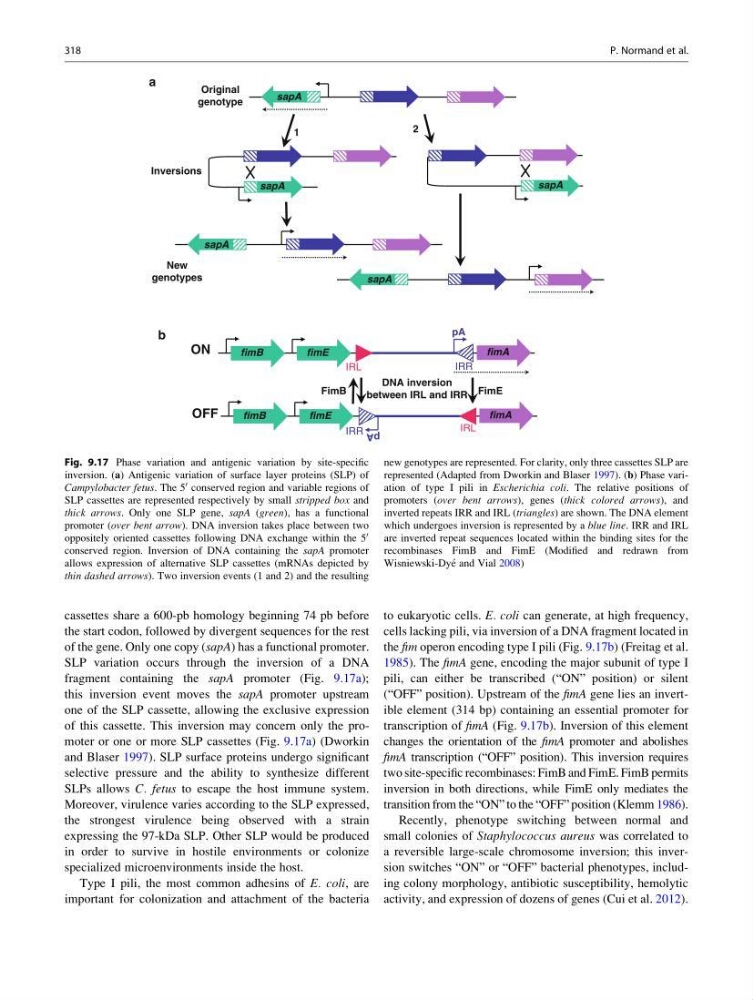
cassettes share a 600-pb homology beginning 74 pb before
the start codon, followed by divergent sequences for the rest
of the gene. Only one copy (sapA) has a functional promoter.
SLP variation occurs through the inversion of a DNA
fragment containing the sapA promoter (Fig. 9.17a);
this inversion event moves the sapA promoter upstream
one of the SLP cassette, allowing the exclusive expression
of this cassette. This inversion may concern only the promoter or one or more SLP cassettes (Fig. 9.17a) (Dworkin
and Blaser 1997). SLP surface proteins undergo significant
selective pressure and the ability to synthesize different
SLPs allows C. fetus to escape the host immune system.
Moreover, virulence varies according to the SLP expressed,
the strongest virulence being observed with a strain
expressing the 97-kDa SLP. Other SLP would be produced
in order to survive in hostile environments or colonize
specialized microenvironments inside the host.
Type I pili, the most common adhesins of E. coli, are
important for colonization and attachment of the bacteria
to eukaryotic cells. E. coli can generate, at high frequency,
cells lacking pili, via inversion of a DNA fragment located in
the fim operon encoding type I pili (Fig. 9.17b) (Freitag et al.
1985). The fimA gene, encoding the major subunit of type I
pili, can either be transcribed (“ON” position) or silent
(“OFF” position). Upstream of the fimA gene lies an invertible element (314 bp) containing an essential promoter for
transcription of fimA (Fig. 9.17b). Inversion of this element
changes the orientation of the fimA promoter and abolishes
fimA transcription (“OFF” position). This inversion requires
two site-specific recombinases: FimB and FimE. FimB permits
inversion in both directions, while FimE only mediates the
transition from the “ON” to the “OFF” position (Klemm 1986).
Recently, phenotype switching between normal and
small colonies of Staphylococcus aureus was correlated to
a reversible large-scale chromosome inversion; this inversion switches “ON” or “OFF” bacterial phenotypes, including colony morphology, antibiotic susceptibility, hemolytic
activity, and expression of dozens of genes (Cui et al. 2012).
Inversions
Original
genotype
New
genotypes
1
2
a
sapA
sapA
sapA
sapA
sapA
b
FimB
FimE
DNA inversion
between IRL and IRR
ON
pA
IRL
IRR
fimB
fimE
fimA
OFF
fimB
fimE
fimA
pA
IRL
IRR
Fig. 9.17 Phase variation and antigenic variation by site-specific
inversion. (a) Antigenic variation of surface layer proteins (SLP) of
Campylobacter fetus. The 5
0 conserved region and variable regions of
SLP cassettes are represented respectively by small stripped box and
thick arrows. Only one SLP gene, sapA (green), has a functional
promoter (over bent arrow). DNA inversion takes place between two
oppositely oriented cassettes following DNA exchange within the 5
0
conserved region. Inversion of DNA containing the sapA promoter
allows expression of alternative SLP cassettes (mRNAs depicted by
thin dashed arrows). Two inversion events (1 and 2) and the resulting
new genotypes are represented. For clarity, only three cassettes SLP are
represented (Adapted from Dworkin and Blaser 1997). (b) Phase variation of type I pili in Escherichia coli. The relative positions of
promoters (over bent arrows), genes (thick colored arrows), and
inverted repeats IRR and IRL (triangles) are shown. The DNA element
which undergoes inversion is represented by a blue line. IRR and IRL
are inverted repeat sequences located within the binding sites for the
recombinases FimB and FimE (Modified and redrawn from
Wisniewski-Dye ´ and Vial 2008)
318
P. Normand et al.
the start codon, followed by divergent sequences for the rest
of the gene. Only one copy (sapA) has a functional promoter.
SLP variation occurs through the inversion of a DNA
fragment containing the sapA promoter (Fig. 9.17a);
this inversion event moves the sapA promoter upstream
one of the SLP cassette, allowing the exclusive expression
of this cassette. This inversion may concern only the promoter or one or more SLP cassettes (Fig. 9.17a) (Dworkin
and Blaser 1997). SLP surface proteins undergo significant
selective pressure and the ability to synthesize different
SLPs allows C. fetus to escape the host immune system.
Moreover, virulence varies according to the SLP expressed,
the strongest virulence being observed with a strain
expressing the 97-kDa SLP. Other SLP would be produced
in order to survive in hostile environments or colonize
specialized microenvironments inside the host.
Type I pili, the most common adhesins of E. coli, are
important for colonization and attachment of the bacteria
to eukaryotic cells. E. coli can generate, at high frequency,
cells lacking pili, via inversion of a DNA fragment located in
the fim operon encoding type I pili (Fig. 9.17b) (Freitag et al.
1985). The fimA gene, encoding the major subunit of type I
pili, can either be transcribed (“ON” position) or silent
(“OFF” position). Upstream of the fimA gene lies an invertible element (314 bp) containing an essential promoter for
transcription of fimA (Fig. 9.17b). Inversion of this element
changes the orientation of the fimA promoter and abolishes
fimA transcription (“OFF” position). This inversion requires
two site-specific recombinases: FimB and FimE. FimB permits
inversion in both directions, while FimE only mediates the
transition from the “ON” to the “OFF” position (Klemm 1986).
Recently, phenotype switching between normal and
small colonies of Staphylococcus aureus was correlated to
a reversible large-scale chromosome inversion; this inversion switches “ON” or “OFF” bacterial phenotypes, including colony morphology, antibiotic susceptibility, hemolytic
activity, and expression of dozens of genes (Cui et al. 2012).
Inversions
Original
genotype
New
genotypes
1
2
a
sapA
sapA
sapA
sapA
sapA
b
FimB
FimE
DNA inversion
between IRL and IRR
ON
pA
IRL
IRR
fimB
fimE
fimA
OFF
fimB
fimE
fimA
pA
IRL
IRR
Fig. 9.17 Phase variation and antigenic variation by site-specific
inversion. (a) Antigenic variation of surface layer proteins (SLP) of
Campylobacter fetus. The 5
0 conserved region and variable regions of
SLP cassettes are represented respectively by small stripped box and
thick arrows. Only one SLP gene, sapA (green), has a functional
promoter (over bent arrow). DNA inversion takes place between two
oppositely oriented cassettes following DNA exchange within the 5
0
conserved region. Inversion of DNA containing the sapA promoter
allows expression of alternative SLP cassettes (mRNAs depicted by
thin dashed arrows). Two inversion events (1 and 2) and the resulting
new genotypes are represented. For clarity, only three cassettes SLP are
represented (Adapted from Dworkin and Blaser 1997). (b) Phase variation of type I pili in Escherichia coli. The relative positions of
promoters (over bent arrows), genes (thick colored arrows), and
inverted repeats IRR and IRL (triangles) are shown. The DNA element
which undergoes inversion is represented by a blue line. IRR and IRL
are inverted repeat sequences located within the binding sites for the
recombinases FimB and FimE (Modified and redrawn from
Wisniewski-Dye ´ and Vial 2008)
318
P. Normand et al.