

genomes of more than 9 Mb have 150 identified transcriptional regulators (Normand et al. 2007).
It is also estimated that seven transcriptional regulators
control 50 % of regulated genes in E. coli, while 60 transcriptional regulators control only one promoter (MartinezAntonio and Collado-Vides 2003).
9.2.2 Signal Transduction Systems
Bacteria have developed systems for the transduction
of signals*, which associate proteins able to perceive
changes in environmental parameters and transmit these
informations to other proteins through different molecular
mechanisms that will result in adaptation of the metabolism,
the physiology, or the behavior of the bacteria.
Depending on the signal transduction mechanisms,
several major types of signaling systems* can be distinguished in bacteria (Galperin 2005):
(i) Systems with histidine protein kinases (HK and MCP)
(ii) Systems with serine/threonine/tyrosine protein kinases
(STYK)
(iii) Systems with an intracellular secondary messenger
such as di-cGMP (GGDEF/EAL/HD-GYP) and cAMP
(AC)
Generally the number of signaling proteins is correlated
with genome size; however, it tends to increase with the
complexity of the lifestyle of the organism (Table 9.1).
The detailed structural study of a number of these signal
transduction systems coupled with comparative genomic
studies made possible by the rapid increase in the number
of sequenced genomes has revealed the modular structure of
bacterial signal transduction proteins (Fig. 9.4). This modular organization resulting from the combination of distinct
protein domains has led to the generation of a wide variety of
signaling proteins by multiple combinations of a limited
number of domains (Table 9.2) (Galperin and Gomelsky
2005).
9.2.2.1 Histidine Protein Kinase Systems
Histidine protein kinase systems are the signal transduction
systems most common in the bacterial world. They consist
of two proteins, a histidine kinase protein (HK) and a
response regulator (RR), that interact through the transfer
of a phosphoryl group from the HK protein onto the RR
protein (Fig. 9.5). Phosphorylation of the response regulator
leads to its activation and to generation of a signal along the
pathway. According to the method of perception of the
signal, two types of histidine protein kinase systems can be
distinguished:
(i) The conventional two-component systems in which the
HK perceives the signal.
(ii) The chemotaxis signaling systems. The perception of
the signal is carried by transmembrane receptors distinct
from the HK, the MCP proteins.
9.2.2.2 The Two-Component Systems (TCS)
With the exception of mycoplasmas, most bacteria and
many archaea have several two-component systems*
(Stock et al. 2000). Escherichia coli has 30 HKs, Bacillus
subtilis 37, the cyanobacterium Nostoc sp. PCC7220 134,
and an archaea Methanospirillum hungatei 76 (Table 9.3).
The TCS are involved in many processes such as the regulation of carbon and nitrogen metabolism, phosphate
uptake, growth under aerobic or anaerobic conditions,
osmoregulation, sporulation, and biofilm formation
(Table 9.3).
TCS are much less common in eukaryotes where
cascades involving phosphorylation of Tyr and Ser/Thr protein kinases are predominant. Nevertheless, such systems
have been identified in yeasts such as Saccharomyces
cerevisiae and Schizosaccharomyces pombe; fungi such as
Candida albicans, Neurospora crassa, and Aspergillus
nidulans, where they are involved in osmoregulation and
development; but also in plants such as Arabidopsis thaliana
in the genome of which 11 HKs have been identified. HKs
are homodimers (Fig. 9.6) consisting of:
0
2 000
4 000
6 000
8 000
100 000
9
8
7
6
5
4
3
2
1
0
R
2 =0.44
…..
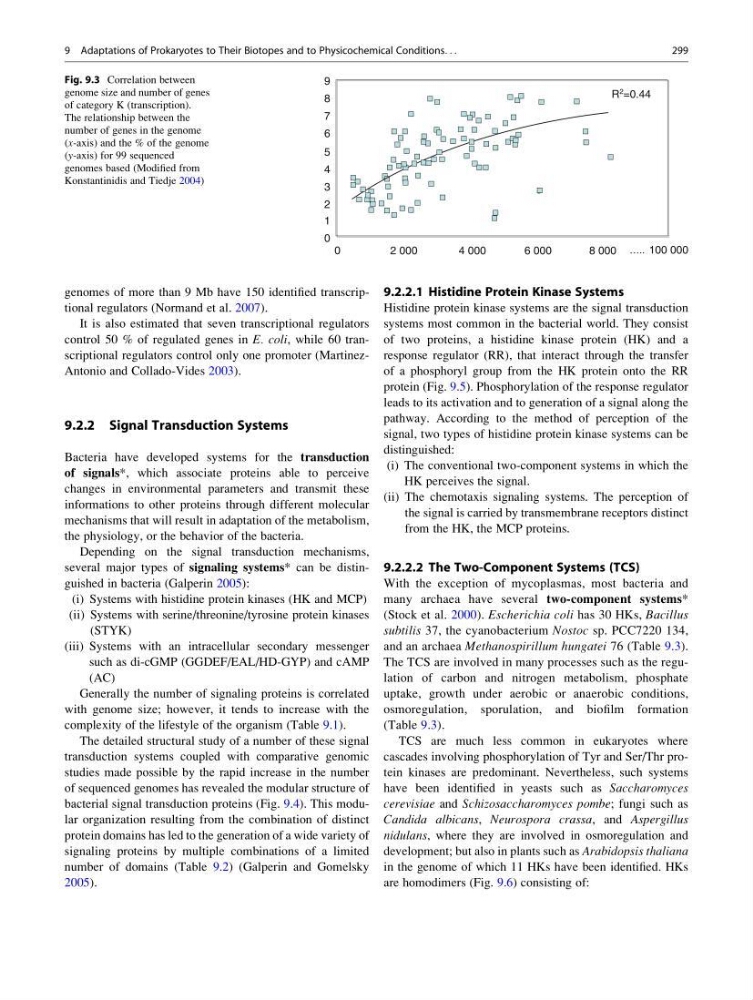
Fig. 9.3 Correlation between
genome size and number of genes
of category K (transcription).
The relationship between the
number of genes in the genome
(x-axis) and the % of the genome
(y-axis) for 99 sequenced
genomes based (Modified from
Konstantinidis and Tiedje 2004)
9 Adaptations of Prokaryotes to Their Biotopes and to Physicochemical Conditions. . .
299
It is also estimated that seven transcriptional regulators
control 50 % of regulated genes in E. coli, while 60 transcriptional regulators control only one promoter (MartinezAntonio and Collado-Vides 2003).
9.2.2 Signal Transduction Systems
Bacteria have developed systems for the transduction
of signals*, which associate proteins able to perceive
changes in environmental parameters and transmit these
informations to other proteins through different molecular
mechanisms that will result in adaptation of the metabolism,
the physiology, or the behavior of the bacteria.
Depending on the signal transduction mechanisms,
several major types of signaling systems* can be distinguished in bacteria (Galperin 2005):
(i) Systems with histidine protein kinases (HK and MCP)
(ii) Systems with serine/threonine/tyrosine protein kinases
(STYK)
(iii) Systems with an intracellular secondary messenger
such as di-cGMP (GGDEF/EAL/HD-GYP) and cAMP
(AC)
Generally the number of signaling proteins is correlated
with genome size; however, it tends to increase with the
complexity of the lifestyle of the organism (Table 9.1).
The detailed structural study of a number of these signal
transduction systems coupled with comparative genomic
studies made possible by the rapid increase in the number
of sequenced genomes has revealed the modular structure of
bacterial signal transduction proteins (Fig. 9.4). This modular organization resulting from the combination of distinct
protein domains has led to the generation of a wide variety of
signaling proteins by multiple combinations of a limited
number of domains (Table 9.2) (Galperin and Gomelsky
2005).
9.2.2.1 Histidine Protein Kinase Systems
Histidine protein kinase systems are the signal transduction
systems most common in the bacterial world. They consist
of two proteins, a histidine kinase protein (HK) and a
response regulator (RR), that interact through the transfer
of a phosphoryl group from the HK protein onto the RR
protein (Fig. 9.5). Phosphorylation of the response regulator
leads to its activation and to generation of a signal along the
pathway. According to the method of perception of the
signal, two types of histidine protein kinase systems can be
distinguished:
(i) The conventional two-component systems in which the
HK perceives the signal.
(ii) The chemotaxis signaling systems. The perception of
the signal is carried by transmembrane receptors distinct
from the HK, the MCP proteins.
9.2.2.2 The Two-Component Systems (TCS)
With the exception of mycoplasmas, most bacteria and
many archaea have several two-component systems*
(Stock et al. 2000). Escherichia coli has 30 HKs, Bacillus
subtilis 37, the cyanobacterium Nostoc sp. PCC7220 134,
and an archaea Methanospirillum hungatei 76 (Table 9.3).
The TCS are involved in many processes such as the regulation of carbon and nitrogen metabolism, phosphate
uptake, growth under aerobic or anaerobic conditions,
osmoregulation, sporulation, and biofilm formation
(Table 9.3).
TCS are much less common in eukaryotes where
cascades involving phosphorylation of Tyr and Ser/Thr protein kinases are predominant. Nevertheless, such systems
have been identified in yeasts such as Saccharomyces
cerevisiae and Schizosaccharomyces pombe; fungi such as
Candida albicans, Neurospora crassa, and Aspergillus
nidulans, where they are involved in osmoregulation and
development; but also in plants such as Arabidopsis thaliana
in the genome of which 11 HKs have been identified. HKs
are homodimers (Fig. 9.6) consisting of:
0
2 000
4 000
6 000
8 000
100 000
9
8
7
6
5
4
3
2
1
0
R
2 =0.44
…..
Fig. 9.3 Correlation between
genome size and number of genes
of category K (transcription).
The relationship between the
number of genes in the genome
(x-axis) and the % of the genome
(y-axis) for 99 sequenced
genomes based (Modified from
Konstantinidis and Tiedje 2004)
9 Adaptations of Prokaryotes to Their Biotopes and to Physicochemical Conditions. . .
299