

microbial ecology during the last years, which may provide
further insights in the causal relationships between microbial biodiversity and ecosystem functioning. Another
sticking point is our ability to link the diversity of
metabolites and the diversity and activities of microorganisms in a range of ecosystems. Integrative microbiology made on model microorganisms and collaboration
between microbial ecologists and scientists working on
natural substances should help defining these links. Ecological approaches have immense prospects for current
ecotoxicological issues; they now largely guide studies on
the impact of pollutants in the environment on environmental
and human health and ecosystem biodiversity and functioning.
The ability of researchers to assess to what extent the diversity
of microbial communities are important for ecosystem functioning and services, and the resilience capacity of these facing
global change factors is a great challenge for which social
and political expectations are high.
References
Achenbach LA, Carey J, Madigan MT (2001) Photosynthetic and
phylogenetic primers for detection of anoxygenic phototrophs in
natural environments. Appl Environ Microbiol 67:2922–2926
Amann RI, Ludwig W, Schleifer KH (1995) Phylogenetic identification
and in situ detection of individual microbial cells without cultivation. Microbiol Rev 59:143–169
Andrews JH, Kinkel LL, Berbee FM, Nordheim EV (1987) Fungi, leaves,
and the theory of island biogeography. Microb Ecol 14:277–290
Attard E, Poly F, Commeaux C, Laurent F, Terada A, Smets BF,
Recous S, Le Roux XL (2010) Shifts between Nitrospira- and
Nitrobacter-like nitrite oxidizers underlie the response of soil
potential nitrite oxidation to changes in tillage practices. Environ
Microbiol 12:315–326
Box 8.4: Industrial Exploitation of Microbial Biodiversity
Robert Duran
The food industry is a major user of microbial biodiversity. The French cheese industry, for example, produces
hundreds of soft or semihard cheese, using several species of lactic acid bacteria (Lactococcus, Streptococcus,
Lactobacillus, Leuconostoc) that contribute to the acidification of milk and also participate in sensory
characteristics through the synthesis of lytic enzymes
and propionic bacteria (Propionibacterium) that produce a variety of compounds, in particular carbon dioxide that in turn produces holes. Fungi (yeasts of the
genera Kluyveromyces, Debaryomyces, and Saccharomyces and molds of the genus Penicillium) are used for
the production of aromas; Geotrichum candidum
changes the appearance of goat cheese imparting a
“toad skin,” P. camembertii contributes to the formation
of a layer of felt on Camembert, and P. roqueforti causes
a marbling of blue cheese. Hundreds of strains have
been selected for each type of cheese over the centuries
(www.inra.fr/layout/set/print/la_science_et_vous/
apprendre_experimenter/monde_microbien/menons_l_
enquete/la_biodiversite_des_microorganismes_des_
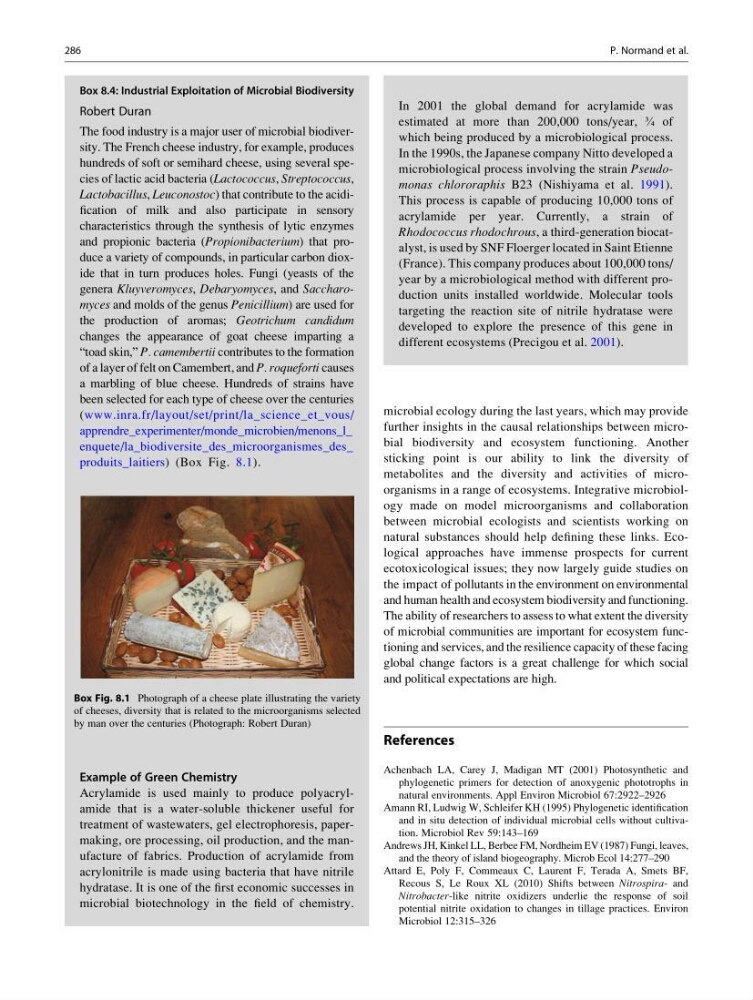
produits_laitiers) (Box Fig. 8.1).
Example of Green Chemistry
Acrylamide is used mainly to produce polyacrylamide that is a water-soluble thickener useful for
treatment of wastewaters, gel electrophoresis, papermaking, ore processing, oil production, and the manufacture of fabrics. Production of acrylamide from
acrylonitrile is made using bacteria that have nitrile
hydratase. It is one of the first economic successes in
microbial biotechnology in the field of chemistry.
(continued)
Box Fig. 8.1 Photograph of a cheese plate illustrating the variety
of cheeses, diversity that is related to the microorganisms selected
by man over the centuries (Photograph: Robert Duran)
Box 8.4 (continued)
In 2001 the global demand for acrylamide was
estimated at more than 200,000 tons/year, ¾ of
which being produced by a microbiological process.
In the 1990s, the Japanese company Nitto developed a
microbiological process involving the strain Pseudomonas chlororaphis B23 (Nishiyama et al. 1991).
This process is capable of producing 10,000 tons of
acrylamide per year. Currently, a strain of
Rhodococcus rhodochrous, a third-generation biocatalyst, is used by SNF Floerger located in Saint Etienne
(France). This company produces about 100,000 tons/
year by a microbiological method with different production units installed worldwide. Molecular tools
targeting the reaction site of nitrile hydratase were
developed to explore the presence of this gene in
different ecosystems (Precigou et al. 2001).
286
P. Normand et al.
further insights in the causal relationships between microbial biodiversity and ecosystem functioning. Another
sticking point is our ability to link the diversity of
metabolites and the diversity and activities of microorganisms in a range of ecosystems. Integrative microbiology made on model microorganisms and collaboration
between microbial ecologists and scientists working on
natural substances should help defining these links. Ecological approaches have immense prospects for current
ecotoxicological issues; they now largely guide studies on
the impact of pollutants in the environment on environmental
and human health and ecosystem biodiversity and functioning.
The ability of researchers to assess to what extent the diversity
of microbial communities are important for ecosystem functioning and services, and the resilience capacity of these facing
global change factors is a great challenge for which social
and political expectations are high.
References
Achenbach LA, Carey J, Madigan MT (2001) Photosynthetic and
phylogenetic primers for detection of anoxygenic phototrophs in
natural environments. Appl Environ Microbiol 67:2922–2926
Amann RI, Ludwig W, Schleifer KH (1995) Phylogenetic identification
and in situ detection of individual microbial cells without cultivation. Microbiol Rev 59:143–169
Andrews JH, Kinkel LL, Berbee FM, Nordheim EV (1987) Fungi, leaves,
and the theory of island biogeography. Microb Ecol 14:277–290
Attard E, Poly F, Commeaux C, Laurent F, Terada A, Smets BF,
Recous S, Le Roux XL (2010) Shifts between Nitrospira- and
Nitrobacter-like nitrite oxidizers underlie the response of soil
potential nitrite oxidation to changes in tillage practices. Environ
Microbiol 12:315–326
Box 8.4: Industrial Exploitation of Microbial Biodiversity
Robert Duran
The food industry is a major user of microbial biodiversity. The French cheese industry, for example, produces
hundreds of soft or semihard cheese, using several species of lactic acid bacteria (Lactococcus, Streptococcus,
Lactobacillus, Leuconostoc) that contribute to the acidification of milk and also participate in sensory
characteristics through the synthesis of lytic enzymes
and propionic bacteria (Propionibacterium) that produce a variety of compounds, in particular carbon dioxide that in turn produces holes. Fungi (yeasts of the
genera Kluyveromyces, Debaryomyces, and Saccharomyces and molds of the genus Penicillium) are used for
the production of aromas; Geotrichum candidum
changes the appearance of goat cheese imparting a
“toad skin,” P. camembertii contributes to the formation
of a layer of felt on Camembert, and P. roqueforti causes
a marbling of blue cheese. Hundreds of strains have
been selected for each type of cheese over the centuries
(www.inra.fr/layout/set/print/la_science_et_vous/
apprendre_experimenter/monde_microbien/menons_l_
enquete/la_biodiversite_des_microorganismes_des_
produits_laitiers) (Box Fig. 8.1).
Example of Green Chemistry
Acrylamide is used mainly to produce polyacrylamide that is a water-soluble thickener useful for
treatment of wastewaters, gel electrophoresis, papermaking, ore processing, oil production, and the manufacture of fabrics. Production of acrylamide from
acrylonitrile is made using bacteria that have nitrile
hydratase. It is one of the first economic successes in
microbial biotechnology in the field of chemistry.
(continued)
Box Fig. 8.1 Photograph of a cheese plate illustrating the variety
of cheeses, diversity that is related to the microorganisms selected
by man over the centuries (Photograph: Robert Duran)
Box 8.4 (continued)
In 2001 the global demand for acrylamide was
estimated at more than 200,000 tons/year, ¾ of
which being produced by a microbiological process.
In the 1990s, the Japanese company Nitto developed a
microbiological process involving the strain Pseudomonas chlororaphis B23 (Nishiyama et al. 1991).
This process is capable of producing 10,000 tons of
acrylamide per year. Currently, a strain of
Rhodococcus rhodochrous, a third-generation biocatalyst, is used by SNF Floerger located in Saint Etienne
(France). This company produces about 100,000 tons/
year by a microbiological method with different production units installed worldwide. Molecular tools
targeting the reaction site of nitrile hydratase were
developed to explore the presence of this gene in
different ecosystems (Precigou et al. 2001).
286
P. Normand et al.