

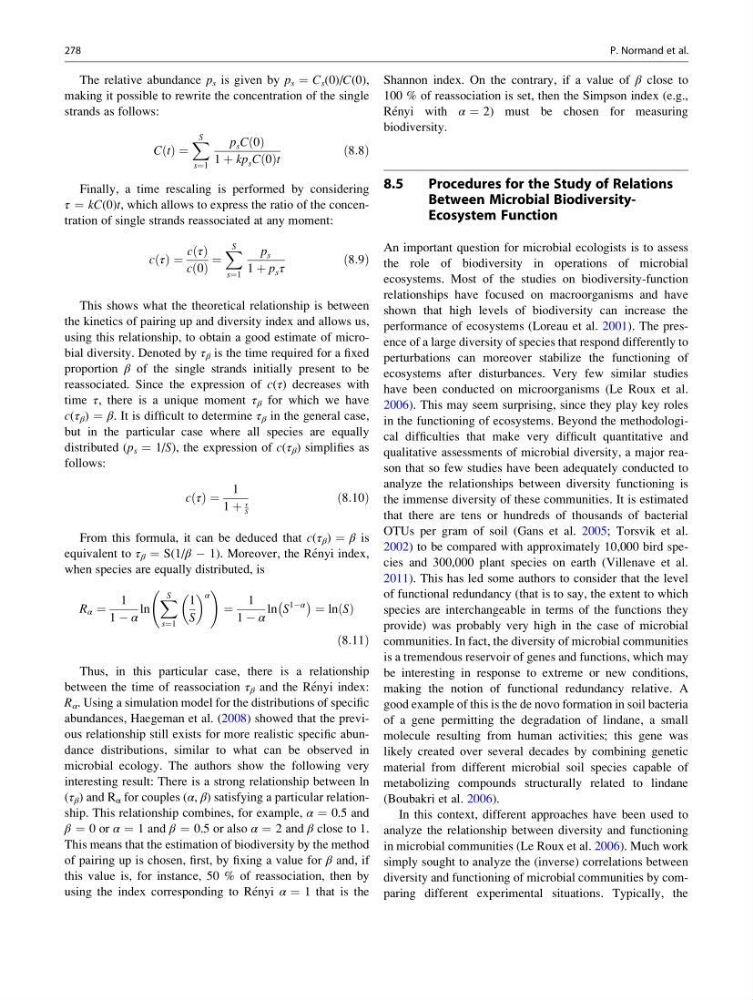
The relative abundance p s is given by p s ¼ C s (0)/C(0),
making it possible to rewrite the concentration of the single
strands as follows:
C t
ð Þ ¼
X S
s¼1
p s C 0
ð Þ
1 þ kp s C 0
ð Þt
ð8:8Þ
Finally, a time rescaling is performed by considering
τ ¼ kC(0)t, which allows to express the ratio of the concentration of single strands reassociated at any moment:
c τ
ð Þ ¼
c τ
ð Þ
c 0
ð Þ
¼
X S
s¼1
p s
1 þ p s τ
ð8:9Þ
This shows what the theoretical relationship is between
the kinetics of pairing up and diversity index and allows us,
using this relationship, to obtain a good estimate of microbial diversity. Denoted by τ β is the time required for a fixed
proportion β of the single strands initially present to be
reassociated. Since the expression of c(τ) decreases with
time τ, there is a unique moment τ β for which we have
c(τ β ) ¼ β. It is difficult to determine τ β in the general case,
but in the particular case where all species are equally
distributed (p s ¼ 1/S), the expression of c(τ β ) simplifies as
follows:
c τ
ð Þ ¼
1
1 þ
τ
S
ð8:10Þ
From this formula, it can be deduced that c(τ β ) ¼ β is
equivalent to τ β ¼ S(1/β À 1). Moreover, the Re ´nyi index,
when species are equally distributed, is
R α ¼
1
1 À α
ln
X S
s¼1
1
S
α
!
¼
1
1 À α
ln S
1Àα
À
Á ¼ ln S
ð Þ
ð8:11Þ
Thus, in this particular case, there is a relationship
between the time of reassociation τ β and the Re ´nyi index:
R α . Using a simulation model for the distributions of specific
abundances, Haegeman et al. (2008) showed that the previous relationship still exists for more realistic specific abundance distributions, similar to what can be observed in
microbial ecology. The authors show the following very
interesting result: There is a strong relationship between ln
(τ β ) and R α for couples (α, β) satisfying a particular relationship. This relationship combines, for example, α ¼ 0.5 and
β ¼ 0 or α ¼ 1 and β ¼ 0.5 or also α ¼ 2 and β close to 1.
This means that the estimation of biodiversity by the method
of pairing up is chosen, first, by fixing a value for β and, if
this value is, for instance, 50 % of reassociation, then by
using the index corresponding to Re ´nyi α ¼ 1 that is the
Shannon index. On the contrary, if a value of β close to
100 % of reassociation is set, then the Simpson index (e.g.,
Re ´nyi with α ¼ 2) must be chosen for measuring
biodiversity.
8.5
Procedures for the Study of Relations
Between Microbial BiodiversityEcosystem Function
An important question for microbial ecologists is to assess
the role of biodiversity in operations of microbial
ecosystems. Most of the studies on biodiversity-function
relationships have focused on macroorganisms and have
shown that high levels of biodiversity can increase the
performance of ecosystems (Loreau et al. 2001). The presence of a large diversity of species that respond differently to
perturbations can moreover stabilize the functioning of
ecosystems after disturbances. Very few similar studies
have been conducted on microorganisms (Le Roux et al.
2006). This may seem surprising, since they play key roles
in the functioning of ecosystems. Beyond the methodological difficulties that make very difficult quantitative and
qualitative assessments of microbial diversity, a major reason that so few studies have been adequately conducted to
analyze the relationships between diversity functioning is
the immense diversity of these communities. It is estimated
that there are tens or hundreds of thousands of bacterial
OTUs per gram of soil (Gans et al. 2005; Torsvik et al.
2002) to be compared with approximately 10,000 bird species and 300,000 plant species on earth (Villenave et al.
2011). This has led some authors to consider that the level
of functional redundancy (that is to say, the extent to which
species are interchangeable in terms of the functions they
provide) was probably very high in the case of microbial
communities. In fact, the diversity of microbial communities
is a tremendous reservoir of genes and functions, which may
be interesting in response to extreme or new conditions,
making the notion of functional redundancy relative. A
good example of this is the de novo formation in soil bacteria
of a gene permitting the degradation of lindane, a small
molecule resulting from human activities; this gene was
likely created over several decades by combining genetic
material from different microbial soil species capable of
metabolizing compounds structurally related to lindane
(Boubakri et al. 2006).
In this context, different approaches have been used to
analyze the relationship between diversity and functioning
in microbial communities (Le Roux et al. 2006). Much work
simply sought to analyze the (inverse) correlations between
diversity and functioning of microbial communities by comparing different experimental situations. Typically, the
278
P. Normand et al.
making it possible to rewrite the concentration of the single
strands as follows:
C t
ð Þ ¼
X S
s¼1
p s C 0
ð Þ
1 þ kp s C 0
ð Þt
ð8:8Þ
Finally, a time rescaling is performed by considering
τ ¼ kC(0)t, which allows to express the ratio of the concentration of single strands reassociated at any moment:
c τ
ð Þ ¼
c τ
ð Þ
c 0
ð Þ
¼
X S
s¼1
p s
1 þ p s τ
ð8:9Þ
This shows what the theoretical relationship is between
the kinetics of pairing up and diversity index and allows us,
using this relationship, to obtain a good estimate of microbial diversity. Denoted by τ β is the time required for a fixed
proportion β of the single strands initially present to be
reassociated. Since the expression of c(τ) decreases with
time τ, there is a unique moment τ β for which we have
c(τ β ) ¼ β. It is difficult to determine τ β in the general case,
but in the particular case where all species are equally
distributed (p s ¼ 1/S), the expression of c(τ β ) simplifies as
follows:
c τ
ð Þ ¼
1
1 þ
τ
S
ð8:10Þ
From this formula, it can be deduced that c(τ β ) ¼ β is
equivalent to τ β ¼ S(1/β À 1). Moreover, the Re ´nyi index,
when species are equally distributed, is
R α ¼
1
1 À α
ln
X S
s¼1
1
S
α
!
¼
1
1 À α
ln S
1Àα
À
Á ¼ ln S
ð Þ
ð8:11Þ
Thus, in this particular case, there is a relationship
between the time of reassociation τ β and the Re ´nyi index:
R α . Using a simulation model for the distributions of specific
abundances, Haegeman et al. (2008) showed that the previous relationship still exists for more realistic specific abundance distributions, similar to what can be observed in
microbial ecology. The authors show the following very
interesting result: There is a strong relationship between ln
(τ β ) and R α for couples (α, β) satisfying a particular relationship. This relationship combines, for example, α ¼ 0.5 and
β ¼ 0 or α ¼ 1 and β ¼ 0.5 or also α ¼ 2 and β close to 1.
This means that the estimation of biodiversity by the method
of pairing up is chosen, first, by fixing a value for β and, if
this value is, for instance, 50 % of reassociation, then by
using the index corresponding to Re ´nyi α ¼ 1 that is the
Shannon index. On the contrary, if a value of β close to
100 % of reassociation is set, then the Simpson index (e.g.,
Re ´nyi with α ¼ 2) must be chosen for measuring
biodiversity.
8.5
Procedures for the Study of Relations
Between Microbial BiodiversityEcosystem Function
An important question for microbial ecologists is to assess
the role of biodiversity in operations of microbial
ecosystems. Most of the studies on biodiversity-function
relationships have focused on macroorganisms and have
shown that high levels of biodiversity can increase the
performance of ecosystems (Loreau et al. 2001). The presence of a large diversity of species that respond differently to
perturbations can moreover stabilize the functioning of
ecosystems after disturbances. Very few similar studies
have been conducted on microorganisms (Le Roux et al.
2006). This may seem surprising, since they play key roles
in the functioning of ecosystems. Beyond the methodological difficulties that make very difficult quantitative and
qualitative assessments of microbial diversity, a major reason that so few studies have been adequately conducted to
analyze the relationships between diversity functioning is
the immense diversity of these communities. It is estimated
that there are tens or hundreds of thousands of bacterial
OTUs per gram of soil (Gans et al. 2005; Torsvik et al.
2002) to be compared with approximately 10,000 bird species and 300,000 plant species on earth (Villenave et al.
2011). This has led some authors to consider that the level
of functional redundancy (that is to say, the extent to which
species are interchangeable in terms of the functions they
provide) was probably very high in the case of microbial
communities. In fact, the diversity of microbial communities
is a tremendous reservoir of genes and functions, which may
be interesting in response to extreme or new conditions,
making the notion of functional redundancy relative. A
good example of this is the de novo formation in soil bacteria
of a gene permitting the degradation of lindane, a small
molecule resulting from human activities; this gene was
likely created over several decades by combining genetic
material from different microbial soil species capable of
metabolizing compounds structurally related to lindane
(Boubakri et al. 2006).
In this context, different approaches have been used to
analyze the relationship between diversity and functioning
in microbial communities (Le Roux et al. 2006). Much work
simply sought to analyze the (inverse) correlations between
diversity and functioning of microbial communities by comparing different experimental situations. Typically, the
278
P. Normand et al.