

cases, the sequence divergence of genes linked to a function
can vary too much between phylogenetic groups for a single
pair of primers to amplify all sequences corresponding to
this gene. For instance, the second step of nitrification
(NO 2
À
> NO 3
À
) is performed by different groups of
nitrite-oxidizing bacteria which harbor the gene encoding
nitrite oxidoreductase NxrA. However, groups such as
Nitrobacter versus Nitrospira have sequences that are too
different for this gene to be amplified by the same primers
(Wertz et al. 2008). The second factor is, on the contrary,
that it is also necessary that there is enough variation for the
targeted sequence in different taxa to be distinguished.
Finally, the concept of conservation of function between
homologous genes, which is the foundation on which homology is defined, is sometimes difficult to assess. For example,
in the case of alternative iron or vanadium nitrogenases,
there is clearly a common origin, the function is retained,
but with a non-negligible modification, i.e., the change of
metal in the cofactor (Normand and Bousquet 1989). Despite
these difficulties, many genes other than rrs are studied to
characterize the diversity of microbial communities. This is
particularly important when microbial functions rather than
taxonomic diversity or population dynamics per se are studied. Indeed, the link between phylogenetic markers and functional ones is sometimes rather weak (Salles et al. 2012).
Nitrogen Cycle
The nitrogen cycle is probably the one where knowledge of
the sequences of key genes of the various functions involved
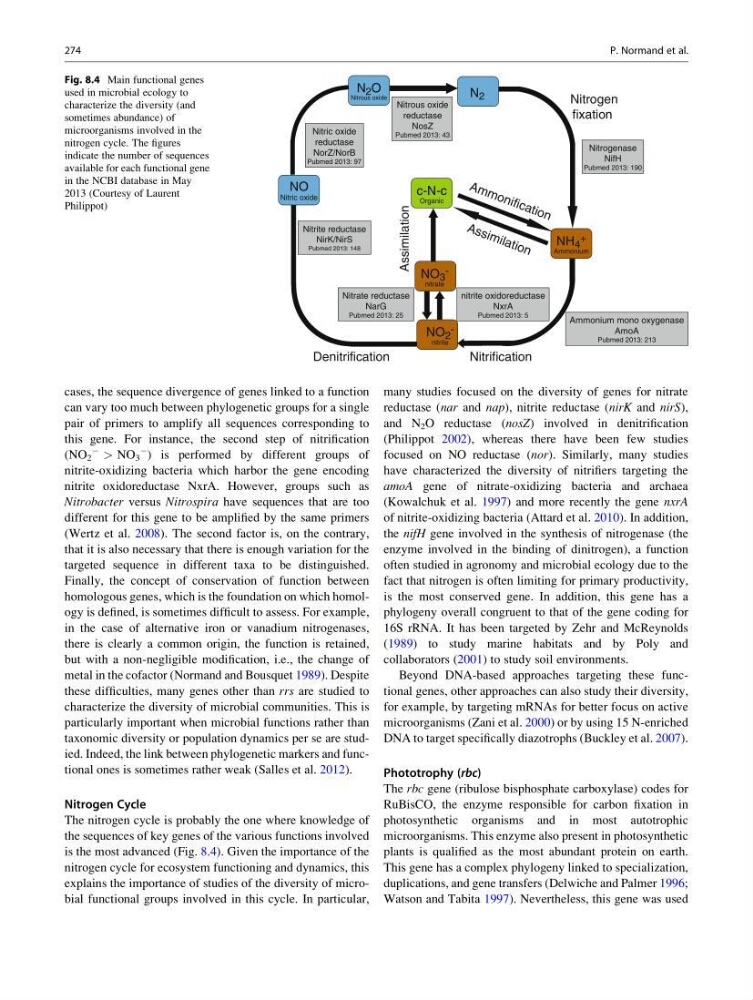
is the most advanced (Fig. 8.4). Given the importance of the
nitrogen cycle for ecosystem functioning and dynamics, this
explains the importance of studies of the diversity of microbial functional groups involved in this cycle. In particular,
many studies focused on the diversity of genes for nitrate
reductase (nar and nap), nitrite reductase (nirK and nirS),
and N 2 O reductase (nosZ) involved in denitrification
(Philippot 2002), whereas there have been few studies
focused on NO reductase (nor). Similarly, many studies
have characterized the diversity of nitrifiers targeting the
amoA gene of nitrate-oxidizing bacteria and archaea
(Kowalchuk et al. 1997) and more recently the gene nxrA
of nitrite-oxidizing bacteria (Attard et al. 2010). In addition,
the nifH gene involved in the synthesis of nitrogenase (the
enzyme involved in the binding of dinitrogen), a function
often studied in agronomy and microbial ecology due to the
fact that nitrogen is often limiting for primary productivity,
is the most conserved gene. In addition, this gene has a
phylogeny overall congruent to that of the gene coding for
16S rRNA. It has been targeted by Zehr and McReynolds
(1989) to study marine habitats and by Poly and
collaborators (2001) to study soil environments.
Beyond DNA-based approaches targeting these functional genes, other approaches can also study their diversity,
for example, by targeting mRNAs for better focus on active
microorganisms (Zani et al. 2000) or by using 15 N-enriched
DNA to target specifically diazotrophs (Buckley et al. 2007).
Phototrophy (rbc)
The rbc gene (ribulose bisphosphate carboxylase) codes for
RuBisCO, the enzyme responsible for carbon fixation in
photosynthetic organisms and in most autotrophic
microorganisms. This enzyme also present in photosynthetic
plants is qualified as the most abundant protein on earth.
This gene has a complex phylogeny linked to specialization,
duplications, and gene transfers (Delwiche and Palmer 1996;
Watson and Tabita 1997). Nevertheless, this gene was used
nitrite oxidoreductase
NxrA
Pubmed 2013: 5
Nitrous oxide
reductase
NosZ
Pubmed 2013: 43
Nitrite reductase
NirK/NirS
Pubmed 2013: 148
Nitric oxide
reductase
NorZ/NorB
Pubmed 2013: 97
Nitrogenase
NifH
Pubmed 2013: 190
Ammonium mono oxygenase
AmoA
Pubmed 2013: 213
N 2
NO 3
-
nitrate
NH 4
+
Ammonium
c-N-c
Organic
NO
Nitric oxide
N 2 O
Nitrous oxide
Nitrate reductase
NarG
Pubmed 2013: 25
NO 2
-
nitrite
Nitrogen
fixation
Denitrification
A m m o n if ic a ti o n
A s s im il a ti o n
Nitrification
Assimilation
Fig. 8.4 Main functional genes
used in microbial ecology to
characterize the diversity (and
sometimes abundance) of
microorganisms involved in the
nitrogen cycle. The figures
indicate the number of sequences
available for each functional gene
in the NCBI database in May
2013 (Courtesy of Laurent
Philippot)
274
P. Normand et al.
can vary too much between phylogenetic groups for a single
pair of primers to amplify all sequences corresponding to
this gene. For instance, the second step of nitrification
(NO 2
À
> NO 3
À
) is performed by different groups of
nitrite-oxidizing bacteria which harbor the gene encoding
nitrite oxidoreductase NxrA. However, groups such as
Nitrobacter versus Nitrospira have sequences that are too
different for this gene to be amplified by the same primers
(Wertz et al. 2008). The second factor is, on the contrary,
that it is also necessary that there is enough variation for the
targeted sequence in different taxa to be distinguished.
Finally, the concept of conservation of function between
homologous genes, which is the foundation on which homology is defined, is sometimes difficult to assess. For example,
in the case of alternative iron or vanadium nitrogenases,
there is clearly a common origin, the function is retained,
but with a non-negligible modification, i.e., the change of
metal in the cofactor (Normand and Bousquet 1989). Despite
these difficulties, many genes other than rrs are studied to
characterize the diversity of microbial communities. This is
particularly important when microbial functions rather than
taxonomic diversity or population dynamics per se are studied. Indeed, the link between phylogenetic markers and functional ones is sometimes rather weak (Salles et al. 2012).
Nitrogen Cycle
The nitrogen cycle is probably the one where knowledge of
the sequences of key genes of the various functions involved
is the most advanced (Fig. 8.4). Given the importance of the
nitrogen cycle for ecosystem functioning and dynamics, this
explains the importance of studies of the diversity of microbial functional groups involved in this cycle. In particular,
many studies focused on the diversity of genes for nitrate
reductase (nar and nap), nitrite reductase (nirK and nirS),
and N 2 O reductase (nosZ) involved in denitrification
(Philippot 2002), whereas there have been few studies
focused on NO reductase (nor). Similarly, many studies
have characterized the diversity of nitrifiers targeting the
amoA gene of nitrate-oxidizing bacteria and archaea
(Kowalchuk et al. 1997) and more recently the gene nxrA
of nitrite-oxidizing bacteria (Attard et al. 2010). In addition,
the nifH gene involved in the synthesis of nitrogenase (the
enzyme involved in the binding of dinitrogen), a function
often studied in agronomy and microbial ecology due to the
fact that nitrogen is often limiting for primary productivity,
is the most conserved gene. In addition, this gene has a
phylogeny overall congruent to that of the gene coding for
16S rRNA. It has been targeted by Zehr and McReynolds
(1989) to study marine habitats and by Poly and
collaborators (2001) to study soil environments.
Beyond DNA-based approaches targeting these functional genes, other approaches can also study their diversity,
for example, by targeting mRNAs for better focus on active
microorganisms (Zani et al. 2000) or by using 15 N-enriched
DNA to target specifically diazotrophs (Buckley et al. 2007).
Phototrophy (rbc)
The rbc gene (ribulose bisphosphate carboxylase) codes for
RuBisCO, the enzyme responsible for carbon fixation in
photosynthetic organisms and in most autotrophic
microorganisms. This enzyme also present in photosynthetic
plants is qualified as the most abundant protein on earth.
This gene has a complex phylogeny linked to specialization,
duplications, and gene transfers (Delwiche and Palmer 1996;
Watson and Tabita 1997). Nevertheless, this gene was used
nitrite oxidoreductase
NxrA
Pubmed 2013: 5
Nitrous oxide
reductase
NosZ
Pubmed 2013: 43
Nitrite reductase
NirK/NirS
Pubmed 2013: 148
Nitric oxide
reductase
NorZ/NorB
Pubmed 2013: 97
Nitrogenase
NifH
Pubmed 2013: 190
Ammonium mono oxygenase
AmoA
Pubmed 2013: 213
N 2
NO 3
-
nitrate
NH 4
+
Ammonium
c-N-c
Organic
NO
Nitric oxide
N 2 O
Nitrous oxide
Nitrate reductase
NarG
Pubmed 2013: 25
NO 2
-
nitrite
Nitrogen
fixation
Denitrification
A m m o n if ic a ti o n
A s s im il a ti o n
Nitrification
Assimilation
Fig. 8.4 Main functional genes
used in microbial ecology to
characterize the diversity (and
sometimes abundance) of
microorganisms involved in the
nitrogen cycle. The figures
indicate the number of sequences
available for each functional gene
in the NCBI database in May
2013 (Courtesy of Laurent
Philippot)
274
P. Normand et al.