

and transmission to them, an adaptation that helps complete
the life cycle of the parasite. It diffuses into the rodent’s brain
chemicals that make it more active, less fearful of predators,
and that give it somehow “risk appetite”. T. gondii is capable
of infecting humans, that play the role of the intermediate
host. Cats rarely eat humans, so there should be little advantage for the parasite to manipulate human, which definitely
constitutes a dead end. Still, it influences human behavior, as
if it were that of a mouse and it was necessary to rush into the
cat’s claws: “risk-taking” and machismo increase significantly in human individuals infected with T. gondii; the
frequency of traffic accidents for example is 2.7 times higher
in infected individuals compared to healthy ones (Webster
2001; Lafferty 2006).
7.9
Kingdom Stramenopiles
7.9.1 General Remarks
The kingdom Stramenopiles
20 (¼Straminopiles, Stramenopila, Heterokonta) brings together taxa that were customarily classified within animals (Actinophryda, opalines), fungi
(customary meaning; e.g. Oobionta, Labyrinthulobionta)
and “algae” (Chromobionta). The bicosoecids have the
Mosquito
Salivary
glands
Plasmodium (n)
Man
Hepatocytes
(liver)
Multiplication
Red blood
cells (erythrocytes)
Male gametocyst (n)
Female gametocyst (n)
Meiosis
n
Sting
Bloodstream
Sting
Zygote
(2n)
Female
gamete
(n)
Male gamete (n)
Digestive tract
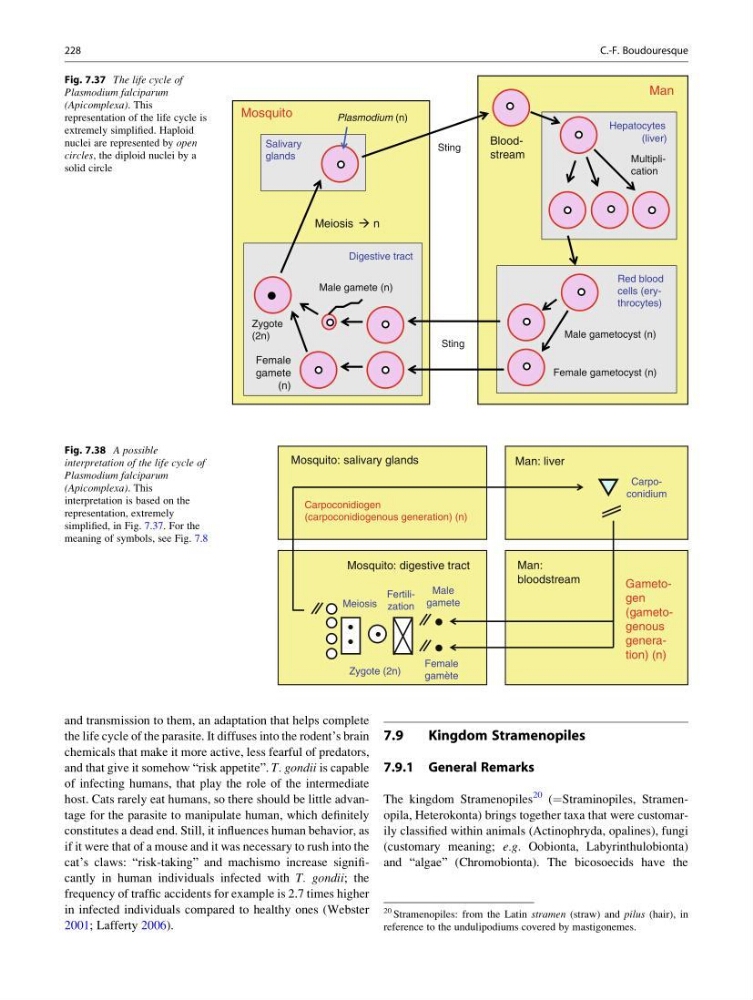
Fig. 7.37 The life cycle of
Plasmodium falciparum
(Apicomplexa). This
representation of the life cycle is
extremely simplified. Haploid
nuclei are represented by open
circles, the diploid nuclei by a
solid circle
Man: liver
Man:
bloodstream
Male
gamete
Female
gamète
Zygote (2n)
Mosquito: salivary glands
Mosquito: digestive tract
Meiosis
Carpoconidiogen
(carpoconidiogenous generation) (n)
Gametogen
(gametogenous
generation) (n)
Carpoconidium
Fertilization
Fig. 7.38 A possible
interpretation of the life cycle of
Plasmodium falciparum
(Apicomplexa). This
interpretation is based on the
representation, extremely
simplified, in Fig. 7.37. For the
meaning of symbols, see Fig. 7.8
20 Stramenopiles: from the Latin stramen (straw) and pilus (hair), in
reference to the undulipodiums covered by mastigonemes.
228
C.-F. Boudouresque
the life cycle of the parasite. It diffuses into the rodent’s brain
chemicals that make it more active, less fearful of predators,
and that give it somehow “risk appetite”. T. gondii is capable
of infecting humans, that play the role of the intermediate
host. Cats rarely eat humans, so there should be little advantage for the parasite to manipulate human, which definitely
constitutes a dead end. Still, it influences human behavior, as
if it were that of a mouse and it was necessary to rush into the
cat’s claws: “risk-taking” and machismo increase significantly in human individuals infected with T. gondii; the
frequency of traffic accidents for example is 2.7 times higher
in infected individuals compared to healthy ones (Webster
2001; Lafferty 2006).
7.9
Kingdom Stramenopiles
7.9.1 General Remarks
The kingdom Stramenopiles
20 (¼Straminopiles, Stramenopila, Heterokonta) brings together taxa that were customarily classified within animals (Actinophryda, opalines), fungi
(customary meaning; e.g. Oobionta, Labyrinthulobionta)
and “algae” (Chromobionta). The bicosoecids have the
Mosquito
Salivary
glands
Plasmodium (n)
Man
Hepatocytes
(liver)
Multiplication
Red blood
cells (erythrocytes)
Male gametocyst (n)
Female gametocyst (n)
Meiosis
n
Sting
Bloodstream
Sting
Zygote
(2n)
Female
gamete
(n)
Male gamete (n)
Digestive tract
Fig. 7.37 The life cycle of
Plasmodium falciparum
(Apicomplexa). This
representation of the life cycle is
extremely simplified. Haploid
nuclei are represented by open
circles, the diploid nuclei by a
solid circle
Man: liver
Man:
bloodstream
Male
gamete
Female
gamète
Zygote (2n)
Mosquito: salivary glands
Mosquito: digestive tract
Meiosis
Carpoconidiogen
(carpoconidiogenous generation) (n)
Gametogen
(gametogenous
generation) (n)
Carpoconidium
Fertilization
Fig. 7.38 A possible
interpretation of the life cycle of
Plasmodium falciparum
(Apicomplexa). This
interpretation is based on the
representation, extremely
simplified, in Fig. 7.37. For the
meaning of symbols, see Fig. 7.8
20 Stramenopiles: from the Latin stramen (straw) and pilus (hair), in
reference to the undulipodiums covered by mastigonemes.
228
C.-F. Boudouresque