

perforated by pores, which is part of the skeleton. The outer
part (ectoplasm) contains digestive vacuoles and lipid
reserve droplets, keeping the cell buoyant (Tregouboff
1953a). At the periphery of the cell, not limited by a cell
wall, the cytoplasm is extended by very narrow
pseudopodia. Some pseudopodia are slender, raylike, and
supported internally by a microtubule (axopods); others do
not have microtubules and may anastomose (filopodes). The
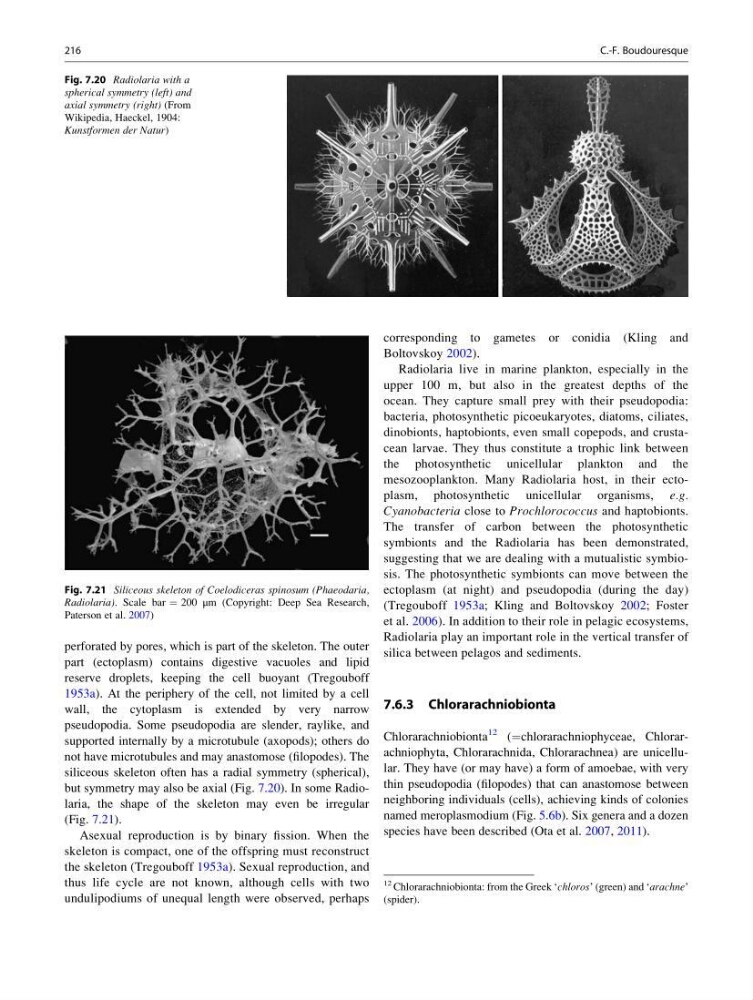
siliceous skeleton often has a radial symmetry (spherical),
but symmetry may also be axial (Fig. 7.20). In some Radiolaria, the shape of the skeleton may even be irregular
(Fig. 7.21).
Asexual reproduction is by binary fission. When the
skeleton is compact, one of the offspring must reconstruct
the skeleton (Tregouboff 1953a). Sexual reproduction, and
thus life cycle are not known, although cells with two
undulipodiums of unequal length were observed, perhaps
corresponding to gametes or conidia (Kling and
Boltovskoy 2002).
Radiolaria live in marine plankton, especially in the
upper 100 m, but also in the greatest depths of the
ocean. They capture small prey with their pseudopodia:
bacteria, photosynthetic picoeukaryotes, diatoms, ciliates,
dinobionts, haptobionts, even small copepods, and crustacean larvae. They thus constitute a trophic link between
the photosynthetic unicellular plankton and the
mesozooplankton. Many Radiolaria host, in their ectoplasm, photosynthetic unicellular organisms, e.g.
Cyanobacteria close to Prochlorococcus and haptobionts.
The transfer of carbon between the photosynthetic
symbionts and the Radiolaria has been demonstrated,
suggesting that we are dealing with a mutualistic symbiosis. The photosynthetic symbionts can move between the
ectoplasm (at night) and pseudopodia (during the day)
(Tregouboff 1953a; Kling and Boltovskoy 2002; Foster
et al. 2006). In addition to their role in pelagic ecosystems,
Radiolaria play an important role in the vertical transfer of
silica between pelagos and sediments.
7.6.3 Chlorarachniobionta
Chlorarachniobionta
12 (¼chlorarachniophyceae, Chlorarachniophyta, Chlorarachnida, Chlorarachnea) are unicellular. They have (or may have) a form of amoebae, with very
thin pseudopodia (filopodes) that can anastomose between
neighboring individuals (cells), achieving kinds of colonies
named meroplasmodium (Fig. 5.6b). Six genera and a dozen
species have been described (Ota et al. 2007, 2011).
Fig. 7.20 Radiolaria with a
spherical symmetry (left) and
axial symmetry (right) (From
Wikipedia, Haeckel, 1904:
Kunstformen der Natur)
Fig. 7.21 Siliceous skeleton of Coelodiceras spinosum (Phaeodaria,
Radiolaria). Scale bar ¼ 200 μm (Copyright: Deep Sea Research,
Paterson et al. 2007)
12 Chlorarachniobionta: from the Greek ‘chloros’ (green) and ‘arachne’
(spider).
216
C.-F. Boudouresque
part (ectoplasm) contains digestive vacuoles and lipid
reserve droplets, keeping the cell buoyant (Tregouboff
1953a). At the periphery of the cell, not limited by a cell
wall, the cytoplasm is extended by very narrow
pseudopodia. Some pseudopodia are slender, raylike, and
supported internally by a microtubule (axopods); others do
not have microtubules and may anastomose (filopodes). The
siliceous skeleton often has a radial symmetry (spherical),
but symmetry may also be axial (Fig. 7.20). In some Radiolaria, the shape of the skeleton may even be irregular
(Fig. 7.21).
Asexual reproduction is by binary fission. When the
skeleton is compact, one of the offspring must reconstruct
the skeleton (Tregouboff 1953a). Sexual reproduction, and
thus life cycle are not known, although cells with two
undulipodiums of unequal length were observed, perhaps
corresponding to gametes or conidia (Kling and
Boltovskoy 2002).
Radiolaria live in marine plankton, especially in the
upper 100 m, but also in the greatest depths of the
ocean. They capture small prey with their pseudopodia:
bacteria, photosynthetic picoeukaryotes, diatoms, ciliates,
dinobionts, haptobionts, even small copepods, and crustacean larvae. They thus constitute a trophic link between
the photosynthetic unicellular plankton and the
mesozooplankton. Many Radiolaria host, in their ectoplasm, photosynthetic unicellular organisms, e.g.
Cyanobacteria close to Prochlorococcus and haptobionts.
The transfer of carbon between the photosynthetic
symbionts and the Radiolaria has been demonstrated,
suggesting that we are dealing with a mutualistic symbiosis. The photosynthetic symbionts can move between the
ectoplasm (at night) and pseudopodia (during the day)
(Tregouboff 1953a; Kling and Boltovskoy 2002; Foster
et al. 2006). In addition to their role in pelagic ecosystems,
Radiolaria play an important role in the vertical transfer of
silica between pelagos and sediments.
7.6.3 Chlorarachniobionta
Chlorarachniobionta
12 (¼chlorarachniophyceae, Chlorarachniophyta, Chlorarachnida, Chlorarachnea) are unicellular. They have (or may have) a form of amoebae, with very
thin pseudopodia (filopodes) that can anastomose between
neighboring individuals (cells), achieving kinds of colonies
named meroplasmodium (Fig. 5.6b). Six genera and a dozen
species have been described (Ota et al. 2007, 2011).
Fig. 7.20 Radiolaria with a
spherical symmetry (left) and
axial symmetry (right) (From
Wikipedia, Haeckel, 1904:
Kunstformen der Natur)
Fig. 7.21 Siliceous skeleton of Coelodiceras spinosum (Phaeodaria,
Radiolaria). Scale bar ¼ 200 μm (Copyright: Deep Sea Research,
Paterson et al. 2007)
12 Chlorarachniobionta: from the Greek ‘chloros’ (green) and ‘arachne’
(spider).
216
C.-F. Boudouresque