

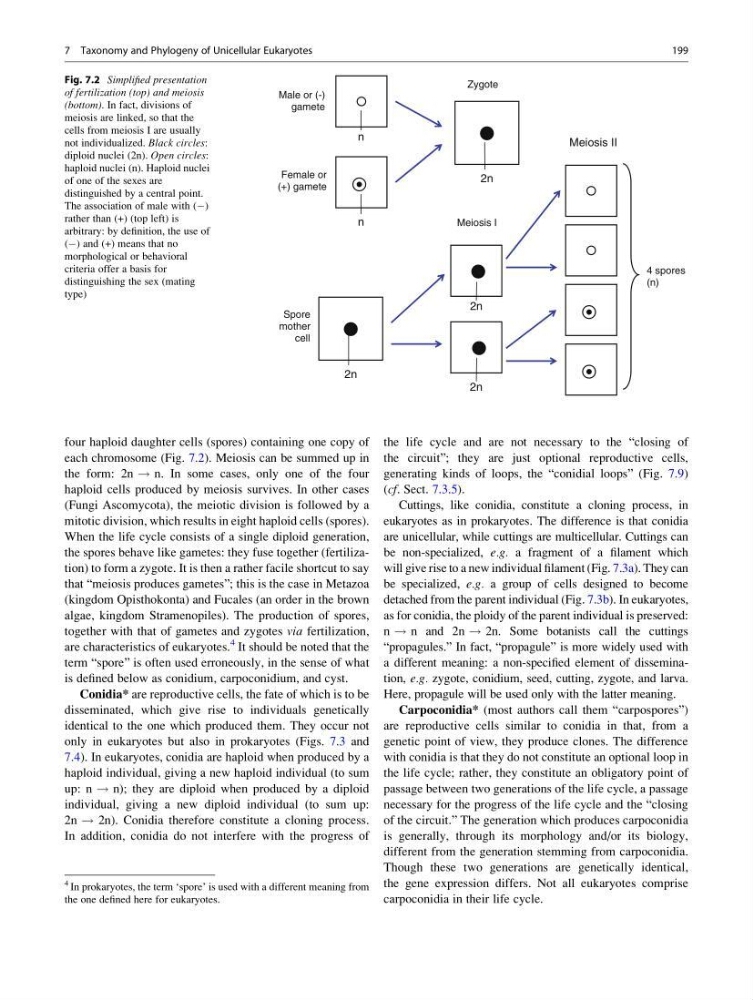
four haploid daughter cells (spores) containing one copy of
each chromosome (Fig. 7.2). Meiosis can be summed up in
the form: 2n ! n. In some cases, only one of the four
haploid cells produced by meiosis survives. In other cases
(Fungi Ascomycota), the meiotic division is followed by a
mitotic division, which results in eight haploid cells (spores).
When the life cycle consists of a single diploid generation,
the spores behave like gametes: they fuse together (fertilization) to form a zygote. It is then a rather facile shortcut to say
that “meiosis produces gametes”; this is the case in Metazoa
(kingdom Opisthokonta) and Fucales (an order in the brown
algae, kingdom Stramenopiles). The production of spores,
together with that of gametes and zygotes via fertilization,
are characteristics of eukaryotes.
4 It should be noted that the
term “spore” is often used erroneously, in the sense of what
is defined below as conidium, carpoconidium, and cyst.
Conidia* are reproductive cells, the fate of which is to be
disseminated, which give rise to individuals genetically
identical to the one which produced them. They occur not
only in eukaryotes but also in prokaryotes (Figs. 7.3 and
7.4). In eukaryotes, conidia are haploid when produced by a
haploid individual, giving a new haploid individual (to sum
up: n ! n); they are diploid when produced by a diploid
individual, giving a new diploid individual (to sum up:
2n ! 2n). Conidia therefore constitute a cloning process.
In addition, conidia do not interfere with the progress of
the life cycle and are not necessary to the “closing of
the circuit”; they are just optional reproductive cells,
generating kinds of loops, the “conidial loops” (Fig. 7.9)
(cf. Sect. 7.3.5).
Cuttings, like conidia, constitute a cloning process, in
eukaryotes as in prokaryotes. The difference is that conidia
are unicellular, while cuttings are multicellular. Cuttings can
be non-specialized, e.g. a fragment of a filament which
will give rise to a new individual filament (Fig. 7.3a). They can
be specialized, e.g. a group of cells designed to become
detached from the parent individual (Fig. 7.3b). In eukaryotes,
as for conidia, the ploidy of the parent individual is preserved:
n ! n and 2n ! 2n. Some botanists call the cuttings
“propagules.” In fact, “propagule” is more widely used with
a different meaning: a non-specified element of dissemination, e.g. zygote, conidium, seed, cutting, zygote, and larva.
Here, propagule will be used only with the latter meaning.
Carpoconidia* (most authors call them “carpospores”)
are reproductive cells similar to conidia in that, from a
genetic point of view, they produce clones. The difference
with conidia is that they do not constitute an optional loop in
the life cycle; rather, they constitute an obligatory point of
passage between two generations of the life cycle, a passage
necessary for the progress of the life cycle and the “closing
of the circuit.” The generation which produces carpoconidia
is generally, through its morphology and/or its biology,
different from the generation stemming from carpoconidia.
Though these two generations are genetically identical,
the gene expression differs. Not all eukaryotes comprise
carpoconidia in their life cycle.
4 spores
(n)
n
Male or (-)
gamete
Female or
(+) gamete
n
2n
Zygote
2n
Spore
mother
cell
Meiosis II
2n
2n
Meiosis I
Fig. 7.2 Simplified presentation
of fertilization (top) and meiosis
(bottom). In fact, divisions of
meiosis are linked, so that the
cells from meiosis I are usually
not individualized. Black circles:
diploid nuclei (2n). Open circles:
haploid nuclei (n). Haploid nuclei
of one of the sexes are
distinguished by a central point.
The association of male with (À)
rather than (+) (top left) is
arbitrary: by definition, the use of
(À) and (+) means that no
morphological or behavioral
criteria offer a basis for
distinguishing the sex (mating
type)
4 In prokaryotes, the term ‘spore’ is used with a different meaning from
the one defined here for eukaryotes.
7 Taxonomy and Phylogeny of Unicellular Eukaryotes
199
each chromosome (Fig. 7.2). Meiosis can be summed up in
the form: 2n ! n. In some cases, only one of the four
haploid cells produced by meiosis survives. In other cases
(Fungi Ascomycota), the meiotic division is followed by a
mitotic division, which results in eight haploid cells (spores).
When the life cycle consists of a single diploid generation,
the spores behave like gametes: they fuse together (fertilization) to form a zygote. It is then a rather facile shortcut to say
that “meiosis produces gametes”; this is the case in Metazoa
(kingdom Opisthokonta) and Fucales (an order in the brown
algae, kingdom Stramenopiles). The production of spores,
together with that of gametes and zygotes via fertilization,
are characteristics of eukaryotes.
4 It should be noted that the
term “spore” is often used erroneously, in the sense of what
is defined below as conidium, carpoconidium, and cyst.
Conidia* are reproductive cells, the fate of which is to be
disseminated, which give rise to individuals genetically
identical to the one which produced them. They occur not
only in eukaryotes but also in prokaryotes (Figs. 7.3 and
7.4). In eukaryotes, conidia are haploid when produced by a
haploid individual, giving a new haploid individual (to sum
up: n ! n); they are diploid when produced by a diploid
individual, giving a new diploid individual (to sum up:
2n ! 2n). Conidia therefore constitute a cloning process.
In addition, conidia do not interfere with the progress of
the life cycle and are not necessary to the “closing of
the circuit”; they are just optional reproductive cells,
generating kinds of loops, the “conidial loops” (Fig. 7.9)
(cf. Sect. 7.3.5).
Cuttings, like conidia, constitute a cloning process, in
eukaryotes as in prokaryotes. The difference is that conidia
are unicellular, while cuttings are multicellular. Cuttings can
be non-specialized, e.g. a fragment of a filament which
will give rise to a new individual filament (Fig. 7.3a). They can
be specialized, e.g. a group of cells designed to become
detached from the parent individual (Fig. 7.3b). In eukaryotes,
as for conidia, the ploidy of the parent individual is preserved:
n ! n and 2n ! 2n. Some botanists call the cuttings
“propagules.” In fact, “propagule” is more widely used with
a different meaning: a non-specified element of dissemination, e.g. zygote, conidium, seed, cutting, zygote, and larva.
Here, propagule will be used only with the latter meaning.
Carpoconidia* (most authors call them “carpospores”)
are reproductive cells similar to conidia in that, from a
genetic point of view, they produce clones. The difference
with conidia is that they do not constitute an optional loop in
the life cycle; rather, they constitute an obligatory point of
passage between two generations of the life cycle, a passage
necessary for the progress of the life cycle and the “closing
of the circuit.” The generation which produces carpoconidia
is generally, through its morphology and/or its biology,
different from the generation stemming from carpoconidia.
Though these two generations are genetically identical,
the gene expression differs. Not all eukaryotes comprise
carpoconidia in their life cycle.
4 spores
(n)
n
Male or (-)
gamete
Female or
(+) gamete
n
2n
Zygote
2n
Spore
mother
cell
Meiosis II
2n
2n
Meiosis I
Fig. 7.2 Simplified presentation
of fertilization (top) and meiosis
(bottom). In fact, divisions of
meiosis are linked, so that the
cells from meiosis I are usually
not individualized. Black circles:
diploid nuclei (2n). Open circles:
haploid nuclei (n). Haploid nuclei
of one of the sexes are
distinguished by a central point.
The association of male with (À)
rather than (+) (top left) is
arbitrary: by definition, the use of
(À) and (+) means that no
morphological or behavioral
criteria offer a basis for
distinguishing the sex (mating
type)
4 In prokaryotes, the term ‘spore’ is used with a different meaning from
the one defined here for eukaryotes.
7 Taxonomy and Phylogeny of Unicellular Eukaryotes
199