

and prokaryotes. However, when a given eukaryotic character is considered alone, it can be absent from a taxon. This
is considered to be a derived, not ancestral, character,
corresponding to a secondary loss.
The differences between prokaryotes and eukaryotes are
dealt with in Chap. 3. Here, we simply recall the characters
common to all eukaryotes, or to most of them, characters of
probable ancestral nature. These characters will not be
recalled hereafter in the taxonomic section, except for their
absence, probably due to a secondary loss.
First of all, the eukaryotic cell is characterized by the
presence of a true nucleus. Most of the genetic material
(DNA) is localized within this nucleus, separated from the
cytoplasm by a double-layered membrane, the nuclear envelope. The nuclear DNA is of eukaryotic-type, with two strands
wound around each other in a double helix; strands are linear,
with open ends, unlike the prokaryotic-type DNA which is
circular. The DNA is packaged by large proteic molecules,
the histones. The genes are distributed into several
chromosomes (at least two). The number of genes is generally
high (up to 40,000). The major part of the genome is composed of repetitive DNA, with noncoding regions taking a
large part (up to 90 %), within (introns) and between genes.
The enzymes involved in the vitamin B 12 (cobalamin)
synthesis have been characterized in some prokaryotic
organisms only. In contrast, eukaryotes do not synthesize
this vitamin, despite its role in the pathway that produces
the amino acid methionine and in a variety of metabolic
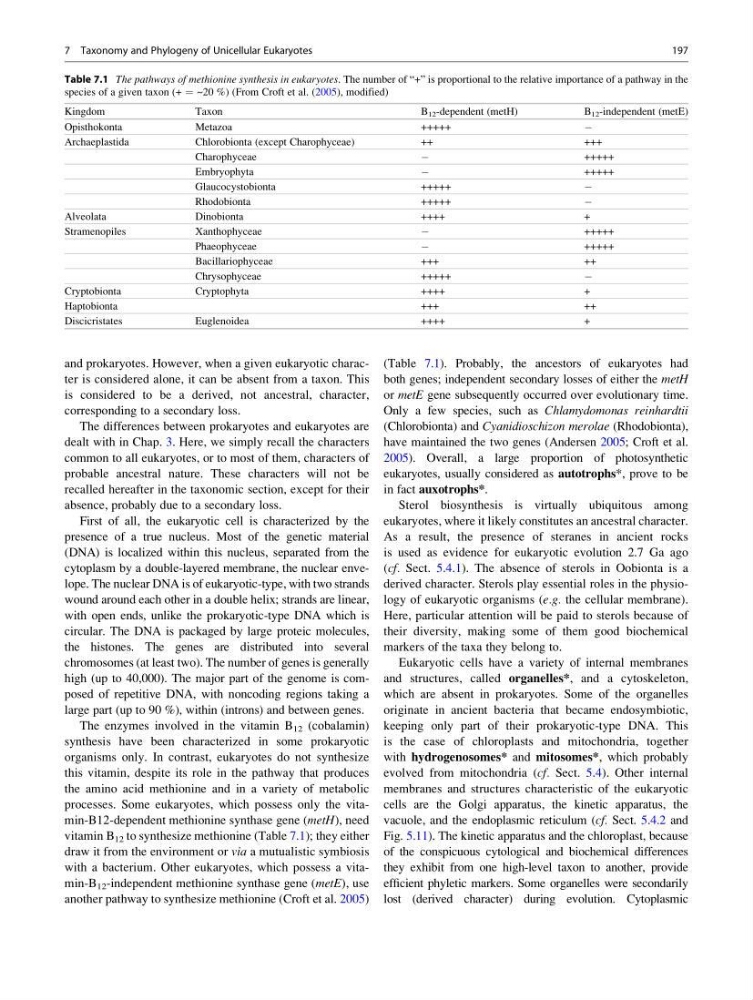
processes. Some eukaryotes, which possess only the vitamin-B12-dependent methionine synthase gene (metH), need
vitamin B 12 to synthesize methionine (Table 7.1); they either
draw it from the environment or via a mutualistic symbiosis
with a bacterium. Other eukaryotes, which possess a vitamin-B 12 -independent methionine synthase gene (metE), use
another pathway to synthesize methionine (Croft et al. 2005)
(Table 7.1). Probably, the ancestors of eukaryotes had
both genes; independent secondary losses of either the metH
or metE gene subsequently occurred over evolutionary time.
Only a few species, such as Chlamydomonas reinhardtii
(Chlorobionta) and Cyanidioschizon merolae (Rhodobionta),
have maintained the two genes (Andersen 2005; Croft et al.
2005). Overall, a large proportion of photosynthetic
eukaryotes, usually considered as autotrophs*, prove to be
in fact auxotrophs*.
Sterol biosynthesis is virtually ubiquitous among
eukaryotes, where it likely constitutes an ancestral character.
As a result, the presence of steranes in ancient rocks
is used as evidence for eukaryotic evolution 2.7 Ga ago
(cf. Sect. 5.4.1). The absence of sterols in Oobionta is a
derived character. Sterols play essential roles in the physiology of eukaryotic organisms (e.g. the cellular membrane).
Here, particular attention will be paid to sterols because of
their diversity, making some of them good biochemical
markers of the taxa they belong to.
Eukaryotic cells have a variety of internal membranes
and structures, called organelles*, and a cytoskeleton,
which are absent in prokaryotes. Some of the organelles
originate in ancient bacteria that became endosymbiotic,
keeping only part of their prokaryotic-type DNA. This
is the case of chloroplasts and mitochondria, together
with hydrogenosomes* and mitosomes*, which probably
evolved from mitochondria (cf. Sect. 5.4). Other internal
membranes and structures characteristic of the eukaryotic
cells are the Golgi apparatus, the kinetic apparatus, the
vacuole, and the endoplasmic reticulum (cf. Sect. 5.4.2 and
Fig. 5.11). The kinetic apparatus and the chloroplast, because
of the conspicuous cytological and biochemical differences
they exhibit from one high-level taxon to another, provide
efficient phyletic markers. Some organelles were secondarily
lost (derived character) during evolution. Cytoplasmic
Table 7.1 The pathways of methionine synthesis in eukaryotes. The number of “+” is proportional to the relative importance of a pathway in the
species of a given taxon (+ ¼ ~20 %) (From Croft et al. (2005), modified)
Kingdom
Taxon
B 12 -dependent (metH)
B 12 -independent (metE)
Opisthokonta
Metazoa
+++++
À
Archaeplastida
Chlorobionta (except Charophyceae)
++
+++
Charophyceae
À
+++++
Embryophyta
À
+++++
Glaucocystobionta
+++++
À
Rhodobionta
+++++
À
Alveolata
Dinobionta
++++
+
Stramenopiles
Xanthophyceae
À
+++++
Phaeophyceae
À
+++++
Bacillariophyceae
+++
++
Chrysophyceae
+++++
À
Cryptobionta
Cryptophyta
++++
+
Haptobionta
+++
++
Discicristates
Euglenoidea
++++
+
7 Taxonomy and Phylogeny of Unicellular Eukaryotes
197
is considered to be a derived, not ancestral, character,
corresponding to a secondary loss.
The differences between prokaryotes and eukaryotes are
dealt with in Chap. 3. Here, we simply recall the characters
common to all eukaryotes, or to most of them, characters of
probable ancestral nature. These characters will not be
recalled hereafter in the taxonomic section, except for their
absence, probably due to a secondary loss.
First of all, the eukaryotic cell is characterized by the
presence of a true nucleus. Most of the genetic material
(DNA) is localized within this nucleus, separated from the
cytoplasm by a double-layered membrane, the nuclear envelope. The nuclear DNA is of eukaryotic-type, with two strands
wound around each other in a double helix; strands are linear,
with open ends, unlike the prokaryotic-type DNA which is
circular. The DNA is packaged by large proteic molecules,
the histones. The genes are distributed into several
chromosomes (at least two). The number of genes is generally
high (up to 40,000). The major part of the genome is composed of repetitive DNA, with noncoding regions taking a
large part (up to 90 %), within (introns) and between genes.
The enzymes involved in the vitamin B 12 (cobalamin)
synthesis have been characterized in some prokaryotic
organisms only. In contrast, eukaryotes do not synthesize
this vitamin, despite its role in the pathway that produces
the amino acid methionine and in a variety of metabolic
processes. Some eukaryotes, which possess only the vitamin-B12-dependent methionine synthase gene (metH), need
vitamin B 12 to synthesize methionine (Table 7.1); they either
draw it from the environment or via a mutualistic symbiosis
with a bacterium. Other eukaryotes, which possess a vitamin-B 12 -independent methionine synthase gene (metE), use
another pathway to synthesize methionine (Croft et al. 2005)
(Table 7.1). Probably, the ancestors of eukaryotes had
both genes; independent secondary losses of either the metH
or metE gene subsequently occurred over evolutionary time.
Only a few species, such as Chlamydomonas reinhardtii
(Chlorobionta) and Cyanidioschizon merolae (Rhodobionta),
have maintained the two genes (Andersen 2005; Croft et al.
2005). Overall, a large proportion of photosynthetic
eukaryotes, usually considered as autotrophs*, prove to be
in fact auxotrophs*.
Sterol biosynthesis is virtually ubiquitous among
eukaryotes, where it likely constitutes an ancestral character.
As a result, the presence of steranes in ancient rocks
is used as evidence for eukaryotic evolution 2.7 Ga ago
(cf. Sect. 5.4.1). The absence of sterols in Oobionta is a
derived character. Sterols play essential roles in the physiology of eukaryotic organisms (e.g. the cellular membrane).
Here, particular attention will be paid to sterols because of
their diversity, making some of them good biochemical
markers of the taxa they belong to.
Eukaryotic cells have a variety of internal membranes
and structures, called organelles*, and a cytoskeleton,
which are absent in prokaryotes. Some of the organelles
originate in ancient bacteria that became endosymbiotic,
keeping only part of their prokaryotic-type DNA. This
is the case of chloroplasts and mitochondria, together
with hydrogenosomes* and mitosomes*, which probably
evolved from mitochondria (cf. Sect. 5.4). Other internal
membranes and structures characteristic of the eukaryotic
cells are the Golgi apparatus, the kinetic apparatus, the
vacuole, and the endoplasmic reticulum (cf. Sect. 5.4.2 and
Fig. 5.11). The kinetic apparatus and the chloroplast, because
of the conspicuous cytological and biochemical differences
they exhibit from one high-level taxon to another, provide
efficient phyletic markers. Some organelles were secondarily
lost (derived character) during evolution. Cytoplasmic
Table 7.1 The pathways of methionine synthesis in eukaryotes. The number of “+” is proportional to the relative importance of a pathway in the
species of a given taxon (+ ¼ ~20 %) (From Croft et al. (2005), modified)
Kingdom
Taxon
B 12 -dependent (metH)
B 12 -independent (metE)
Opisthokonta
Metazoa
+++++
À
Archaeplastida
Chlorobionta (except Charophyceae)
++
+++
Charophyceae
À
+++++
Embryophyta
À
+++++
Glaucocystobionta
+++++
À
Rhodobionta
+++++
À
Alveolata
Dinobionta
++++
+
Stramenopiles
Xanthophyceae
À
+++++
Phaeophyceae
À
+++++
Bacillariophyceae
+++
++
Chrysophyceae
+++++
À
Cryptobionta
Cryptophyta
++++
+
Haptobionta
+++
++
Discicristates
Euglenoidea
++++
+
7 Taxonomy and Phylogeny of Unicellular Eukaryotes
197