

The Bacilli class includes two orders.
The Bacillales order which is composed of nine families of
chemoorganotrophic aerobic or facultative anaerobic cocci or
rods with a fermentative and respiratory metabolism. Family
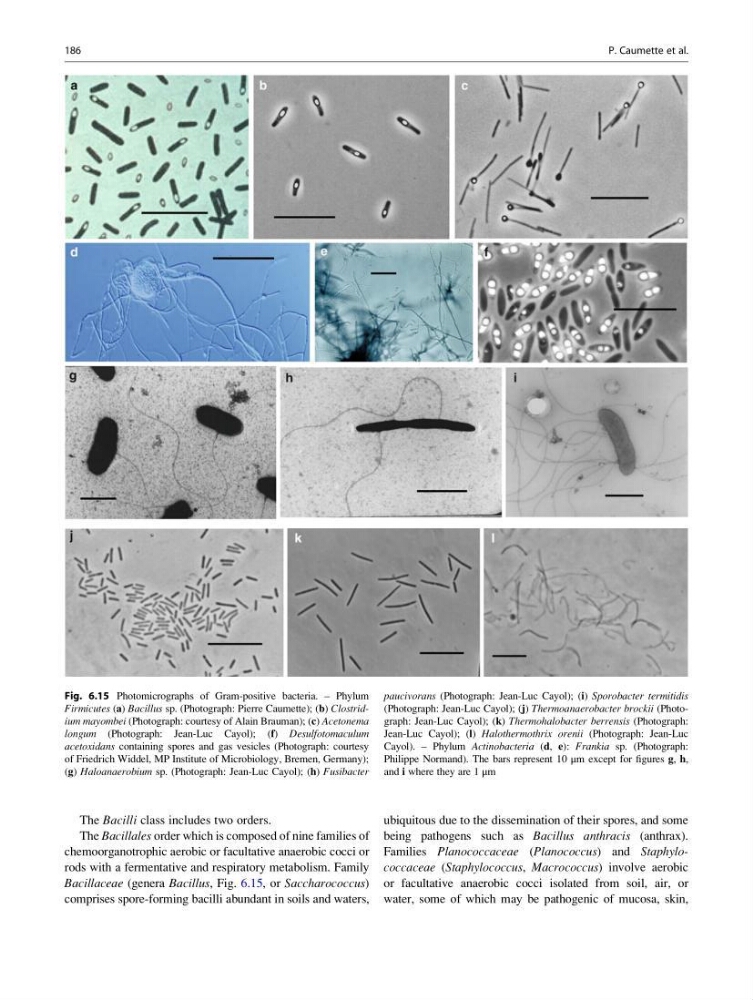
Bacillaceae (genera Bacillus, Fig. 6.15, or Saccharococcus)
comprises spore-forming bacilli abundant in soils and waters,
ubiquitous due to the dissemination of their spores, and some
being pathogens such as Bacillus anthracis (anthrax).
Families Planococcaceae (Planococcus) and Staphylococcaceae (Staphylococcus, Macrococcus) involve aerobic
or facultative anaerobic cocci isolated from soil, air, or
water, some of which may be pathogenic of mucosa, skin,
Fig. 6.15 Photomicrographs of Gram-positive bacteria. – Phylum
Firmicutes (a) Bacillus sp. (Photograph: Pierre Caumette); (b) Clostridium mayombei (Photograph: courtesy of Alain Brauman); (c) Acetonema
longum (Photograph: Jean-Luc Cayol); (f) Desulfotomaculum
acetoxidans containing spores and gas vesicles (Photograph: courtesy
of Friedrich Widdel, MP Institute of Microbiology, Bremen, Germany);
(g) Haloanaerobium sp. (Photograph: Jean-Luc Cayol); (h) Fusibacter
paucivorans (Photograph: Jean-Luc Cayol); (i) Sporobacter termitidis
(Photograph: Jean-Luc Cayol); (j) Thermoanaerobacter brockii (Photograph: Jean-Luc Cayol); (k) Thermohalobacter berrensis (Photograph:
Jean-Luc Cayol); (l) Halothermothrix orenii (Photograph: Jean-Luc
Cayol). – Phylum Actinobacteria (d, e): Frankia sp. (Photograph:
Philippe Normand). The bars represent 10 μm except for figures g, h,
and i where they are 1 μm
186
P. Caumette et al.
The Bacillales order which is composed of nine families of
chemoorganotrophic aerobic or facultative anaerobic cocci or
rods with a fermentative and respiratory metabolism. Family
Bacillaceae (genera Bacillus, Fig. 6.15, or Saccharococcus)
comprises spore-forming bacilli abundant in soils and waters,
ubiquitous due to the dissemination of their spores, and some
being pathogens such as Bacillus anthracis (anthrax).
Families Planococcaceae (Planococcus) and Staphylococcaceae (Staphylococcus, Macrococcus) involve aerobic
or facultative anaerobic cocci isolated from soil, air, or
water, some of which may be pathogenic of mucosa, skin,
Fig. 6.15 Photomicrographs of Gram-positive bacteria. – Phylum
Firmicutes (a) Bacillus sp. (Photograph: Pierre Caumette); (b) Clostridium mayombei (Photograph: courtesy of Alain Brauman); (c) Acetonema
longum (Photograph: Jean-Luc Cayol); (f) Desulfotomaculum
acetoxidans containing spores and gas vesicles (Photograph: courtesy
of Friedrich Widdel, MP Institute of Microbiology, Bremen, Germany);
(g) Haloanaerobium sp. (Photograph: Jean-Luc Cayol); (h) Fusibacter
paucivorans (Photograph: Jean-Luc Cayol); (i) Sporobacter termitidis
(Photograph: Jean-Luc Cayol); (j) Thermoanaerobacter brockii (Photograph: Jean-Luc Cayol); (k) Thermohalobacter berrensis (Photograph:
Jean-Luc Cayol); (l) Halothermothrix orenii (Photograph: Jean-Luc
Cayol). – Phylum Actinobacteria (d, e): Frankia sp. (Photograph:
Philippe Normand). The bars represent 10 μm except for figures g, h,
and i where they are 1 μm
186
P. Caumette et al.