

for methanogenesis. The methyl groups of these molecules
are used as electron acceptors and are reduced directly
to CH 4 . A small amount of these molecules are used
as electron donor through oxidation processes leading to
the formation of CO 2 . Finally, some Methanosarcinales
species can catabolize acetate molecules by reducing their
methyl carbon to CH 4 and by oxidizing their carboxyl
carbon to CO 2 . CH4 production has been reported in
non-methanogen organisms (e.g., aerobic bacteria, plants,
mitochondria, etc.). However, this production results from
side reactions of their normal metabolism and leads to very
small amount of CH 4 . Methanogens are currently divided
into six orders, forming two distinct lineages. Methanogen
class I gathers Methanobacteriales, Methanococcales,
and Methanopyrales, whereas Methanomicrobia (i.e.,
methanogen class II) encompasses Methanocellales,
Methanomicrobiales, and Methanosarcinales. However,
the relationships among orders within each class are not
resolved (Fig. 6.9). Most methanogens are mesophilic,
although extremophiles living in hot (e.g., Methanocaldococcus and Methanopyrus), cold (e.g., Methanogenium
frigidum), or hypersaline (e.g., Methanothermobacter,
Methanohalobium) environments are known. Methanogens
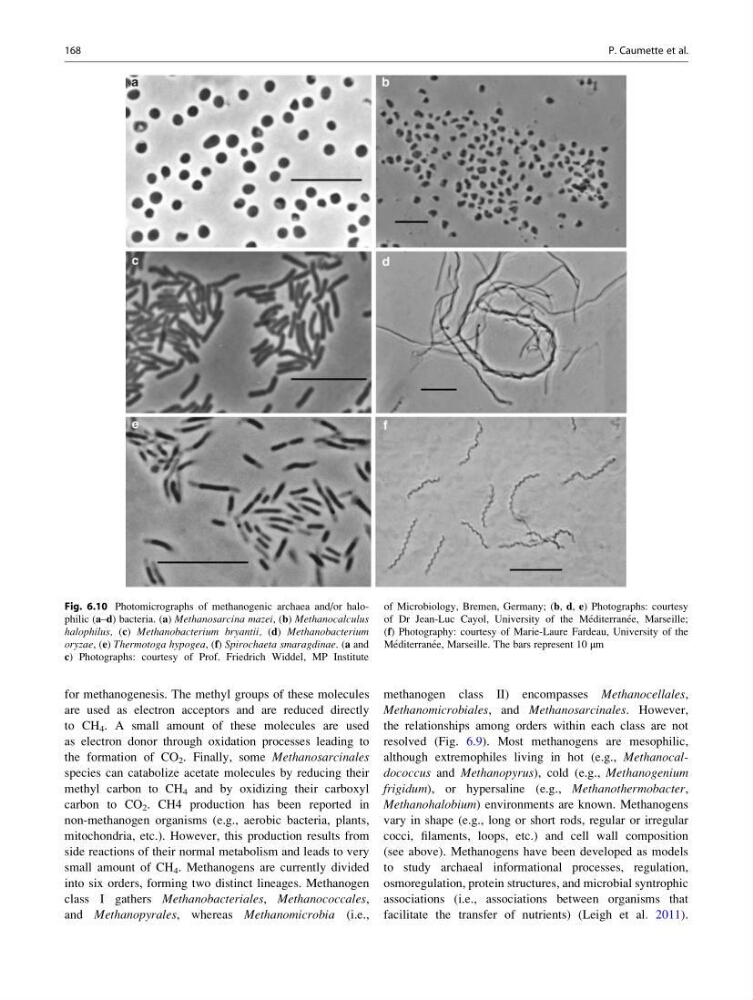
vary in shape (e.g., long or short rods, regular or irregular
cocci, filaments, loops, etc.) and cell wall composition
(see above). Methanogens have been developed as models
to study archaeal informational processes, regulation,
osmoregulation, protein structures, and microbial syntrophic
associations (i.e., associations between organisms that
facilitate the transfer of nutrients) (Leigh et al. 2011).
Fig. 6.10 Photomicrographs of methanogenic archaea and/or halophilic (a–d) bacteria. (a) Methanosarcina mazei, (b) Methanocalculus
halophilus, (c) Methanobacterium bryantii, (d) Methanobacterium
oryzae, (e) Thermotoga hypogea, (f) Spirochaeta smaragdinae. (a and
c) Photographs: courtesy of Prof. Friedrich Widdel, MP Institute
of Microbiology, Bremen, Germany; (b, d, e) Photographs: courtesy
of Dr Jean-Luc Cayol, University of the Me ´diterrane ´e, Marseille;
(f) Photography: courtesy of Marie-Laure Fardeau, University of the
Me ´diterrane ´e, Marseille. The bars represent 10 μm
168
P. Caumette et al.
are used as electron acceptors and are reduced directly
to CH 4 . A small amount of these molecules are used
as electron donor through oxidation processes leading to
the formation of CO 2 . Finally, some Methanosarcinales
species can catabolize acetate molecules by reducing their
methyl carbon to CH 4 and by oxidizing their carboxyl
carbon to CO 2 . CH4 production has been reported in
non-methanogen organisms (e.g., aerobic bacteria, plants,
mitochondria, etc.). However, this production results from
side reactions of their normal metabolism and leads to very
small amount of CH 4 . Methanogens are currently divided
into six orders, forming two distinct lineages. Methanogen
class I gathers Methanobacteriales, Methanococcales,
and Methanopyrales, whereas Methanomicrobia (i.e.,
methanogen class II) encompasses Methanocellales,
Methanomicrobiales, and Methanosarcinales. However,
the relationships among orders within each class are not
resolved (Fig. 6.9). Most methanogens are mesophilic,
although extremophiles living in hot (e.g., Methanocaldococcus and Methanopyrus), cold (e.g., Methanogenium
frigidum), or hypersaline (e.g., Methanothermobacter,
Methanohalobium) environments are known. Methanogens
vary in shape (e.g., long or short rods, regular or irregular
cocci, filaments, loops, etc.) and cell wall composition
(see above). Methanogens have been developed as models
to study archaeal informational processes, regulation,
osmoregulation, protein structures, and microbial syntrophic
associations (i.e., associations between organisms that
facilitate the transfer of nutrients) (Leigh et al. 2011).
Fig. 6.10 Photomicrographs of methanogenic archaea and/or halophilic (a–d) bacteria. (a) Methanosarcina mazei, (b) Methanocalculus
halophilus, (c) Methanobacterium bryantii, (d) Methanobacterium
oryzae, (e) Thermotoga hypogea, (f) Spirochaeta smaragdinae. (a and
c) Photographs: courtesy of Prof. Friedrich Widdel, MP Institute
of Microbiology, Bremen, Germany; (b, d, e) Photographs: courtesy
of Dr Jean-Luc Cayol, University of the Me ´diterrane ´e, Marseille;
(f) Photography: courtesy of Marie-Laure Fardeau, University of the
Me ´diterrane ´e, Marseille. The bars represent 10 μm
168
P. Caumette et al.