

risk of having to cut into smaller and smaller units and thus
increase beyond the reasonable the number of subgroups.
There is no solution that can be applied arbitrarily to all
situations. For example, Shigella flexneri and Escherichia
coli, two Gammaproteobacteria (family Enterobacteriaceae),
exhibit a level of DNA/DNA hybridization above 70 %,
which means that these two genera represent in fact the
same species. However, there is a consensus to keep the two
names because of the risks for human health due to their
different pathogenicity characteristics. In this case, the phenotype has precedence over the genotype to maintain both
species (and genera). However, the existence of pathogenic
Escherichia coli strains may reduce the need to distinguish
between the two genera and bring forward a name change in
Escherichia and Shigella. Conversely, some broad and highly
diversified genera such as Bradyrhizobium (Alphaproteobacteria), Bacillus (Firmicutes), or Clostridium (Firmicutes)
gather groups of species which likely represent distinct
genera. Finally, it should be remembered that any revision
of the nomenclature associated with the reconsideration of
some taxa raises the issue of names priority rules.
6.6
Systematic of Prokaryotic
Microorganisms: Hierarchical
Organization and Phylogenetics
Prokaryotic microorganisms correspond to two of the three
domains* of life: Archaea and Bacteria (cf. Sect. 5.1.4,
Fig. 5.9). Their systematics is described in the “Bergey’s
Manual for Systematic Bacteriology, second edition”
published in five volumes (Boone and Castenholz 2001;
Brenner et al. 2005; de Vos et al. 2008; Krieg et al. 2011;
Goodfellow et al. 2012). For more information, the reader
may consult the website http://www.bacterio.cict.fr/.
In the text of this book, the Latin terms used are those
accepted by the Nomenclature Committee as they appear in
the second edition of the “Bergey’s Manual for Systematic
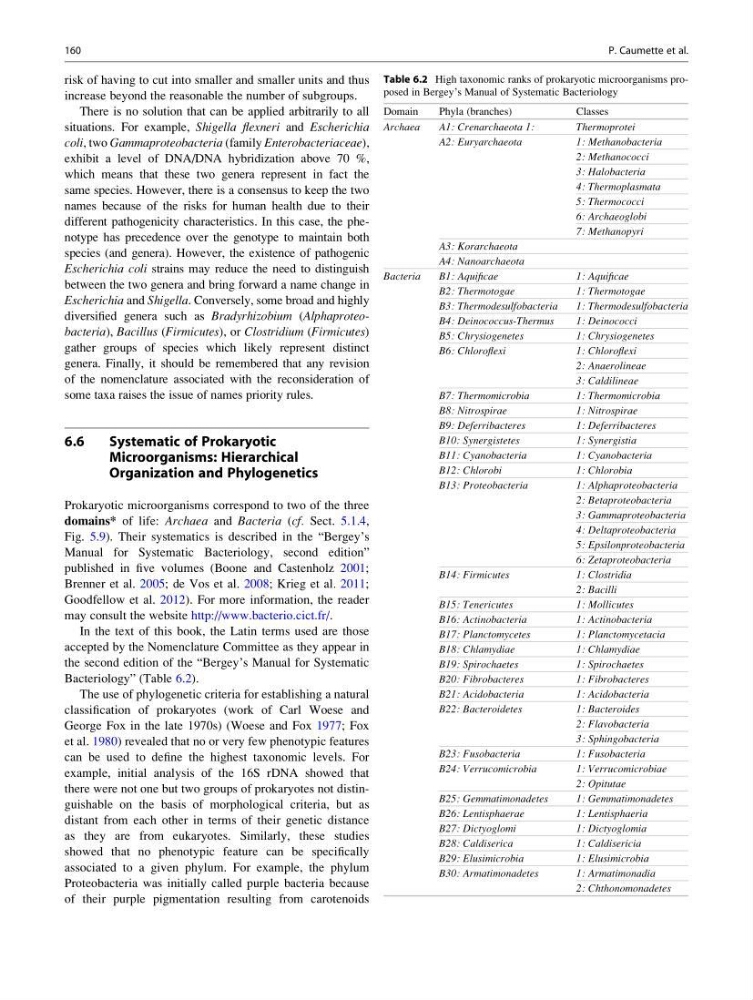
Bacteriology” (Table 6.2).
The use of phylogenetic criteria for establishing a natural
classification of prokaryotes (work of Carl Woese and
George Fox in the late 1970s) (Woese and Fox 1977; Fox
et al. 1980) revealed that no or very few phenotypic features
can be used to define the highest taxonomic levels. For
example, initial analysis of the 16S rDNA showed that
there were not one but two groups of prokaryotes not distinguishable on the basis of morphological criteria, but as
distant from each other in terms of their genetic distance
as they are from eukaryotes. Similarly, these studies
showed that no phenotypic feature can be specifically
associated to a given phylum. For example, the phylum
Proteobacteria was initially called purple bacteria because
of their purple pigmentation resulting from carotenoids
Table 6.2 High taxonomic ranks of prokaryotic microorganisms proposed in Bergey’s Manual of Systematic Bacteriology
Domain
Phyla (branches)
Classes
Archaea
A1: Crenarchaeota 1:
Thermoprotei
A2: Euryarchaeota
1: Methanobacteria
2: Methanococci
3: Halobacteria
4: Thermoplasmata
5: Thermococci
6: Archaeoglobi
7: Methanopyri
A3: Korarchaeota
A4: Nanoarchaeota
Bacteria
B1: Aquificae
1: Aquificae
B2: Thermotogae
1: Thermotogae
B3: Thermodesulfobacteria
1: Thermodesulfobacteria
B4: Deinococcus-Thermus
1: Deinococci
B5: Chrysiogenetes
1: Chrysiogenetes
B6: Chloroflexi
1: Chloroflexi
2: Anaerolineae
3: Caldilineae
B7: Thermomicrobia
1: Thermomicrobia
B8: Nitrospirae
1: Nitrospirae
B9: Deferribacteres
1: Deferribacteres
B10: Synergistetes
1: Synergistia
B11: Cyanobacteria
1: Cyanobacteria
B12: Chlorobi
1: Chlorobia
B13: Proteobacteria
1: Alphaproteobacteria
2: Betaproteobacteria
3: Gammaproteobacteria
4: Deltaproteobacteria
5: Epsilonproteobacteria
6: Zetaproteobacteria
B14: Firmicutes
1: Clostridia
2: Bacilli
B15: Tenericutes
1: Mollicutes
B16: Actinobacteria
1: Actinobacteria
B17: Planctomycetes
1: Planctomycetacia
B18: Chlamydiae
1: Chlamydiae
B19: Spirochaetes
1: Spirochaetes
B20: Fibrobacteres
1: Fibrobacteres
B21: Acidobacteria
1: Acidobacteria
B22: Bacteroidetes
1: Bacteroides
2: Flavobacteria
3: Sphingobacteria
B23: Fusobacteria
1: Fusobacteria
B24: Verrucomicrobia
1: Verrucomicrobiae
2: Opitutae
B25: Gemmatimonadetes
1: Gemmatimonadetes
B26: Lentisphaerae
1: Lentisphaeria
B27: Dictyoglomi
1: Dictyoglomia
B28: Caldiserica
1: Caldisericia
B29: Elusimicrobia
1: Elusimicrobia
B30: Armatimonadetes
1: Armatimonadia
2: Chthonomonadetes
160
P. Caumette et al.
increase beyond the reasonable the number of subgroups.
There is no solution that can be applied arbitrarily to all
situations. For example, Shigella flexneri and Escherichia
coli, two Gammaproteobacteria (family Enterobacteriaceae),
exhibit a level of DNA/DNA hybridization above 70 %,
which means that these two genera represent in fact the
same species. However, there is a consensus to keep the two
names because of the risks for human health due to their
different pathogenicity characteristics. In this case, the phenotype has precedence over the genotype to maintain both
species (and genera). However, the existence of pathogenic
Escherichia coli strains may reduce the need to distinguish
between the two genera and bring forward a name change in
Escherichia and Shigella. Conversely, some broad and highly
diversified genera such as Bradyrhizobium (Alphaproteobacteria), Bacillus (Firmicutes), or Clostridium (Firmicutes)
gather groups of species which likely represent distinct
genera. Finally, it should be remembered that any revision
of the nomenclature associated with the reconsideration of
some taxa raises the issue of names priority rules.
6.6
Systematic of Prokaryotic
Microorganisms: Hierarchical
Organization and Phylogenetics
Prokaryotic microorganisms correspond to two of the three
domains* of life: Archaea and Bacteria (cf. Sect. 5.1.4,
Fig. 5.9). Their systematics is described in the “Bergey’s
Manual for Systematic Bacteriology, second edition”
published in five volumes (Boone and Castenholz 2001;
Brenner et al. 2005; de Vos et al. 2008; Krieg et al. 2011;
Goodfellow et al. 2012). For more information, the reader
may consult the website http://www.bacterio.cict.fr/.
In the text of this book, the Latin terms used are those
accepted by the Nomenclature Committee as they appear in
the second edition of the “Bergey’s Manual for Systematic
Bacteriology” (Table 6.2).
The use of phylogenetic criteria for establishing a natural
classification of prokaryotes (work of Carl Woese and
George Fox in the late 1970s) (Woese and Fox 1977; Fox
et al. 1980) revealed that no or very few phenotypic features
can be used to define the highest taxonomic levels. For
example, initial analysis of the 16S rDNA showed that
there were not one but two groups of prokaryotes not distinguishable on the basis of morphological criteria, but as
distant from each other in terms of their genetic distance
as they are from eukaryotes. Similarly, these studies
showed that no phenotypic feature can be specifically
associated to a given phylum. For example, the phylum
Proteobacteria was initially called purple bacteria because
of their purple pigmentation resulting from carotenoids
Table 6.2 High taxonomic ranks of prokaryotic microorganisms proposed in Bergey’s Manual of Systematic Bacteriology
Domain
Phyla (branches)
Classes
Archaea
A1: Crenarchaeota 1:
Thermoprotei
A2: Euryarchaeota
1: Methanobacteria
2: Methanococci
3: Halobacteria
4: Thermoplasmata
5: Thermococci
6: Archaeoglobi
7: Methanopyri
A3: Korarchaeota
A4: Nanoarchaeota
Bacteria
B1: Aquificae
1: Aquificae
B2: Thermotogae
1: Thermotogae
B3: Thermodesulfobacteria
1: Thermodesulfobacteria
B4: Deinococcus-Thermus
1: Deinococci
B5: Chrysiogenetes
1: Chrysiogenetes
B6: Chloroflexi
1: Chloroflexi
2: Anaerolineae
3: Caldilineae
B7: Thermomicrobia
1: Thermomicrobia
B8: Nitrospirae
1: Nitrospirae
B9: Deferribacteres
1: Deferribacteres
B10: Synergistetes
1: Synergistia
B11: Cyanobacteria
1: Cyanobacteria
B12: Chlorobi
1: Chlorobia
B13: Proteobacteria
1: Alphaproteobacteria
2: Betaproteobacteria
3: Gammaproteobacteria
4: Deltaproteobacteria
5: Epsilonproteobacteria
6: Zetaproteobacteria
B14: Firmicutes
1: Clostridia
2: Bacilli
B15: Tenericutes
1: Mollicutes
B16: Actinobacteria
1: Actinobacteria
B17: Planctomycetes
1: Planctomycetacia
B18: Chlamydiae
1: Chlamydiae
B19: Spirochaetes
1: Spirochaetes
B20: Fibrobacteres
1: Fibrobacteres
B21: Acidobacteria
1: Acidobacteria
B22: Bacteroidetes
1: Bacteroides
2: Flavobacteria
3: Sphingobacteria
B23: Fusobacteria
1: Fusobacteria
B24: Verrucomicrobia
1: Verrucomicrobiae
2: Opitutae
B25: Gemmatimonadetes
1: Gemmatimonadetes
B26: Lentisphaerae
1: Lentisphaeria
B27: Dictyoglomi
1: Dictyoglomia
B28: Caldiserica
1: Caldisericia
B29: Elusimicrobia
1: Elusimicrobia
B30: Armatimonadetes
1: Armatimonadia
2: Chthonomonadetes
160
P. Caumette et al.