

to analyze hundreds of sequences). Its use is preferable to the
UPGMA* that assumes that all sequences are evolving at the
same rate (molecular clock hypothesis, Box 5.3; Ochman
et al. 1999), but less satisfactory than the Maximum Likelihood* that is time-consuming.
6.5
Classification of Prokaryotic
Microorganisms: Phylogeny Versus
Phenotype
Classifications based on phenotypic criteria are more ancient
than those based on molecular phylogeny. With regard to the
prokaryotic microorganisms, many inconsistencies exist
between phenotypic similarity levels and evolutionary
relationships deduced from molecular phylogenies. Most
taxonomic groups have been reconsidered through phylogenetic analysis in the 1980s, and a consensus was reached on
the need for coherence between taxonomy and phylogeny.
Reconciliation between the two schools of thought, similar
in their basic goals but historically distinct, if it makes sense,
is not easy. Thus, the multiple revisions of species, genera,
or higher taxonomic levels pose many complex problems
that are solved gradually. The difficulties are still present in
some taxa where a tangle exists among species, leading to
three possibilities all unsatisfactory: (1) accepting the existence of polymorphic taxa, with significant differences at the
phenotypic level; (2) grouping all bodies taxon in a large
catch-all using the rule of precedence; (3) subdividing heterogeneous taxa into smaller homogeneous subtaxa with the
DNA-DNA Hybridization (%)
16S rRNA Similarity (%)
100
99
97
98
96
94
95
100
90
92
93
80
70
60
50
40
30
20
10
0
91
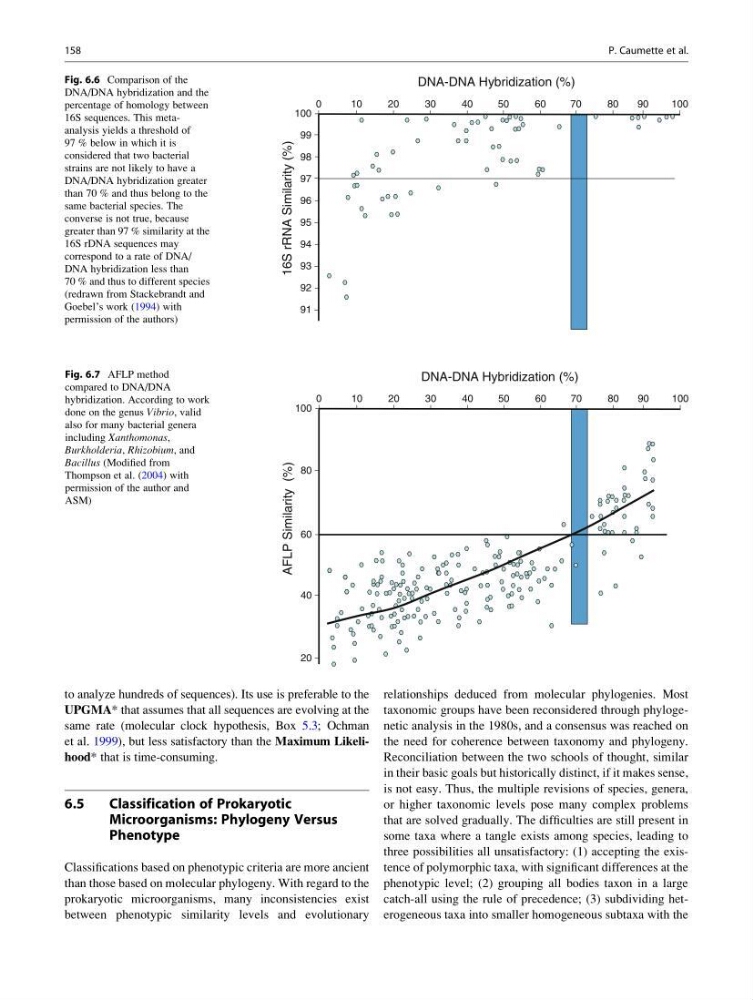
Fig. 6.6 Comparison of the
DNA/DNA hybridization and the
percentage of homology between
16S sequences. This metaanalysis yields a threshold of
97 % below in which it is
considered that two bacterial
strains are not likely to have a
DNA/DNA hybridization greater
than 70 % and thus belong to the
same bacterial species. The
converse is not true, because
greater than 97 % similarity at the
16S rDNA sequences may
correspond to a rate of DNA/
DNA hybridization less than
70 % and thus to different species
(redrawn from Stackebrandt and
Goebel’s work (1994) with
permission of the authors)
DNA-DNA Hybridization (%)
AFLP Similarity (%)
100
80
60
100
90
40
80
70
60
50
40
30
20
10
0
20
Fig. 6.7 AFLP method
compared to DNA/DNA
hybridization. According to work
done on the genus Vibrio, valid
also for many bacterial genera
including Xanthomonas,
Burkholderia, Rhizobium, and
Bacillus (Modified from
Thompson et al. (2004) with
permission of the author and
ASM)
158
P. Caumette et al.
UPGMA* that assumes that all sequences are evolving at the
same rate (molecular clock hypothesis, Box 5.3; Ochman
et al. 1999), but less satisfactory than the Maximum Likelihood* that is time-consuming.
6.5
Classification of Prokaryotic
Microorganisms: Phylogeny Versus
Phenotype
Classifications based on phenotypic criteria are more ancient
than those based on molecular phylogeny. With regard to the
prokaryotic microorganisms, many inconsistencies exist
between phenotypic similarity levels and evolutionary
relationships deduced from molecular phylogenies. Most
taxonomic groups have been reconsidered through phylogenetic analysis in the 1980s, and a consensus was reached on
the need for coherence between taxonomy and phylogeny.
Reconciliation between the two schools of thought, similar
in their basic goals but historically distinct, if it makes sense,
is not easy. Thus, the multiple revisions of species, genera,
or higher taxonomic levels pose many complex problems
that are solved gradually. The difficulties are still present in
some taxa where a tangle exists among species, leading to
three possibilities all unsatisfactory: (1) accepting the existence of polymorphic taxa, with significant differences at the
phenotypic level; (2) grouping all bodies taxon in a large
catch-all using the rule of precedence; (3) subdividing heterogeneous taxa into smaller homogeneous subtaxa with the
DNA-DNA Hybridization (%)
16S rRNA Similarity (%)
100
99
97
98
96
94
95
100
90
92
93
80
70
60
50
40
30
20
10
0
91
Fig. 6.6 Comparison of the
DNA/DNA hybridization and the
percentage of homology between
16S sequences. This metaanalysis yields a threshold of
97 % below in which it is
considered that two bacterial
strains are not likely to have a
DNA/DNA hybridization greater
than 70 % and thus belong to the
same bacterial species. The
converse is not true, because
greater than 97 % similarity at the
16S rDNA sequences may
correspond to a rate of DNA/
DNA hybridization less than
70 % and thus to different species
(redrawn from Stackebrandt and
Goebel’s work (1994) with
permission of the authors)
DNA-DNA Hybridization (%)
AFLP Similarity (%)
100
80
60
100
90
40
80
70
60
50
40
30
20
10
0
20
Fig. 6.7 AFLP method
compared to DNA/DNA
hybridization. According to work
done on the genus Vibrio, valid
also for many bacterial genera
including Xanthomonas,
Burkholderia, Rhizobium, and
Bacillus (Modified from
Thompson et al. (2004) with
permission of the author and
ASM)
158
P. Caumette et al.