

Box 6.1 (continued)
ecological niche that are in intense competition with any
adaptive mutant from this population. Well defined, the
ecotypes share many properties attributed to eukaryotic
species: the genetic diversity within ecotypes is limited
by a cohesive force (here, the periodic selection), and the
ecotypes are ecologically distinct. Therefore, ecotypes
can be discovered and classified as genomic groups even
when one remains ignorant of their ecology. This model
is attractive because it is now possible to find the specific
genome of a bacterial species and to then infer its specific ecological functions. This was done by Lassalle
and collaborators (2011) who combined comparative
genomics and reverse ecology to unmask the speciesspecific genes and then the species-specific ecological
traits that differentiate Agrobacterium fabrum from its
sister species within the A. tumefaciens complex. It is a
great challenge for comparative genomic programs to
try to find these features in the variable part of the
genome. Conversely, the conserved genome part (the
“core genome”) has likely little effect on these
specificities even if it bears the phylogenetic signatures
used to characterize the species by MLSA. However,
again for reasons of stability of the taxonomy, it may
seem dangerous to raise each prokaryotic group, even a
single clone, with proven ecological specialization and
thus an “ecotype,” to the status of a good and valid
species. In connection with this model, the idea
circulates that there may be a nesting of ecological
specialization levels corresponding to nested taxonomic
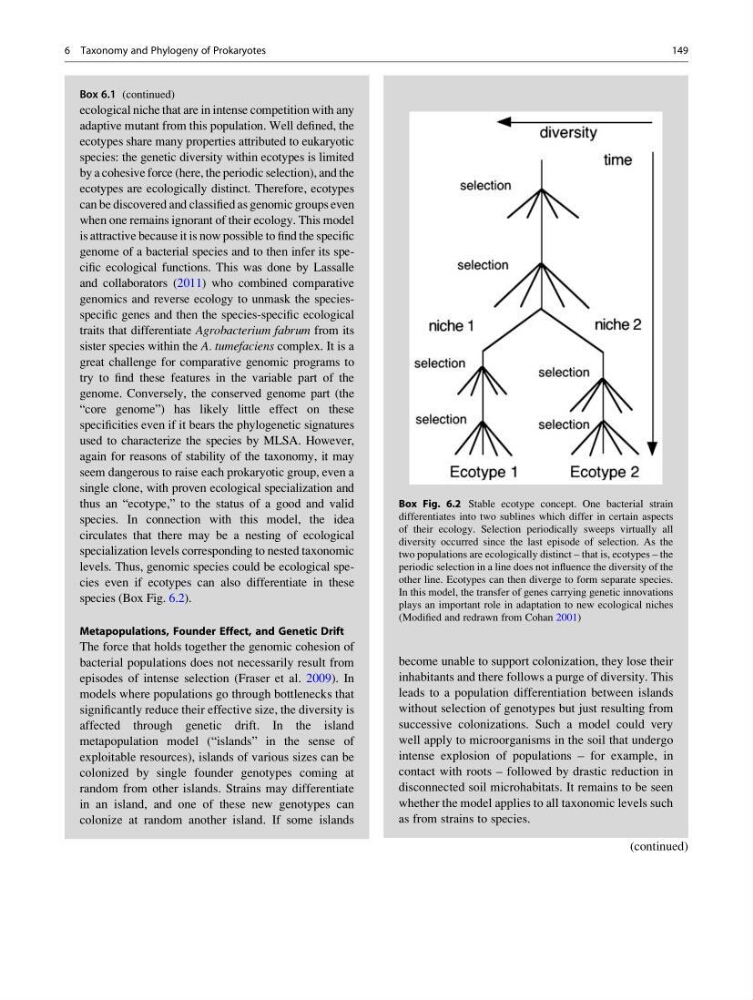
levels. Thus, genomic species could be ecological species even if ecotypes can also differentiate in these
species (Box Fig. 6.2).
Metapopulations, Founder Effect, and Genetic Drift
The force that holds together the genomic cohesion of
bacterial populations does not necessarily result from
episodes of intense selection (Fraser et al. 2009). In
models where populations go through bottlenecks that
significantly reduce their effective size, the diversity is
affected through genetic drift. In the island
metapopulation model (“islands” in the sense of
exploitable resources), islands of various sizes can be
colonized by single founder genotypes coming at
random from other islands. Strains may differentiate
in an island, and one of these new genotypes can
colonize at random another island. If some islands
(continued)
Box 6.1 (continued)
become unable to support colonization, they lose their
inhabitants and there follows a purge of diversity. This
leads to a population differentiation between islands
without selection of genotypes but just resulting from
successive colonizations. Such a model could very
well apply to microorganisms in the soil that undergo
intense explosion of populations – for example, in
contact with roots – followed by drastic reduction in
disconnected soil microhabitats. It remains to be seen
whether the model applies to all taxonomic levels such
as from strains to species.
(continued)
Box Fig. 6.2 Stable ecotype concept. One bacterial strain
differentiates into two sublines which differ in certain aspects
of their ecology. Selection periodically sweeps virtually all
diversity occurred since the last episode of selection. As the
two populations are ecologically distinct – that is, ecotypes – the
periodic selection in a line does not influence the diversity of the
other line. Ecotypes can then diverge to form separate species.
In this model, the transfer of genes carrying genetic innovations
plays an important role in adaptation to new ecological niches
(Modified and redrawn from Cohan 2001)
6 Taxonomy and Phylogeny of Prokaryotes
149
ecological niche that are in intense competition with any
adaptive mutant from this population. Well defined, the
ecotypes share many properties attributed to eukaryotic
species: the genetic diversity within ecotypes is limited
by a cohesive force (here, the periodic selection), and the
ecotypes are ecologically distinct. Therefore, ecotypes
can be discovered and classified as genomic groups even
when one remains ignorant of their ecology. This model
is attractive because it is now possible to find the specific
genome of a bacterial species and to then infer its specific ecological functions. This was done by Lassalle
and collaborators (2011) who combined comparative
genomics and reverse ecology to unmask the speciesspecific genes and then the species-specific ecological
traits that differentiate Agrobacterium fabrum from its
sister species within the A. tumefaciens complex. It is a
great challenge for comparative genomic programs to
try to find these features in the variable part of the
genome. Conversely, the conserved genome part (the
“core genome”) has likely little effect on these
specificities even if it bears the phylogenetic signatures
used to characterize the species by MLSA. However,
again for reasons of stability of the taxonomy, it may
seem dangerous to raise each prokaryotic group, even a
single clone, with proven ecological specialization and
thus an “ecotype,” to the status of a good and valid
species. In connection with this model, the idea
circulates that there may be a nesting of ecological
specialization levels corresponding to nested taxonomic
levels. Thus, genomic species could be ecological species even if ecotypes can also differentiate in these
species (Box Fig. 6.2).
Metapopulations, Founder Effect, and Genetic Drift
The force that holds together the genomic cohesion of
bacterial populations does not necessarily result from
episodes of intense selection (Fraser et al. 2009). In
models where populations go through bottlenecks that
significantly reduce their effective size, the diversity is
affected through genetic drift. In the island
metapopulation model (“islands” in the sense of
exploitable resources), islands of various sizes can be
colonized by single founder genotypes coming at
random from other islands. Strains may differentiate
in an island, and one of these new genotypes can
colonize at random another island. If some islands
(continued)
Box 6.1 (continued)
become unable to support colonization, they lose their
inhabitants and there follows a purge of diversity. This
leads to a population differentiation between islands
without selection of genotypes but just resulting from
successive colonizations. Such a model could very
well apply to microorganisms in the soil that undergo
intense explosion of populations – for example, in
contact with roots – followed by drastic reduction in
disconnected soil microhabitats. It remains to be seen
whether the model applies to all taxonomic levels such
as from strains to species.
(continued)
Box Fig. 6.2 Stable ecotype concept. One bacterial strain
differentiates into two sublines which differ in certain aspects
of their ecology. Selection periodically sweeps virtually all
diversity occurred since the last episode of selection. As the
two populations are ecologically distinct – that is, ecotypes – the
periodic selection in a line does not influence the diversity of the
other line. Ecotypes can then diverge to form separate species.
In this model, the transfer of genes carrying genetic innovations
plays an important role in adaptation to new ecological niches
(Modified and redrawn from Cohan 2001)
6 Taxonomy and Phylogeny of Prokaryotes
149