

Box 6.1 (continued)
“genomic” species. In addition, the committee
strongly encourages research to find a biological
basis for the bacterial species.
An Empirical but Not Arbitrary Definition
The canonical aspect of the 70 % RBR value is
disturbing. In today’s world of biology where
Darwinian-derived concepts constitute a paradigm,
the genomics definition of bacterial species has undeniably creationist’s undertones. It seems that the RBR
allows to capture the “essence” of the species and
therefore suggests that such an “essence” exists. This
Aristotelian view is reinforced by the declared justification of the polyphasic approach, in which different
methodologies are used in conjunction with RBR to
associate to it various phenotypic markers. This
approach would give more highlights to this “essence”
and yield more “shadows” on the wall of “Plato’s
cave.”
In addition, setting a threshold at 70 % on RBR may
seem arbitrary. In fact, this threshold was empirically
obtained by comparing a large amount of RBR values.
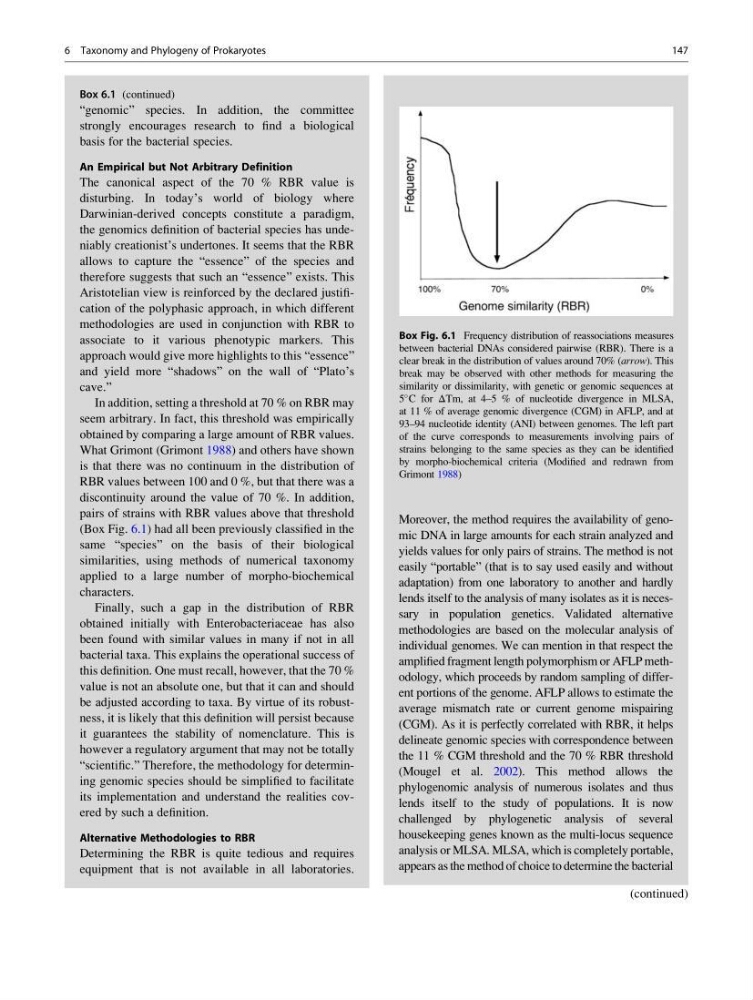
What Grimont (Grimont 1988) and others have shown
is that there was no continuum in the distribution of
RBR values between 100 and 0 %, but that there was a
discontinuity around the value of 70 %. In addition,
pairs of strains with RBR values above that threshold
(Box Fig. 6.1) had all been previously classified in the
same “species” on the basis of their biological
similarities, using methods of numerical taxonomy
applied to a large number of morpho-biochemical
characters.
Finally, such a gap in the distribution of RBR
obtained initially with Enterobacteriaceae has also
been found with similar values in many if not in all
bacterial taxa. This explains the operational success of
this definition. One must recall, however, that the 70 %
value is not an absolute one, but that it can and should
be adjusted according to taxa. By virtue of its robustness, it is likely that this definition will persist because
it guarantees the stability of nomenclature. This is
however a regulatory argument that may not be totally
“scientific.” Therefore, the methodology for determining genomic species should be simplified to facilitate
its implementation and understand the realities covered by such a definition.
Alternative Methodologies to RBR
Determining the RBR is quite tedious and requires
equipment that is not available in all laboratories.
(continued)
Box 6.1 (continued)
Moreover, the method requires the availability of genomic DNA in large amounts for each strain analyzed and
yields values for only pairs of strains. The method is not
easily “portable” (that is to say used easily and without
adaptation) from one laboratory to another and hardly
lends itself to the analysis of many isolates as it is necessary in population genetics. Validated alternative
methodologies are based on the molecular analysis of
individual genomes. We can mention in that respect the
amplified fragment length polymorphism or AFLP methodology, which proceeds by random sampling of different portions of the genome. AFLP allows to estimate the
average mismatch rate or current genome mispairing
(CGM). As it is perfectly correlated with RBR, it helps
delineate genomic species with correspondence between
the 11 % CGM threshold and the 70 % RBR threshold
(Mougel et al. 2002). This method allows the
phylogenomic analysis of numerous isolates and thus
lends itself to the study of populations. It is now
challenged by phylogenetic analysis of several
housekeeping genes known as the multi-locus sequence
analysis or MLSA. MLSA, which is completely portable,
appears as the method of choice to determine the bacterial
(continued)
Box Fig. 6.1 Frequency distribution of reassociations measures
between bacterial DNAs considered pairwise (RBR). There is a
clear break in the distribution of values around 70% (arrow). This
break may be observed with other methods for measuring the
similarity or dissimilarity, with genetic or genomic sequences at
5
C for ΔTm, at 4–5 % of nucleotide divergence in MLSA,
at 11 % of average genomic divergence (CGM) in AFLP, and at
93–94 nucleotide identity (ANI) between genomes. The left part
of the curve corresponds to measurements involving pairs of
strains belonging to the same species as they can be identified
by morpho-biochemical criteria (Modified and redrawn from
Grimont 1988)
6 Taxonomy and Phylogeny of Prokaryotes
147
“genomic” species. In addition, the committee
strongly encourages research to find a biological
basis for the bacterial species.
An Empirical but Not Arbitrary Definition
The canonical aspect of the 70 % RBR value is
disturbing. In today’s world of biology where
Darwinian-derived concepts constitute a paradigm,
the genomics definition of bacterial species has undeniably creationist’s undertones. It seems that the RBR
allows to capture the “essence” of the species and
therefore suggests that such an “essence” exists. This
Aristotelian view is reinforced by the declared justification of the polyphasic approach, in which different
methodologies are used in conjunction with RBR to
associate to it various phenotypic markers. This
approach would give more highlights to this “essence”
and yield more “shadows” on the wall of “Plato’s
cave.”
In addition, setting a threshold at 70 % on RBR may
seem arbitrary. In fact, this threshold was empirically
obtained by comparing a large amount of RBR values.
What Grimont (Grimont 1988) and others have shown
is that there was no continuum in the distribution of
RBR values between 100 and 0 %, but that there was a
discontinuity around the value of 70 %. In addition,
pairs of strains with RBR values above that threshold
(Box Fig. 6.1) had all been previously classified in the
same “species” on the basis of their biological
similarities, using methods of numerical taxonomy
applied to a large number of morpho-biochemical
characters.
Finally, such a gap in the distribution of RBR
obtained initially with Enterobacteriaceae has also
been found with similar values in many if not in all
bacterial taxa. This explains the operational success of
this definition. One must recall, however, that the 70 %
value is not an absolute one, but that it can and should
be adjusted according to taxa. By virtue of its robustness, it is likely that this definition will persist because
it guarantees the stability of nomenclature. This is
however a regulatory argument that may not be totally
“scientific.” Therefore, the methodology for determining genomic species should be simplified to facilitate
its implementation and understand the realities covered by such a definition.
Alternative Methodologies to RBR
Determining the RBR is quite tedious and requires
equipment that is not available in all laboratories.
(continued)
Box 6.1 (continued)
Moreover, the method requires the availability of genomic DNA in large amounts for each strain analyzed and
yields values for only pairs of strains. The method is not
easily “portable” (that is to say used easily and without
adaptation) from one laboratory to another and hardly
lends itself to the analysis of many isolates as it is necessary in population genetics. Validated alternative
methodologies are based on the molecular analysis of
individual genomes. We can mention in that respect the
amplified fragment length polymorphism or AFLP methodology, which proceeds by random sampling of different portions of the genome. AFLP allows to estimate the
average mismatch rate or current genome mispairing
(CGM). As it is perfectly correlated with RBR, it helps
delineate genomic species with correspondence between
the 11 % CGM threshold and the 70 % RBR threshold
(Mougel et al. 2002). This method allows the
phylogenomic analysis of numerous isolates and thus
lends itself to the study of populations. It is now
challenged by phylogenetic analysis of several
housekeeping genes known as the multi-locus sequence
analysis or MLSA. MLSA, which is completely portable,
appears as the method of choice to determine the bacterial
(continued)
Box Fig. 6.1 Frequency distribution of reassociations measures
between bacterial DNAs considered pairwise (RBR). There is a
clear break in the distribution of values around 70% (arrow). This
break may be observed with other methods for measuring the
similarity or dissimilarity, with genetic or genomic sequences at
5
C for ΔTm, at 4–5 % of nucleotide divergence in MLSA,
at 11 % of average genomic divergence (CGM) in AFLP, and at
93–94 nucleotide identity (ANI) between genomes. The left part
of the curve corresponds to measurements involving pairs of
strains belonging to the same species as they can be identified
by morpho-biochemical criteria (Modified and redrawn from
Grimont 1988)
6 Taxonomy and Phylogeny of Prokaryotes
147