

5.1.3 Hierarchical Organization in Search
of a Phylogeny
5.1.3.1 The Need for a Hierarchical Organization
It is important to emphasize here that all work on the hierarchical organization of prokaryotic microorganisms was done
on pure culture isolates obtained in particular by following
the work of Robert Koch (1880) on semisolid media, thus
constituting of course an important step but one limited to
culturable microorganisms on the media used. It is considered that in fact only 0.1–1 % of the prokaryotes present on
our planet can be grown in synthetic media and maintained
Box 5.2 (continued)
Pico-eukaryotes have been essentially described
from aquatic environments although other ecosystems
(e.g., soils or sediments) are not yet explored in detail
for these organisms. It is, however, highly probable
that many pico-eukaryotes are living in these
ecosystems and that they can represent a distinct diversity compared to what is already described in fresh or
marine waters.
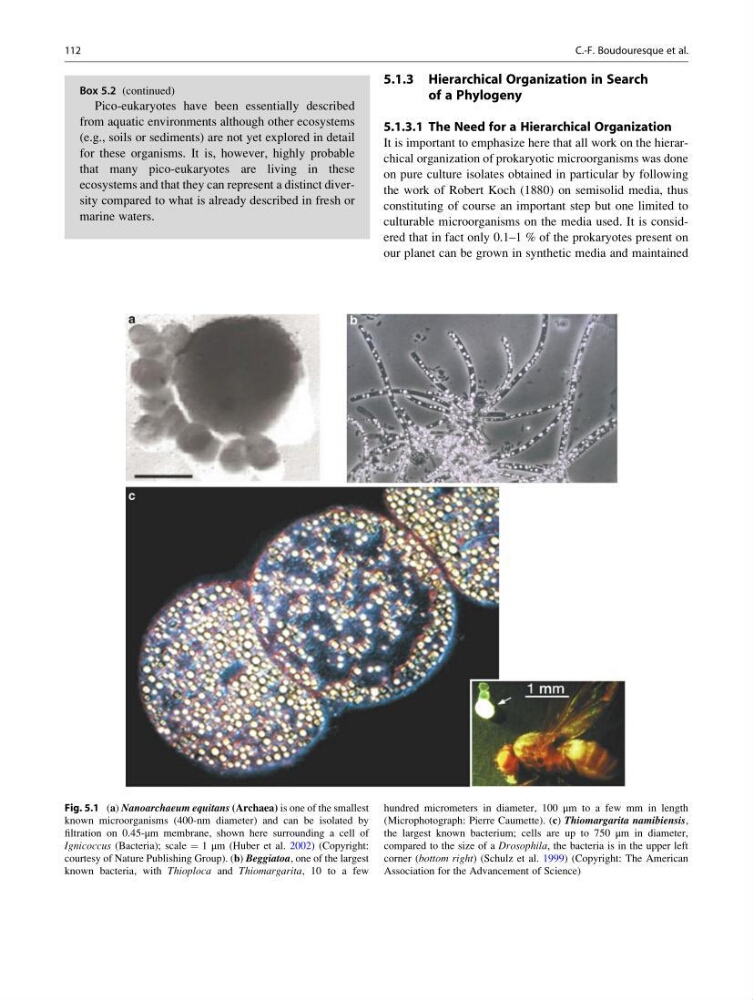
Fig. 5.1 (a) Nanoarchaeum equitans (Archaea) is one of the smallest
known microorganisms (400-nm diameter) and can be isolated by
filtration on 0.45-μm membrane, shown here surrounding a cell of
Ignicoccus (Bacteria); scale ¼ 1 μm (Huber et al. 2002) (Copyright:
courtesy of Nature Publishing Group). (b) Beggiatoa, one of the largest
known bacteria, with Thioploca and Thiomargarita, 10 to a few
hundred micrometers in diameter, 100 μm to a few mm in length
(Microphotograph: Pierre Caumette). (c) Thiomargarita namibiensis,
the largest known bacterium; cells are up to 750 μm in diameter,
compared to the size of a Drosophila, the bacteria is in the upper left
corner (bottom right) (Schulz et al. 1999) (Copyright: The American
Association for the Advancement of Science)
112
C.-F. Boudouresque et al.
of a Phylogeny
5.1.3.1 The Need for a Hierarchical Organization
It is important to emphasize here that all work on the hierarchical organization of prokaryotic microorganisms was done
on pure culture isolates obtained in particular by following
the work of Robert Koch (1880) on semisolid media, thus
constituting of course an important step but one limited to
culturable microorganisms on the media used. It is considered that in fact only 0.1–1 % of the prokaryotes present on
our planet can be grown in synthetic media and maintained
Box 5.2 (continued)
Pico-eukaryotes have been essentially described
from aquatic environments although other ecosystems
(e.g., soils or sediments) are not yet explored in detail
for these organisms. It is, however, highly probable
that many pico-eukaryotes are living in these
ecosystems and that they can represent a distinct diversity compared to what is already described in fresh or
marine waters.
Fig. 5.1 (a) Nanoarchaeum equitans (Archaea) is one of the smallest
known microorganisms (400-nm diameter) and can be isolated by
filtration on 0.45-μm membrane, shown here surrounding a cell of
Ignicoccus (Bacteria); scale ¼ 1 μm (Huber et al. 2002) (Copyright:
courtesy of Nature Publishing Group). (b) Beggiatoa, one of the largest
known bacteria, with Thioploca and Thiomargarita, 10 to a few
hundred micrometers in diameter, 100 μm to a few mm in length
(Microphotograph: Pierre Caumette). (c) Thiomargarita namibiensis,
the largest known bacterium; cells are up to 750 μm in diameter,
compared to the size of a Drosophila, the bacteria is in the upper left
corner (bottom right) (Schulz et al. 1999) (Copyright: The American
Association for the Advancement of Science)
112
C.-F. Boudouresque et al.