

Box 5.1 (continued)
features reignited the debate on the origin of viruses and
the role they might have played in both the emergence of
the eukaryotes (i.e., of the nucleus) and the transition
from RNA to DNA as the chemistry of choice for the
storage of genetic information in cells (Claverie 2006;
Claverie and Abergel 2010).
(continued)
Box 5.1 (continued)
These giant viruses (referred to as “Megaviridae”)
infect amoeba (from the genus Acanthamoeba). Their
double-stranded DNA genomes are up to 1.3 million
base pairs in length and could code for more than
1,000 genes. Most remarkably, they encode many
central components of the protein translation apparatus, including up to seven different aminoacyl tRNA
synthetases. The function of these enzymes is to load
the right amino acid onto its cognate tRNA, thus using
the universal genetic code. The presence of such a
remnant translation apparatus, a hallmark of cellular
organisms, strongly suggests that these viruses
evolved from a cellular ancestor, most likely predating
the emergence (or at least the radiation) of the
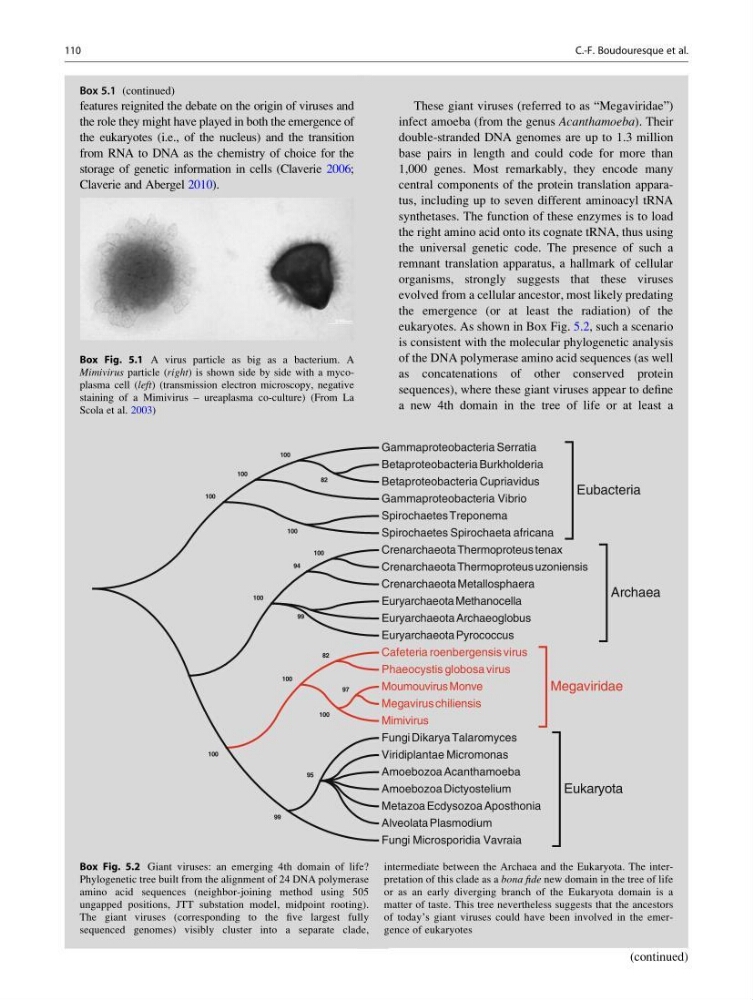
eukaryotes. As shown in Box Fig. 5.2, such a scenario
is consistent with the molecular phylogenetic analysis
of the DNA polymerase amino acid sequences (as well
as concatenations of other conserved protein
sequences), where these giant viruses appear to define
a new 4th domain in the tree of life or at least a
(continued)
Box Fig. 5.1 A virus particle as big as a bacterium. A
Mimivirus particle (right) is shown side by side with a mycoplasma cell (left) (transmission electron microscopy, negative
staining of a Mimivirus – ureaplasma co-culture) (From La
Scola et al. 2003)
Gammaproteobacteria Serratia
Betaproteobacteria Burkholderia
Betaproteobacteria Cupriavidus
Gammaproteobacteria Vibrio
Spirochaetes Treponema
Spirochaetes Spirochaeta africana
Eubacteria
Crenarchaeota Thermoproteus tenax
Crenarchaeota Thermoproteus uzoniensis
Crenarchaeota Metallosphaera
Euryarchaeota Methanocella
Euryarchaeota Archaeoglobus
Euryarchaeota Pyrococcus
Archaea
Cafeteria roenbergensis virus
Phaeocystis globosa virus
Moumouvirus Monve
Megavirus chiliensis
Mimivirus
Megaviridae
Fungi Dikarya Talaromyces
Viridiplantae Micromonas
Amoebozoa Acanthamoeba
Amoebozoa Dictyostelium
Metazoa Ecdysozoa Aposthonia
Alveolata Plasmodium
Fungi Microsporidia Vavraia
Eukaryota
97
100
82
100
100
94
99
100
82
100
100
100
100
100
99
95
Box Fig. 5.2 Giant viruses: an emerging 4th domain of life?
Phylogenetic tree built from the alignment of 24 DNA polymerase
amino acid sequences (neighbor-joining method using 505
ungapped positions, JTT substation model, midpoint rooting).
The giant viruses (corresponding to the five largest fully
sequenced genomes) visibly cluster into a separate clade,
intermediate between the Archaea and the Eukaryota. The interpretation of this clade as a bona fide new domain in the tree of life
or as an early diverging branch of the Eukaryota domain is a
matter of taste. This tree nevertheless suggests that the ancestors
of today’s giant viruses could have been involved in the emergence of eukaryotes
110
C.-F. Boudouresque et al.
features reignited the debate on the origin of viruses and
the role they might have played in both the emergence of
the eukaryotes (i.e., of the nucleus) and the transition
from RNA to DNA as the chemistry of choice for the
storage of genetic information in cells (Claverie 2006;
Claverie and Abergel 2010).
(continued)
Box 5.1 (continued)
These giant viruses (referred to as “Megaviridae”)
infect amoeba (from the genus Acanthamoeba). Their
double-stranded DNA genomes are up to 1.3 million
base pairs in length and could code for more than
1,000 genes. Most remarkably, they encode many
central components of the protein translation apparatus, including up to seven different aminoacyl tRNA
synthetases. The function of these enzymes is to load
the right amino acid onto its cognate tRNA, thus using
the universal genetic code. The presence of such a
remnant translation apparatus, a hallmark of cellular
organisms, strongly suggests that these viruses
evolved from a cellular ancestor, most likely predating
the emergence (or at least the radiation) of the
eukaryotes. As shown in Box Fig. 5.2, such a scenario
is consistent with the molecular phylogenetic analysis
of the DNA polymerase amino acid sequences (as well
as concatenations of other conserved protein
sequences), where these giant viruses appear to define
a new 4th domain in the tree of life or at least a
(continued)
Box Fig. 5.1 A virus particle as big as a bacterium. A
Mimivirus particle (right) is shown side by side with a mycoplasma cell (left) (transmission electron microscopy, negative
staining of a Mimivirus – ureaplasma co-culture) (From La
Scola et al. 2003)
Gammaproteobacteria Serratia
Betaproteobacteria Burkholderia
Betaproteobacteria Cupriavidus
Gammaproteobacteria Vibrio
Spirochaetes Treponema
Spirochaetes Spirochaeta africana
Eubacteria
Crenarchaeota Thermoproteus tenax
Crenarchaeota Thermoproteus uzoniensis
Crenarchaeota Metallosphaera
Euryarchaeota Methanocella
Euryarchaeota Archaeoglobus
Euryarchaeota Pyrococcus
Archaea
Cafeteria roenbergensis virus
Phaeocystis globosa virus
Moumouvirus Monve
Megavirus chiliensis
Mimivirus
Megaviridae
Fungi Dikarya Talaromyces
Viridiplantae Micromonas
Amoebozoa Acanthamoeba
Amoebozoa Dictyostelium
Metazoa Ecdysozoa Aposthonia
Alveolata Plasmodium
Fungi Microsporidia Vavraia
Eukaryota
97
100
82
100
100
94
99
100
82
100
100
100
100
100
99
95
Box Fig. 5.2 Giant viruses: an emerging 4th domain of life?
Phylogenetic tree built from the alignment of 24 DNA polymerase
amino acid sequences (neighbor-joining method using 505
ungapped positions, JTT substation model, midpoint rooting).
The giant viruses (corresponding to the five largest fully
sequenced genomes) visibly cluster into a separate clade,
intermediate between the Archaea and the Eukaryota. The interpretation of this clade as a bona fide new domain in the tree of life
or as an early diverging branch of the Eukaryota domain is a
matter of taste. This tree nevertheless suggests that the ancestors
of today’s giant viruses could have been involved in the emergence of eukaryotes
110
C.-F. Boudouresque et al.