

would have evolved into the mitochondrion. According to
this hypothesis:
1. The ancestor of mitochondria would have initially had an
anaerobic metabolism, and extant mitochondria are
derived from it.
2. The origin of eukaryotes coincides with mitochondrial
endosymbiosis, which implies that amitochondrial
eukaryotes never existed.
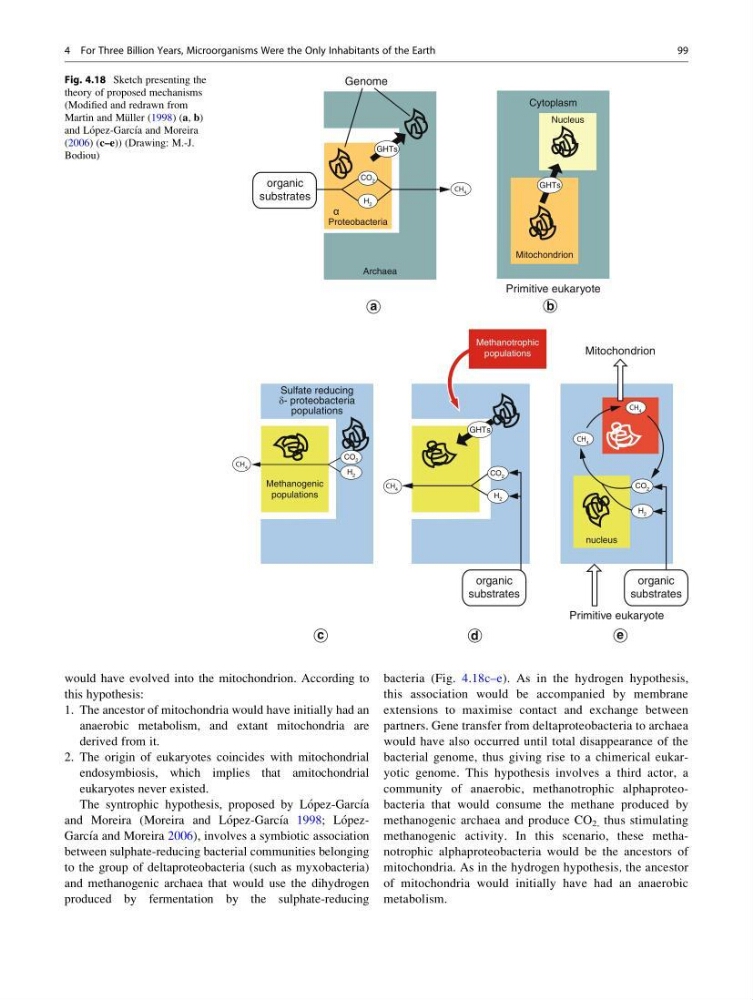
The syntrophic hypothesis, proposed by Lo ´pez-Garcı ´a
and Moreira (Moreira and Lo ´pez-Garcı ´a 1998; Lo ´pezGarcı ´a and Moreira 2006), involves a symbiotic association
between sulphate-reducing bacterial communities belonging
to the group of deltaproteobacteria (such as myxobacteria)
and methanogenic archaea that would use the dihydrogen
produced by fermentation by the sulphate-reducing
bacteria (Fig. 4.18c–e). As in the hydrogen hypothesis,
this association would be accompanied by membrane
extensions to maximise contact and exchange between
partners. Gene transfer from deltaproteobacteria to archaea
would have also occurred until total disappearance of the
bacterial genome, thus giving rise to a chimerical eukaryotic genome. This hypothesis involves a third actor, a
community of anaerobic, methanotrophic alphaproteobacteria that would consume the methane produced by
methanogenic archaea and produce CO 2, thus stimulating
methanogenic activity. In this scenario, these methanotrophic alphaproteobacteria would be the ancestors of
mitochondria. As in the hydrogen hypothesis, the ancestor
of mitochondria would initially have had an anaerobic
metabolism.
Genome
organic
substrates
Proteobacteria
CH 4
α
Archaea
GHTs
a
Cytoplasm
Mitochondrion
Primitive eukaryote
Nucleus
GHTs
b
Sulfate reducing
δ- proteobacteria
populations
Methanogenic
populations
c
Methanotrophic
populations
GHTs
organic
substrates
d
Mitochondrion
Primitive eukaryote
nucleus
organic
substrates
e
CO 2
H 2
CO 2
H 2
CO 2
CO 2
H 2
H 2
CH 4
CH 4
CH 4
CH 4
Fig. 4.18 Sketch presenting the
theory of proposed mechanisms
(Modified and redrawn from
Martin and Mu ¨ller (1998) (a, b)
and Lo ´pez-Garcı ´a and Moreira
(2006) (c–e)) (Drawing: M.-J.
Bodiou)
4 For Three Billion Years, Microorganisms Were the Only Inhabitants of the Earth
99
this hypothesis:
1. The ancestor of mitochondria would have initially had an
anaerobic metabolism, and extant mitochondria are
derived from it.
2. The origin of eukaryotes coincides with mitochondrial
endosymbiosis, which implies that amitochondrial
eukaryotes never existed.
The syntrophic hypothesis, proposed by Lo ´pez-Garcı ´a
and Moreira (Moreira and Lo ´pez-Garcı ´a 1998; Lo ´pezGarcı ´a and Moreira 2006), involves a symbiotic association
between sulphate-reducing bacterial communities belonging
to the group of deltaproteobacteria (such as myxobacteria)
and methanogenic archaea that would use the dihydrogen
produced by fermentation by the sulphate-reducing
bacteria (Fig. 4.18c–e). As in the hydrogen hypothesis,
this association would be accompanied by membrane
extensions to maximise contact and exchange between
partners. Gene transfer from deltaproteobacteria to archaea
would have also occurred until total disappearance of the
bacterial genome, thus giving rise to a chimerical eukaryotic genome. This hypothesis involves a third actor, a
community of anaerobic, methanotrophic alphaproteobacteria that would consume the methane produced by
methanogenic archaea and produce CO 2, thus stimulating
methanogenic activity. In this scenario, these methanotrophic alphaproteobacteria would be the ancestors of
mitochondria. As in the hydrogen hypothesis, the ancestor
of mitochondria would initially have had an anaerobic
metabolism.
Genome
organic
substrates
Proteobacteria
CH 4
α
Archaea
GHTs
a
Cytoplasm
Mitochondrion
Primitive eukaryote
Nucleus
GHTs
b
Sulfate reducing
δ- proteobacteria
populations
Methanogenic
populations
c
Methanotrophic
populations
GHTs
organic
substrates
d
Mitochondrion
Primitive eukaryote
nucleus
organic
substrates
e
CO 2
H 2
CO 2
H 2
CO 2
CO 2
H 2
H 2
CH 4
CH 4
CH 4
CH 4
Fig. 4.18 Sketch presenting the
theory of proposed mechanisms
(Modified and redrawn from
Martin and Mu ¨ller (1998) (a, b)
and Lo ´pez-Garcı ´a and Moreira
(2006) (c–e)) (Drawing: M.-J.
Bodiou)
4 For Three Billion Years, Microorganisms Were the Only Inhabitants of the Earth
99