

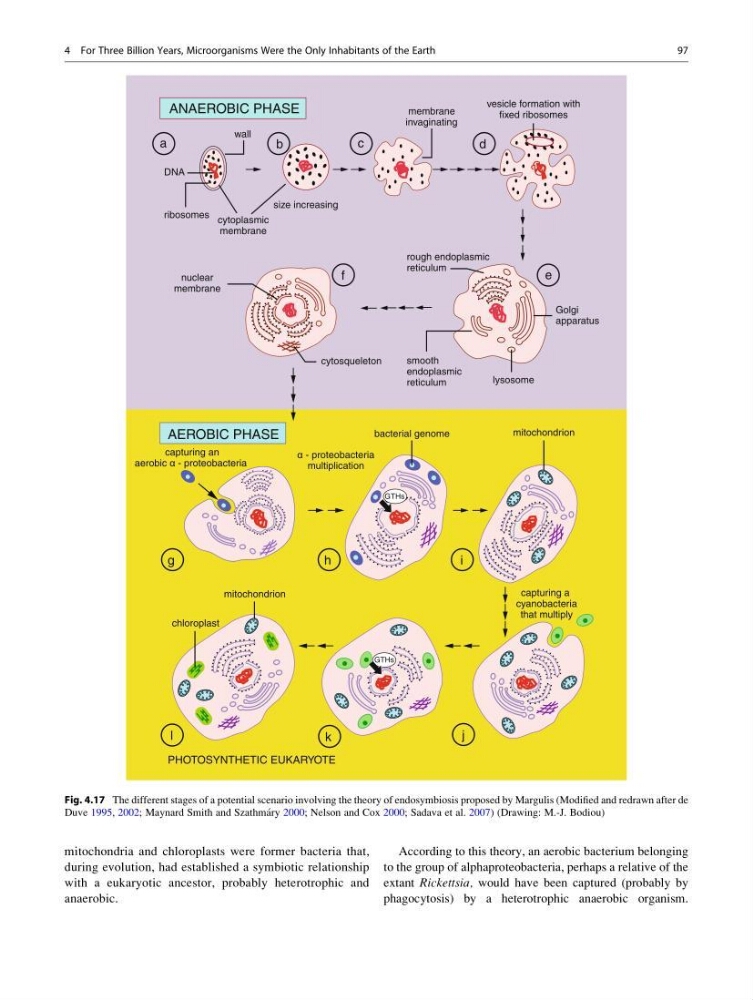
mitochondria and chloroplasts were former bacteria that,
during evolution, had established a symbiotic relationship
with a eukaryotic ancestor, probably heterotrophic and
anaerobic.
According to this theory, an aerobic bacterium belonging
to the group of alphaproteobacteria, perhaps a relative of the
extant Rickettsia, would have been captured (probably by
phagocytosis) by a heterotrophic anaerobic organism.
GTHs
GTHs
mitochondrion
mitochondrion
bacterial genome
AEROBIC PHASE
chloroplast
PHOTOSYNTHETIC EUKARYOTE
capturing an
aerobic α - proteobacteria
α - proteobacteria
multiplication
capturing a
cyanobacteria
that multiply
nuclear
membrane
cytosqueleton
smooth
endoplasmic
reticulum
lysosome
Golgi
apparatus
ANAEROBIC PHASE
ribosomes
DNA
wall
cytoplasmic
membrane
size increasing
membrane
invaginating
vesicle formation with
fixed ribosomes
rough endoplasmic
reticulum
g
h
i
j
k
l
a
b
c
d
e
f
Fig. 4.17 The different stages of a potential scenario involving the theory of endosymbiosis proposed by Margulis (Modified and redrawn after de
Duve 1995, 2002; Maynard Smith and Szathma ´ry 2000; Nelson and Cox 2000; Sadava et al. 2007) (Drawing: M.-J. Bodiou)
4 For Three Billion Years, Microorganisms Were the Only Inhabitants of the Earth
97
during evolution, had established a symbiotic relationship
with a eukaryotic ancestor, probably heterotrophic and
anaerobic.
According to this theory, an aerobic bacterium belonging
to the group of alphaproteobacteria, perhaps a relative of the
extant Rickettsia, would have been captured (probably by
phagocytosis) by a heterotrophic anaerobic organism.
GTHs
GTHs
mitochondrion
mitochondrion
bacterial genome
AEROBIC PHASE
chloroplast
PHOTOSYNTHETIC EUKARYOTE
capturing an
aerobic α - proteobacteria
α - proteobacteria
multiplication
capturing a
cyanobacteria
that multiply
nuclear
membrane
cytosqueleton
smooth
endoplasmic
reticulum
lysosome
Golgi
apparatus
ANAEROBIC PHASE
ribosomes
DNA
wall
cytoplasmic
membrane
size increasing
membrane
invaginating
vesicle formation with
fixed ribosomes
rough endoplasmic
reticulum
g
h
i
j
k
l
a
b
c
d
e
f
Fig. 4.17 The different stages of a potential scenario involving the theory of endosymbiosis proposed by Margulis (Modified and redrawn after de
Duve 1995, 2002; Maynard Smith and Szathma ´ry 2000; Nelson and Cox 2000; Sadava et al. 2007) (Drawing: M.-J. Bodiou)
4 For Three Billion Years, Microorganisms Were the Only Inhabitants of the Earth
97