

630
‘ Candidatus ’
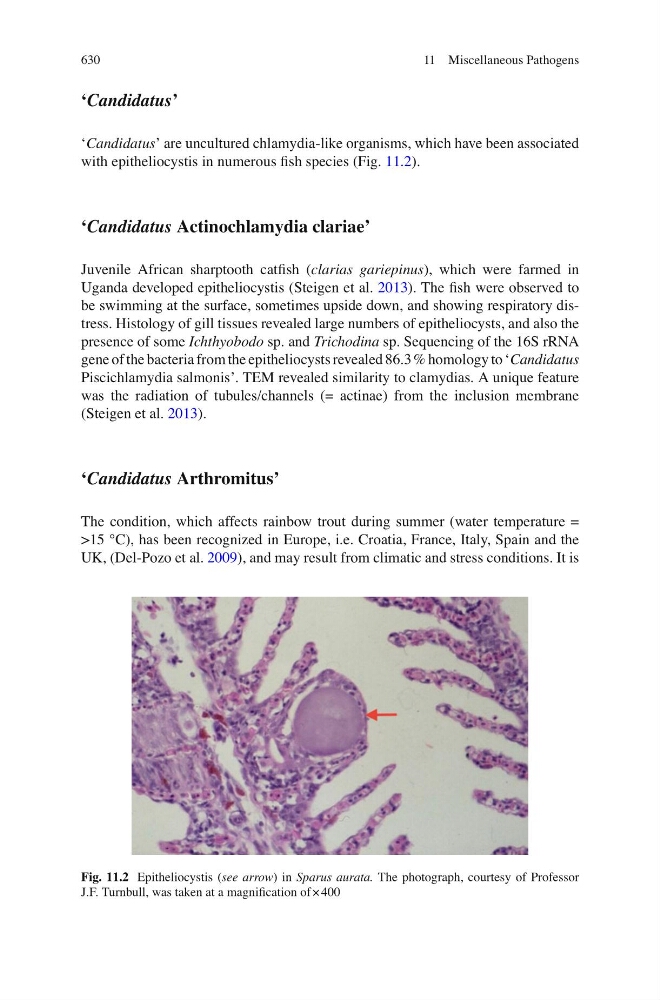
‘ Candidatus ’ are uncultured chlamydia-like organisms, which have been associated
with epitheliocystis in numerous fi sh species (Fig. 11.2 ).
‘ Candidatus Actinochlamydia clariae’
Juvenile African sharptooth catfi sh ( clarias gariepinus ), which were farmed in
Uganda developed epitheliocystis (Steigen et al. 2013 ). The fi sh were observed to
be swimming at the surface, sometimes upside down, and showing respiratory distress. Histology of gill tissues revealed large numbers of epitheliocysts, and also the
presence of some Ichthyobodo sp. and Trichodina sp. Sequencing of the 16S rRNA
gene of the bacteria from the epitheliocysts revealed 86.3 % homology to ‘ Candidatus
Piscichlamydia salmonis’. TEM revealed similarity to clamydias. A unique feature
was the radiation of tubules/channels (= actinae) from the inclusion membrane
(Steigen et al. 2013 ).
‘ Candidatus Arthromitus’
The condition, which affects rainbow trout during summer (water temperature =
>15 °C), has been recognized in Europe, i.e. Croatia, France, Italy, Spain and the
UK, (Del-Pozo et al. 2009 ), and may result from climatic and stress conditions. It is
Fig. 11.2 Epitheliocystis ( see arrow ) in Sparus aurata. The photograph, courtesy of Professor
J.F. Turnbull, was taken at a magnifi cation of × 400
11 Miscellaneous Pathogens