

619
Characteristics of the Pathogen
Serologically, the tench isolate was distinct from all other validly described species of Acholeplasma and Mycoplasma. From the traits, listed above, it was deemed
that the organism formed a new species, for which the name of Mycoplasma mobile
was coined (Kirchhoff et al. 1987 ).
Epizootiology
Mycoplasma-like bacteria occur on fi sh (Kirchhoff and Rosengarten 1984 ), from
which infection probably occurs.
Myxococcaceae Representative
Myxococcus piscicola
There has been one report of gill disease (in 1972) caused by a supposed new species of the fruiting organism Myxococcus, for which the name of Myxococcus piscicola was suggested (Xu 1975 ). This organism was associated with an epizootic in
grass carp ( Ctenopharyngodon idelluls) fi ngerlings held in ponds in Wuhan, China.
Conical fruiting bodies were produced on agar. These fruiting bodies were surrounded by a thin membrane, without peduncle or branches (Xu 1975 ).
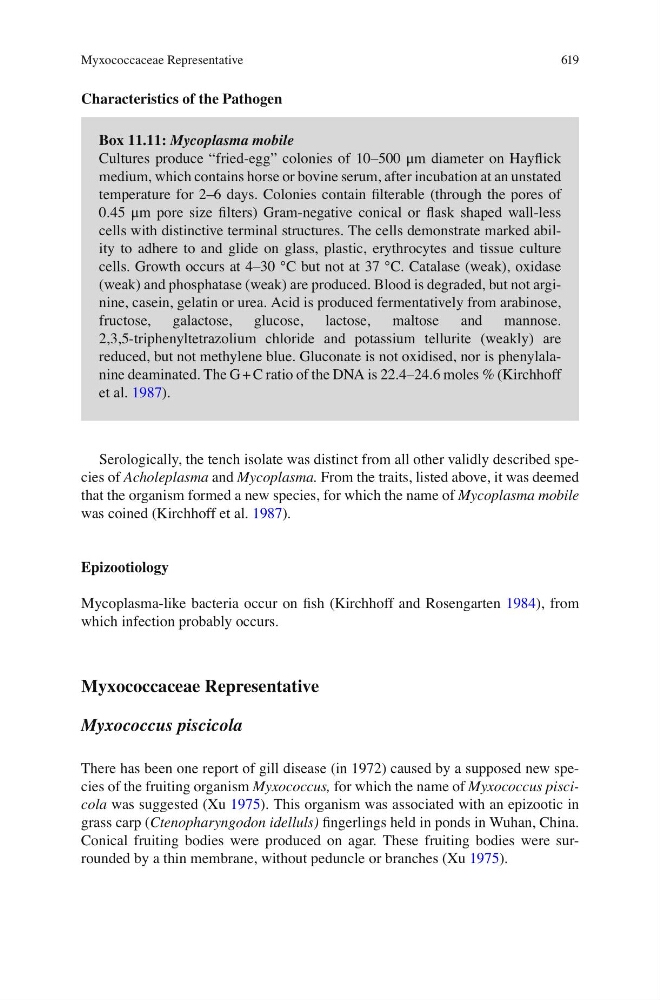
Box 11.11: Mycoplasma mobile
Cultures produce “fried-egg” colonies of 10–500 μm diameter on Hayfl ick
medium, which contains horse or bovine serum, after incubation at an unstated
temperature for 2–6 days. Colonies contain fi lterable (through the pores of
0.45 μm pore size fi lters) Gram-negative conical or fl ask shaped wall-less
cells with distinctive terminal structures. The cells demonstrate marked ability to adhere to and glide on glass, plastic, erythrocytes and tissue culture
cells. Growth occurs at 4–30 °C but not at 37 °C. Catalase (weak), oxidase
(weak) and phosphatase (weak) are produced. Blood is degraded, but not arginine, casein, gelatin or urea. Acid is produced fermentatively from arabinose,
fructose, galactose, glucose, lactose, maltose and mannose.
2,3,5- triphenyltetrazolium chloride and potassium tellurite (weakly) are
reduced, but not methylene blue. Gluconate is not oxidised, nor is phenylalanine deaminated. The G + C ratio of the DNA is 22.4–24.6 moles % (Kirchhoff
et al. 1987 ).
Myxococcaceae Representative