

612
Characteristics of the Pathogen
From the available information, Roald and Hastein ( 1980 ) considered that the
pathogen corresponded to an as yet unnamed species of Acinetobacter. Although
this appears to be a sound decision, bona fi de Acinetobacter spp. should not produce
oxidase (Juni 2005 ). In fact, this ability belongs to the morphologically similar
Moraxella (Juni and Bøvre 2005 ) and Neisseria (Vedros 1984 ). There is some
degree of resemblance between the fi sh pathogen and Mor. atlantae and Mor.
osloensis, although one of the general traits of moraxellae is an inability to produce
acid from carbohydrates. Thus as a compromise solution, it would appear that the
fi sh pathogen should be classifi ed in the area loosely bounded by Acinetobacter,
Moraxella and Neisseria.
Epizootiology
Unreactive Gram-negative rods that are diffi cult to identify and which resemble
Acinetobacter are common inhabitants of fresh water (Allen et al. 1983 ) and marine
ecosystems (Austin 1982 ). In particular, the organisms populate the skin and gills
(Horsley 1973 ) and digestive tract (Shewan 1961 ; Trust and Sparrow 1974 ; Roald
1977 ) of salmonids. Therefore, a ready inoculum of cells is likely to be in continual
contact with fi sh. Conceivably any break in the integument of the host may lead to
colonisation of the nutrient-rich tissues by components of the water- borne or,
indeed, fi sh microfl ora. This may lead to the start of a disease cycle.
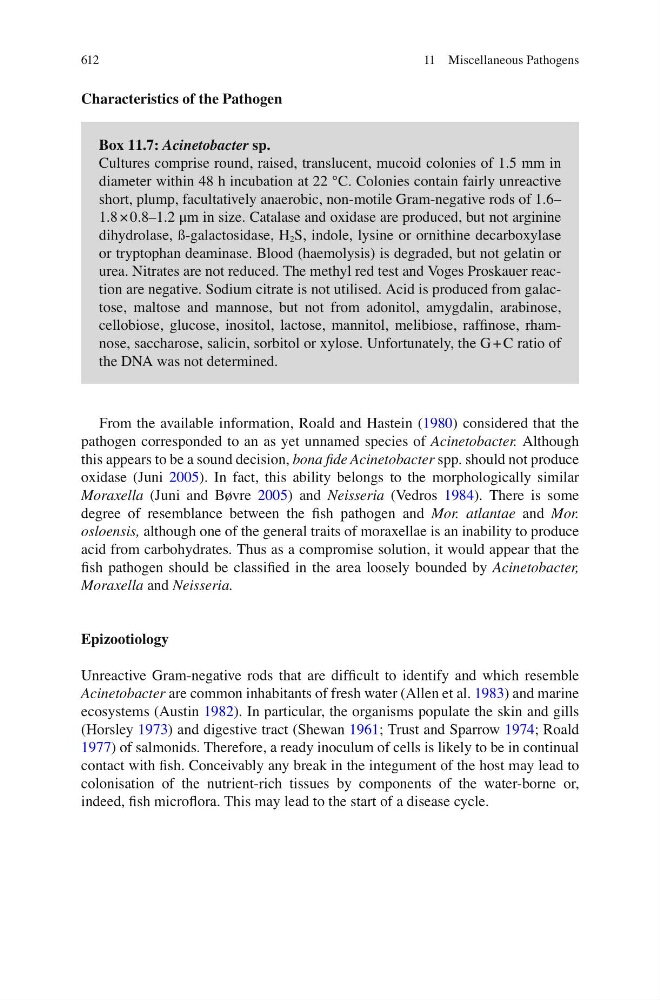
Box 11.7: Acinetobacter sp.
Cultures comprise round, raised, translucent, mucoid colonies of 1.5 mm in
diameter within 48 h incubation at 22 °C. Colonies contain fairly unreactive
short, plump, facultatively anaerobic, non-motile Gram-negative rods of 1.6–
1.8 × 0.8–1.2 μm in size. Catalase and oxidase are produced, but not arginine
dihydrolase, ß-galactosidase, H 2 S, indole, lysine or ornithine decarboxylase
or tryptophan deaminase. Blood (haemolysis) is degraded, but not gelatin or
urea. Nitrates are not reduced. The methyl red test and Voges Proskauer reaction are negative. Sodium citrate is not utilised. Acid is produced from galactose, maltose and mannose, but not from adonitol, amygdalin, arabinose,
cellobiose, glucose, inositol, lactose, mannitol, melibiose, raffi nose, rhamnose, saccharose, salicin, sorbitol or xylose. Unfortunately, the G + C ratio of
the DNA was not determined.
11 Miscellaneous Pathogens