

549
Results of DNA:DNA homology experiments showed a high degree of homology with Ph. damselae, at 88 % re-association. Eight RAPD and 13 ribotypes were
recognised by Pujalte et al. ( 2003 ). Phenotypic and genotypic traits point to relatedness between V. harveyi and V. campbellii (Gomez-Gil et al. 2004 ). Moreover, these
authors considered that some cultures of V. harveyi should more correctly have been
identifi ed as V. campbellii. This raises the question about the role of V. campbellii in
fi sh pathology. This general theme about the accuracy of identifi cation to vibrios
within the Harveyi clade has been voiced by others (Hoffmann et al. 2012 ).
Diagnosis
Molecular methods. Problems with the accuracy of phenotypic-based identifi cation of pathogens, such as V. harveyi, may be overcome by 16S rDNA sequencing
(Ransangan and Mustafa 2009 ). A high level of specifi city and sensitivity (detection
limit = 4.0 × 10
3 cells/ml) involved the use of toxR gene for the detection of V. harveyi; the PCR of which took <5 h to enact and selectively recognised 20 authentic
representatives of the taxon (including cells in diseased fi sh tissues) but not representatives of other vibrios (Pang et al. 2006 ). In another development, multilocus
sequence analysis was described as a reliable and rapid means of identifi cation
(Cano-Gomez et al. 2011 ).
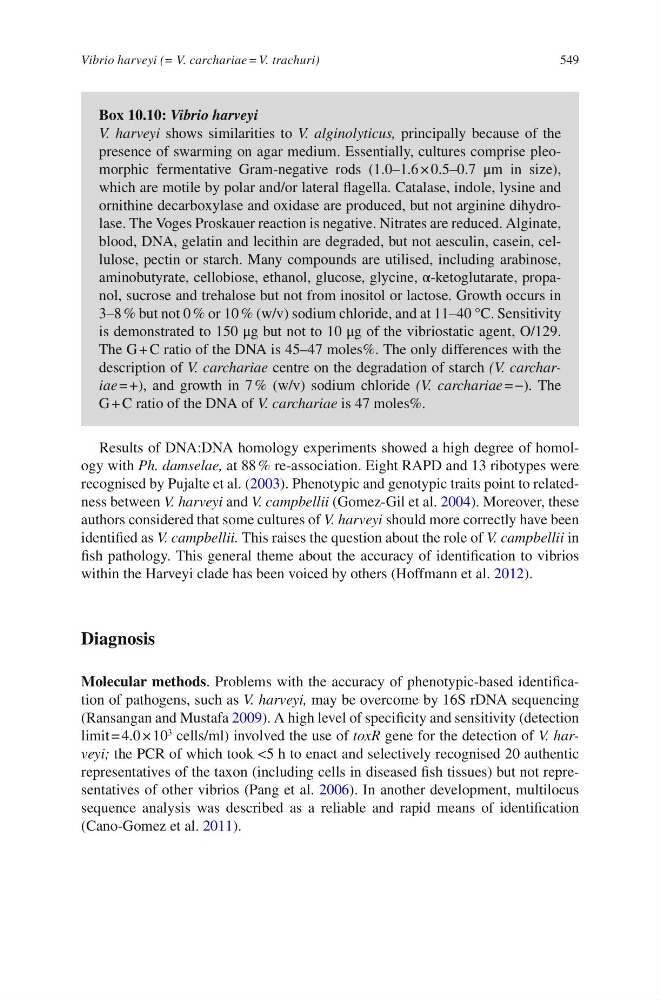
Box 10.10: Vibrio harveyi
V. harveyi shows similarities to V. alginolyticus, principally because of the
presence of swarming on agar medium. Essentially, cultures comprise pleomorphic fermentative Gram-negative rods (1.0–1.6 × 0.5–0.7 μm in size),
which are motile by polar and/or lateral fl agella. Catalase, indole, lysine and
ornithine decarboxylase and oxidase are produced, but not arginine dihydrolase. The Voges Proskauer reaction is negative. Nitrates are reduced. Alginate,
blood, DNA, gelatin and lecithin are degraded, but not aesculin, casein, cellulose, pectin or starch. Many compounds are utilised, including arabinose,
aminobutyrate, cellobiose, ethanol, glucose, glycine, α-ketoglutarate, propanol, sucrose and trehalose but not from inositol or lactose. Growth occurs in
3–8 % but not 0 % or 10 % (w/v) sodium chloride, and at 11–40 °C. Sensitivity
is demonstrated to 150 μg but not to 10 μg of the vibriostatic agent, O/129.
The G + C ratio of the DNA is 45–47 moles%. The only differences with the
description of V. carchariae centre on the degradation of starch (V. carchariae = +), and growth in 7 % (w/v) sodium chloride (V. carchariae = −). The
G + C ratio of the DNA of V. carchariae is 47 moles%.
Vibrio harveyi (= V. carchariae = V. trachuri)