

545
(Reddacliff et al. 1993 ). The organism has been linked with ascites disease in cultured Mandarin fi sh ( Siniperca chuatsi ) (Cao et al. 2013 ). V. cholerae non-O1/nonO139 was isolated from Cardinal tetra ( Paracheirodon axelrodi ) fry and adult
Raphael catfi sh ( Platydoras costatus ), which were from aquaria in the Czech
Republic. Also, disease was recorded in a range of wild fi sh (Rehulka et al. 2015 ).
Petechial haemorrhages developed on the body surface. Internally, there was
congestion of the organs (Muroga et al. 1979 ; Kiiyukia et al. 1992 ). Reddacliff et al.
( 1993 ) reported that septicaemia developed in infected goldfi sh. Diseased common
nase and chub revealed haemorrhages, erythema and hyperaemia in the abdominal
region, within the mouth and at the base of the fi nage (Rehulka et al. 2015 ).
Isolation
This may be achieved by inoculating kidney material (from swabs) onto the surface
of nutrient agar plates, with incubation at 25 °C for an undisclosed period (presumably 2–5 days) (Muroga et al. 1979 ; Kiiyukia et al. 1992 ).
Characteristics of the Pathogen
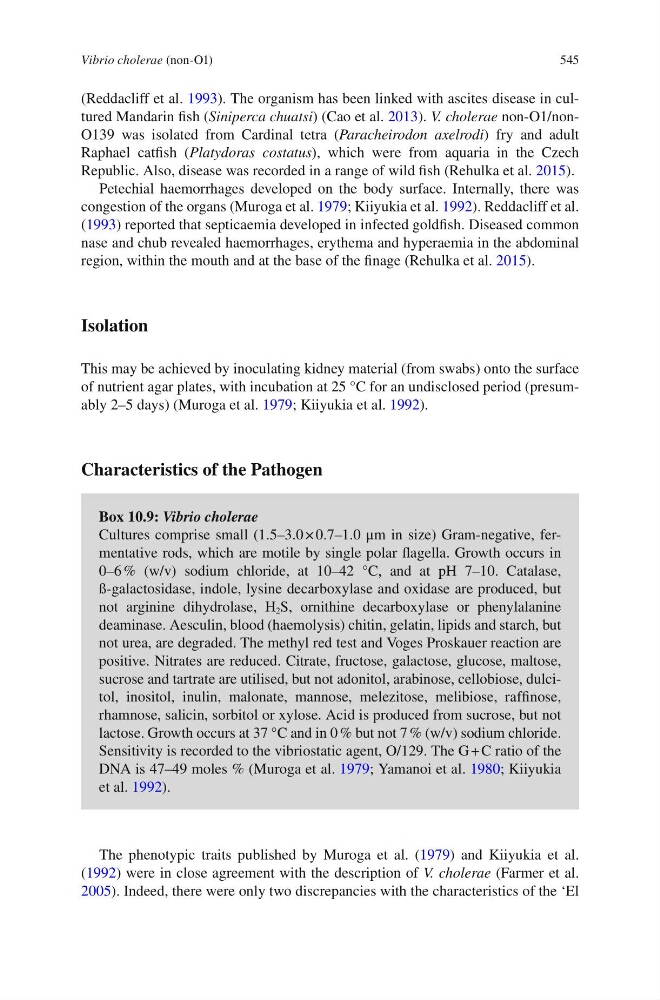
The phenotypic traits published by Muroga et al. ( 1979 ) and Kiiyukia et al.
( 1992 ) were in close agreement with the description of V. cholerae (Farmer et al.
2005 ). Indeed, there were only two discrepancies with the characteristics of the ‘El
Box 10.9: Vibrio cholerae
Cultures comprise small (1.5–3.0 × 0.7–1.0 μm in size) Gram-negative, fermentative rods, which are motile by single polar fl agella. Growth occurs in
0–6 % (w/v) sodium chloride, at 10–42 °C, and at pH 7–10. Catalase,
ß- galactosidase, indole, lysine decarboxylase and oxidase are produced, but
not arginine dihydrolase, H 2 S, ornithine decarboxylase or phenylalanine
deaminase. Aesculin, blood (haemolysis) chitin, gelatin, lipids and starch, but
not urea, are degraded. The methyl red test and Voges Proskauer reaction are
positive. Nitrates are reduced. Citrate, fructose, galactose, glucose, maltose,
sucrose and tartrate are utilised, but not adonitol, arabinose, cellobiose, dulcitol, inositol, inulin, malonate, mannose, melezitose, melibiose, raffi nose,
rhamnose, salicin, sorbitol or xylose. Acid is produced from sucrose, but not
lactose. Growth occurs at 37 °C and in 0 % but not 7 % (w/v) sodium chloride.
Sensitivity is recorded to the vibriostatic agent, O/129. The G + C ratio of the
DNA is 47–49 moles % (Muroga et al. 1979 ; Yamanoi et al. 1980 ; Kiiyukia
et al. 1992 ).
Vibrio cholerae (non-O1)