

525
greatest concentration is in the blood (Tajima et al. 1981 ; Ransom et al. 1984 ).
Usually infected fi sh become inactive, cease feeding (this may cause problems for
chemotherapy), and suffer heavy mortalities.
Fin rot is another condition attributed to V. anguillarum. For example, the pathogen has been blamed for causing fi n rot in juvenile turbot principally in Northern
China (Lei et al. 2006 ). Here, the infection led to mortalities of 90–100 % (Lei et al.
2006 ). The organism has been recovered in mixed communities with V. chagassi
and V. harveyi from sand melts with skin haemorrhages (Fabbro et al. 2011 ).
Isolation and Detection
The pathogen may be readily recovered from infected tissue by use of TSA (Traxler
and Li 1972 ), nutrient agar (Muroga et al. 1976a , b ) and BHIA (Tajima et al. 1981 )
supplemented with sodium chloride at 0.5–3.5 % (w/v), seawater agar and TCBS
(Bolinches et al. 1988 ), with incubation at 15–25 °C for periods of up to 7 days.
The presumptive identifi cation of V. anguillarum has been achieved using a specially designed medium, designated VAM, which combined bile salts with a high
sodium chloride concentration, ampicillin, sorbitol and a high pH (Appendix in
Chap. 12 ; Alsina et al. 1994 ). On VAM, V. anguillarum produced bright yellow
colonies with yellow haloes. Its usefulness was attested by its ability to recognise
the majority, i.e. 197/227 = 87 % of V. anguillarum isolates. However, some erroneous results occurred insofar as VAM recognised 3/66 = 4 % of other vibrios as V.
anguillarum (Alsina et al. 1994 ).
A RT-PCR has been developed for the detection and quantifi cation of V. anguillarum in sea bass tissues, targeting 16S rDNA and toxR genes. The approach was specifi c
and sensitive, detecting 1–10 bacterial cells/reaction in pure culture and 2 × 10
2 –
2 × 10
3 cells/g of fi sh tissue (Crisafi et al. 2011 ). A subsequent publication reported a
multiplex RT-PCR that was useful for detecting the pathogen in seawater. The primers
used targeted vah1, empA and rpoN genes, and the method detected 3 CFU/ml in sea
water within 70 min without the need for need for culturing (Hickey et al. 2015 ).
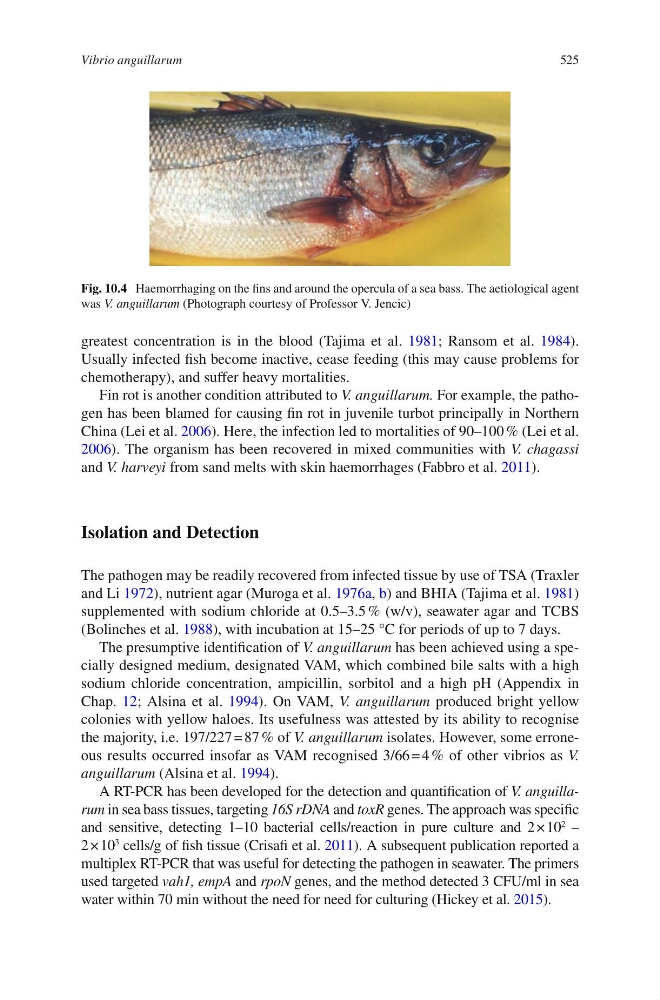
Fig. 10.4 Haemorrhaging on the fi ns and around the opercula of a sea bass. The aetiological agent
was V. anguillarum (Photograph courtesy of Professor V. Jencic)
Vibrio anguillarum