

519
By DNA: DNA hybridisation and 16S 3RNA sequencing, the closest neighbour
was Ali. logei with 57 % re-association (Lunder et al. 2000 ) and 98.8 % sequence
homology (Benediktsdóttir et al. 2000 ), respectively . The organism was transferred
to a newly created genus Aliivibrio as Ali. wodanis on the basis of phylogeny principally involving sequencing of the 16S rRNA gene (Urbanczyk et al. 2007 ).
Vibrio aestuarianus
Characteristics of the Disease
During 2008, cultured tongue sole in China suffered high mortalities with disease
signs including inappetance, erratic swimming, haemorrhages on the head, opercula
and base of the fi ns, dorsal fi n rot, swollen abdomen fi lled with ascitic fl uid, and the
presence of hernias in the intestine (Zhang et al. 2011b ).
Characteristics of the Pathogen
Identifi cation of the four cultures to V. aestuarianus was largely on the sequencing of the 16S rRNA and gyrB genes when homologies of 98–99 % were recorded
with the entry [for V. aestuarianus] in GenBank (Zhang et al. 2011b ). This level of
homology is low to be completely convinced of the justifi able inclusion in the species, and the identifi cation is tentative although the phenotypic evidence is more
supportive.
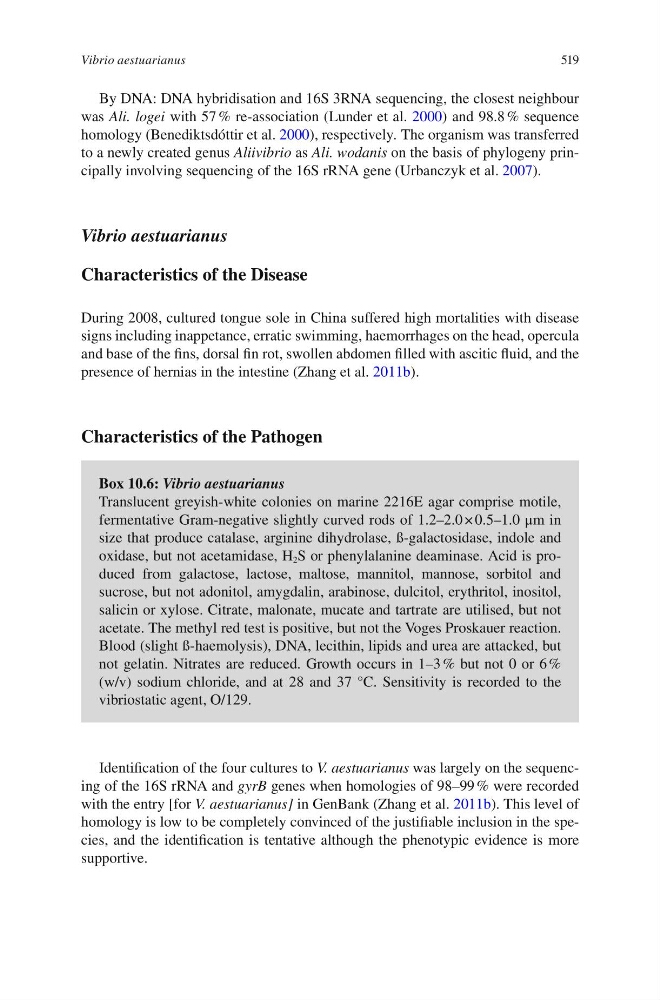
Box 10.6: Vibrio aestuarianus
Translucent greyish-white colonies on marine 2216E agar comprise motile,
fermentative Gram-negative slightly curved rods of 1.2–2.0 × 0.5–1.0 μm in
size that produce catalase, arginine dihydrolase, ß-galactosidase, indole and
oxidase, but not acetamidase, H 2 S or phenylalanine deaminase. Acid is produced from galactose, lactose, maltose, mannitol, mannose, sorbitol and
sucrose, but not adonitol, amygdalin, arabinose, dulcitol, erythritol, inositol,
salicin or xylose. Citrate, malonate, mucate and tartrate are utilised, but not
acetate. The methyl red test is positive, but not the Voges Proskauer reaction.
Blood (slight ß-haemolysis), DNA, lecithin, lipids and urea are attacked, but
not gelatin. Nitrates are reduced. Growth occurs in 1–3 % but not 0 or 6 %
(w/v) sodium chloride, and at 28 and 37 °C. Sensitivity is recorded to the
vibriostatic agent, O/129.
Vibrio aestuarianus