

505
(Snieszko et al. 1964 ). Hence the condition was termed ‘pasteurellosis’. However,
the literature became confusing, insofar as the disease is also referred to in Japan as
‘pseudotuberculosis’ because of the distinctive pathology. (Snieszko et al. 1964 ).
The disease has been responsible for heavy losses among menhaden and striped
mullet in Galveston Bay, Texas (Lewis et al. 1970 ). However, it is in Japan that the
disease has become of considerable economic importance, causing signifi cant
losses in farmed yellowtail (Egusa 1983 ). Since its initial recognition in yellowtails,
pasteurellosis appears to have spread to other fi sh species, including gilt-head sea
bream (Balebona et al. 1998 ), red sea bream (Yasunaga et al. 1983 ), black sea bream
(Muroga et al. 1977 ; Ohnishi et al. 1982 ), Atlantic bluefi n tuna (Mladineo et al.
2006 ), sole (Solea senegalensis) (Zorrilla et al. 1999 ) and golden pompano
( Trachinotus ovatus ) (Snieszko et al. 1964 ). More recently, the disease seems to
have spread to farmed and wild fi sh stocks in the Mediterranean area, notably
Croatia, France, Italy and Spain (Magariños et al. 1992 ; Mladineo et al. 2006 ).
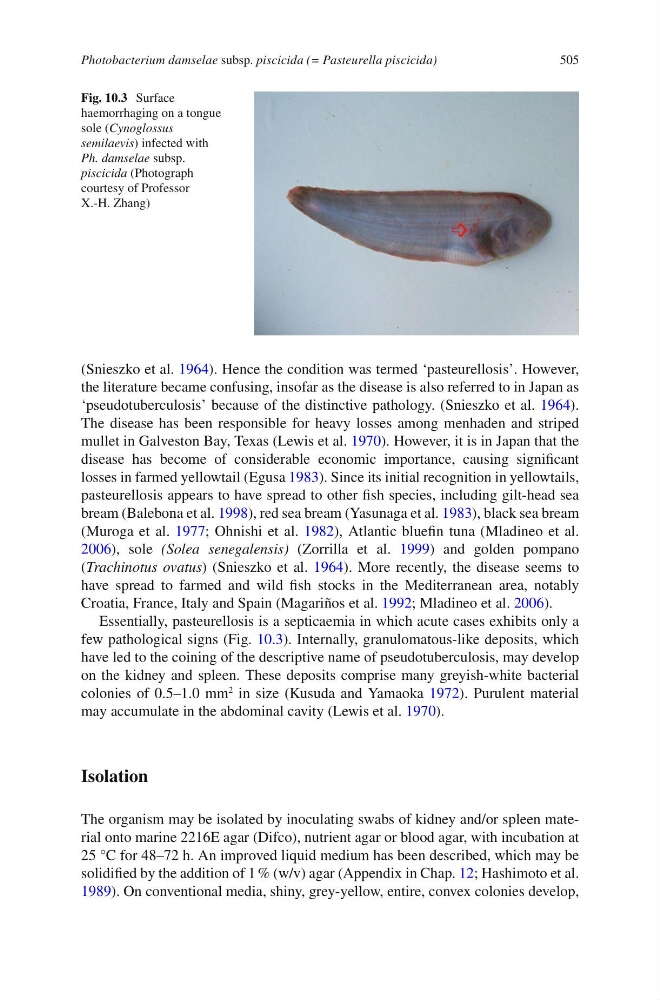
Essentially, pasteurellosis is a septicaemia in which acute cases exhibits only a
few pathological signs (Fig. 10.3 ). Internally, granulomatous-like deposits, which
have led to the coining of the descriptive name of pseudotuberculosis, may develop
on the kidney and spleen. These deposits comprise many greyish-white bacterial
colonies of 0.5–1.0 mm
2 in size (Kusuda and Yamaoka 1972 ). Purulent material
may accumulate in the abdominal cavity (Lewis et al. 1970 ).
Isolation
The organism may be isolated by inoculating swabs of kidney and/or spleen material onto marine 2216E agar (Difco), nutrient agar or blood agar, with incubation at
25 °C for 48–72 h. An improved liquid medium has been described, which may be
solidifi ed by the addition of 1 % (w/v) agar (Appendix in Chap. 12 ; Hashimoto et al.
1989 ). On conventional media, shiny, grey-yellow, entire, convex colonies develop,
Fig. 10.3 Surface
haemorrhaging on a tongue
sole ( Cynoglossus
semilaevis ) infected with
Ph. damselae subsp.
piscicida (Photograph
courtesy of Professor
X.-H. Zhang)
Photobacterium damselae subsp. piscicida (= Pasteurella piscicida)