

477
Pathogenicity
Hybrid sturgeon ( Huso dauricus x Acipenser schrenckii) were used for experimental infections, and a dose of 2 × 10
6 CFU/fi sh resulted in 33 % mortalities at day 5
after infection. Ten- and 100-fold increases in inocula resulted in 60 % and 100 %
mortalities by day 15 (Xu et al. 2015 ).
Pseudomonas anguilliseptica
Characteristics of the Disease
Originally observed in eels, when the disease was referred to as Sekiten byo (= red
spot), the pathogen has been identifi ed in a wide range of other species, including
Baltic herring (Clupea harengus membras) (Lönnström et al. 1994 ), gilthead sea
bream (Doménech et al. 1999 ), black spot sea bream (Pagellus bogaraveo) (LópezRomalde et al. 2003 ), orange-spotted grouper (Epinephelus coioides) (Al-Marzouk
1999 ) and cod (Ferguson et al. 2004 ). Typically, the disease manifests itself by the
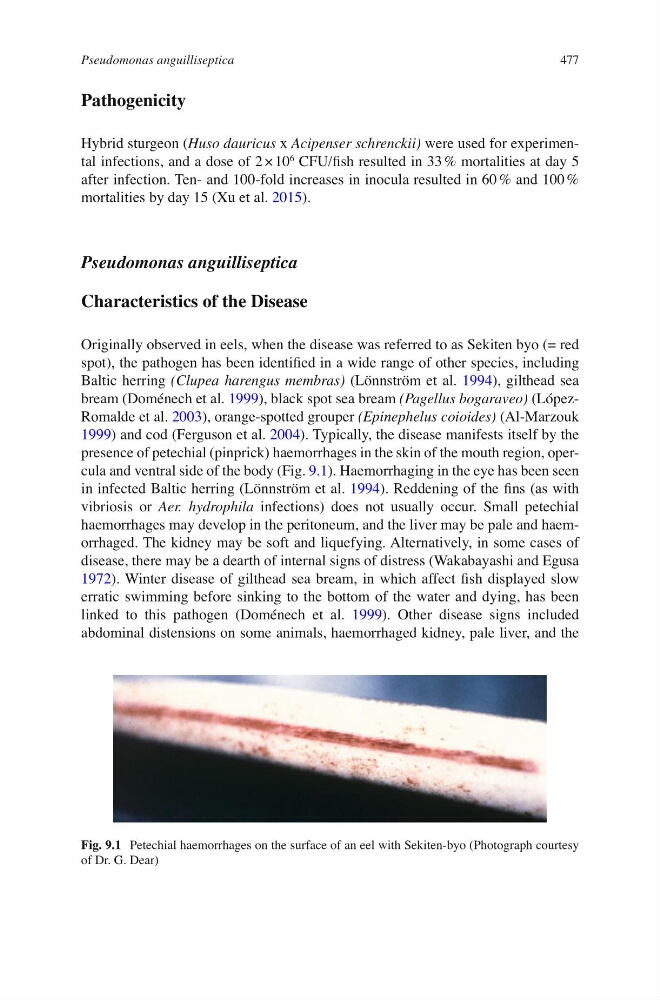
presence of petechial (pinprick) haemorrhages in the skin of the mouth region, opercula and ventral side of the body (Fig. 9.1 ). Haemorrhaging in the eye has been seen
in infected Baltic herring (Lönnström et al. 1994 ). Reddening of the fi ns (as with
vibriosis or Aer. hydrophila infections) does not usually occur. Small petechial
haemorrhages may develop in the peritoneum, and the liver may be pale and haemorrhaged. The kidney may be soft and liquefying. Alternatively, in some cases of
disease, there may be a dearth of internal signs of distress (Wakabayashi and Egusa
1972 ). Winter disease of gilthead sea bream, in which affect fi sh displayed slow
erratic swimming before sinking to the bottom of the water and dying, has been
linked to this pathogen (Doménech et al. 1999 ). Other disease signs included
abdominal distensions on some animals, haemorrhaged kidney, pale liver, and the
Fig. 9.1 Petechial haemorrhages on the surface of an eel with Sekiten-byo (Photograph courtesy
of Dr. G. Dear)
Pseudomonas anguilliseptica
Pathogenicity
Hybrid sturgeon ( Huso dauricus x Acipenser schrenckii) were used for experimental infections, and a dose of 2 × 10
6 CFU/fi sh resulted in 33 % mortalities at day 5
after infection. Ten- and 100-fold increases in inocula resulted in 60 % and 100 %
mortalities by day 15 (Xu et al. 2015 ).
Pseudomonas anguilliseptica
Characteristics of the Disease
Originally observed in eels, when the disease was referred to as Sekiten byo (= red
spot), the pathogen has been identifi ed in a wide range of other species, including
Baltic herring (Clupea harengus membras) (Lönnström et al. 1994 ), gilthead sea
bream (Doménech et al. 1999 ), black spot sea bream (Pagellus bogaraveo) (LópezRomalde et al. 2003 ), orange-spotted grouper (Epinephelus coioides) (Al-Marzouk
1999 ) and cod (Ferguson et al. 2004 ). Typically, the disease manifests itself by the
presence of petechial (pinprick) haemorrhages in the skin of the mouth region, opercula and ventral side of the body (Fig. 9.1 ). Haemorrhaging in the eye has been seen
in infected Baltic herring (Lönnström et al. 1994 ). Reddening of the fi ns (as with
vibriosis or Aer. hydrophila infections) does not usually occur. Small petechial
haemorrhages may develop in the peritoneum, and the liver may be pale and haemorrhaged. The kidney may be soft and liquefying. Alternatively, in some cases of
disease, there may be a dearth of internal signs of distress (Wakabayashi and Egusa
1972 ). Winter disease of gilthead sea bream, in which affect fi sh displayed slow
erratic swimming before sinking to the bottom of the water and dying, has been
linked to this pathogen (Doménech et al. 1999 ). Other disease signs included
abdominal distensions on some animals, haemorrhaged kidney, pale liver, and the
Fig. 9.1 Petechial haemorrhages on the surface of an eel with Sekiten-byo (Photograph courtesy
of Dr. G. Dear)
Pseudomonas anguilliseptica