

404
Characteristics of the Pathogen
Pathogenicity
Laboratory based infectivity experiments with yellow perch by i.p. injection
recorded LD 50 values of 1.5–3.2 × 10
8 CFU/fi sh (Pridgeon et al. 2012 ).
Chryseobacterium piscicola
Characteristics of the Disease
There was an association with external lesions/ulcerations on rainbow trout and
Atlantic salmon farmed in Chile (Ilardi et al. 2009 , 2010 ).
Characteristics of the Pathogen
In the initial study, which proposed a new species, 8 isolates were recovered from
farmed Atlantic salmon and rainbow trout in Chile. Examination of the 16S rRNA
gene sequences revealed that the closest neighbours with homologies of 96.9 and
97.1 %, respectively, were Chryseobacterium soldanellicola and Chryseobacterium
soli (Van Gelderen et al. 2009a ).
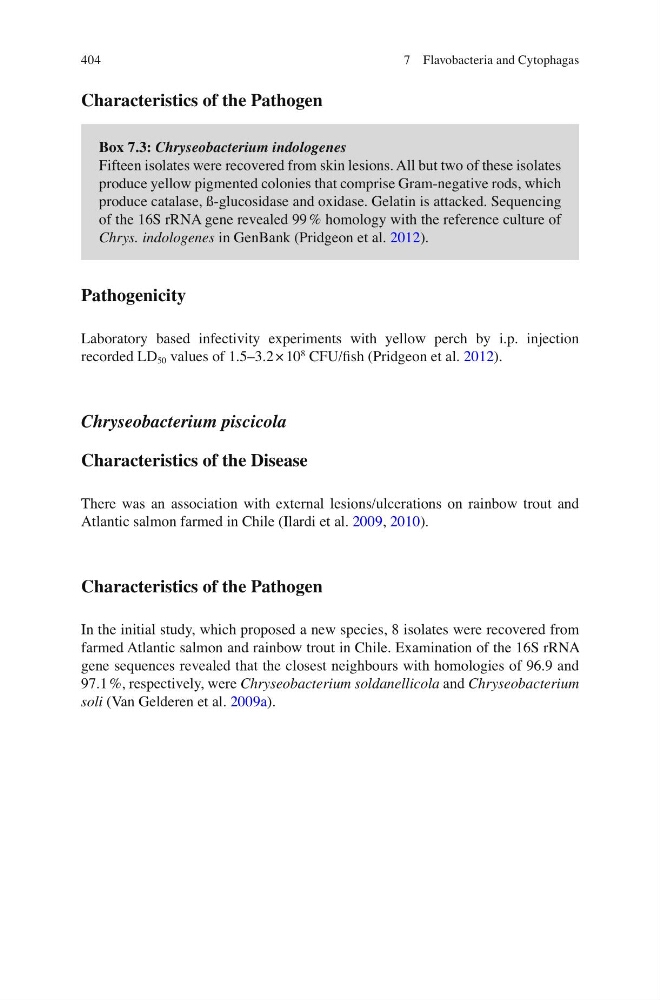
Box 7.3: Chryseobacterium indologenes
Fifteen isolates were recovered from skin lesions. All but two of these isolates
produce yellow pigmented colonies that comprise Gram-negative rods, which
produce catalase, ß-glucosidase and oxidase. Gelatin is attacked. Sequencing
of the 16S rRNA gene revealed 99 % homology with the reference culture of
Chrys. indologenes in GenBank (Pridgeon et al. 2012 ).
7 Flavobacteria and Cytophagas
Characteristics of the Pathogen
Pathogenicity
Laboratory based infectivity experiments with yellow perch by i.p. injection
recorded LD 50 values of 1.5–3.2 × 10
8 CFU/fi sh (Pridgeon et al. 2012 ).
Chryseobacterium piscicola
Characteristics of the Disease
There was an association with external lesions/ulcerations on rainbow trout and
Atlantic salmon farmed in Chile (Ilardi et al. 2009 , 2010 ).
Characteristics of the Pathogen
In the initial study, which proposed a new species, 8 isolates were recovered from
farmed Atlantic salmon and rainbow trout in Chile. Examination of the 16S rRNA
gene sequences revealed that the closest neighbours with homologies of 96.9 and
97.1 %, respectively, were Chryseobacterium soldanellicola and Chryseobacterium
soli (Van Gelderen et al. 2009a ).
Box 7.3: Chryseobacterium indologenes
Fifteen isolates were recovered from skin lesions. All but two of these isolates
produce yellow pigmented colonies that comprise Gram-negative rods, which
produce catalase, ß-glucosidase and oxidase. Gelatin is attacked. Sequencing
of the 16S rRNA gene revealed 99 % homology with the reference culture of
Chrys. indologenes in GenBank (Pridgeon et al. 2012 ).
7 Flavobacteria and Cytophagas