

398
ing the pathogen. In fact, this was not achieved for two decades, until Ordal and
Rucker ( 1944 ) succeeded in 1943 during an outbreak in hatchery-reared sockeye
salmon.
Fish pathogenic fl exibacters have been recognised (see Masumura and
Wakabayashi 1977 ; Hikida et al. 1979 ; Pyle and Shotts 1980 , 1981 ; Wakabayashi
et al. 1984 ). For example, during 1976 and 1977, a bacterial disease developed in
juvenile (usually ≤60 mm in length) red sea bream and black sea bream maintained
at marine sites in Hiroshima Prefecture, Japan. The outbreak occurred 1–2 weeks
after the fi sh were transported from the hatchery to sea cages. An organism was
isolated by Masumura and Wakabayashi ( 1977 ), and later considered to be a new
species of Flexibacter, for which the name of Fle. marinus was coined (Hikida et al.
1979 ). This organism was subsequently re-named as Fle. maritimus (Wakabayashi
et al. 1986 ) and thence as Tenacibaculum maritimum (Suzuki et al. 2001 ). However,
it has been suggested that this taxon is synonymous with Cyt. marina (Holmes
1992 ). Fle. ovolyticus was named as a new pathogen of halibut eggs and larvae
(Hansen et al. 1992 ), and then reclassifi ed as Tenacibaculum ovolyticum (Suzuki
et al. 2001 ). Additional reports of fi sh pathogenic Flexibacter spp. have been noted.
In particular, the genus has been found in cases of fi n rot (Bullock and Snieszko
1970 ; Ziskowski and Murchelano 1975 ; Schneider and Nicholson 1980 ) and general ‘myxobacterial’ diseases (e.g. Pyle and Shotts 1980 , 1981 ).
Flavobacterium became the second genus of yellow-pigmented Gram-negative
fi sh pathogens to be recognised, with the description of Fla. balustinum by Harrison
and Sadler ( 1929 ). This taxon was re-classifi ed into a newly established genus, as
Chryseobacterium balustinum (Vandamme et al. 1994 ). From the original publication, we believe that this organism was really a fi sh spoilage agent rather than a
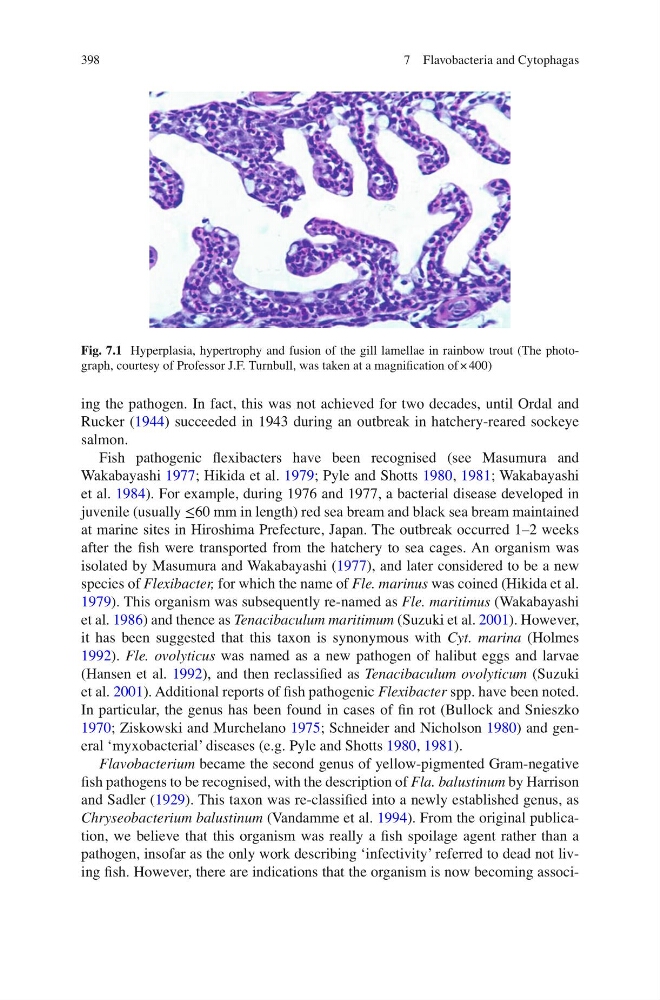
pathogen, insofar as the only work describing ‘infectivity’ referred to dead not living fi sh. However, there are indications that the organism is now becoming associFig. 7.1 Hyperplasia, hypertrophy and fusion of the gill lamellae in rainbow trout (The photograph, courtesy of Professor J.F. Turnbull, was taken at a magnifi cation of × 400)
7 Flavobacteria and Cytophagas
ing the pathogen. In fact, this was not achieved for two decades, until Ordal and
Rucker ( 1944 ) succeeded in 1943 during an outbreak in hatchery-reared sockeye
salmon.
Fish pathogenic fl exibacters have been recognised (see Masumura and
Wakabayashi 1977 ; Hikida et al. 1979 ; Pyle and Shotts 1980 , 1981 ; Wakabayashi
et al. 1984 ). For example, during 1976 and 1977, a bacterial disease developed in
juvenile (usually ≤60 mm in length) red sea bream and black sea bream maintained
at marine sites in Hiroshima Prefecture, Japan. The outbreak occurred 1–2 weeks
after the fi sh were transported from the hatchery to sea cages. An organism was
isolated by Masumura and Wakabayashi ( 1977 ), and later considered to be a new
species of Flexibacter, for which the name of Fle. marinus was coined (Hikida et al.
1979 ). This organism was subsequently re-named as Fle. maritimus (Wakabayashi
et al. 1986 ) and thence as Tenacibaculum maritimum (Suzuki et al. 2001 ). However,
it has been suggested that this taxon is synonymous with Cyt. marina (Holmes
1992 ). Fle. ovolyticus was named as a new pathogen of halibut eggs and larvae
(Hansen et al. 1992 ), and then reclassifi ed as Tenacibaculum ovolyticum (Suzuki
et al. 2001 ). Additional reports of fi sh pathogenic Flexibacter spp. have been noted.
In particular, the genus has been found in cases of fi n rot (Bullock and Snieszko
1970 ; Ziskowski and Murchelano 1975 ; Schneider and Nicholson 1980 ) and general ‘myxobacterial’ diseases (e.g. Pyle and Shotts 1980 , 1981 ).
Flavobacterium became the second genus of yellow-pigmented Gram-negative
fi sh pathogens to be recognised, with the description of Fla. balustinum by Harrison
and Sadler ( 1929 ). This taxon was re-classifi ed into a newly established genus, as
Chryseobacterium balustinum (Vandamme et al. 1994 ). From the original publication, we believe that this organism was really a fi sh spoilage agent rather than a
pathogen, insofar as the only work describing ‘infectivity’ referred to dead not living fi sh. However, there are indications that the organism is now becoming associFig. 7.1 Hyperplasia, hypertrophy and fusion of the gill lamellae in rainbow trout (The photograph, courtesy of Professor J.F. Turnbull, was taken at a magnifi cation of × 400)
7 Flavobacteria and Cytophagas