

375
ated protein was apparently not produced during logarithmic growth, but increased
quantitatively in the stationary phase.
A publication has reported that a L-cysteine uptake system together with a
L-cysteine desulphidase-encoding gene constitutes a novel cdsAB operon important
in virulence (Méndez et al. 2011 ).
An example of the new approach in examining pathogenicity involved an inbred
fi sh model, i.e. platyfi sh ( Xiphophorus maculatus ) and cultured fi sh cells. In particular, infection with Y. ruckeri involved bathing in suspensions containing 10
6 to
10
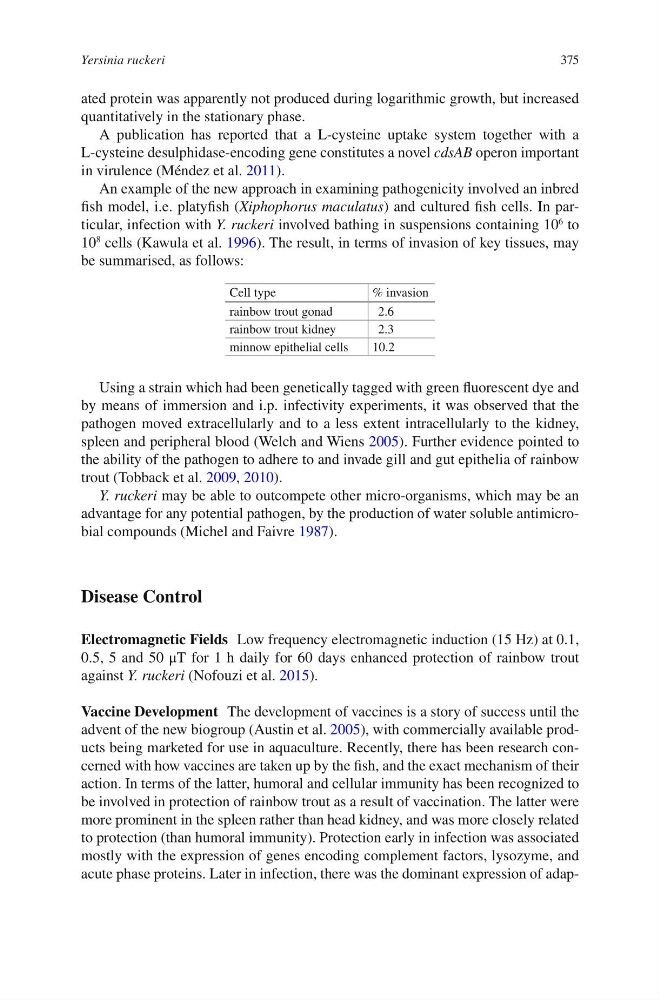
8 cells (Kawula et al. 1996 ). The result, in terms of invasion of key tissues, may
be summarised, as follows:
Cell type
% invasion
rainbow trout gonad
2.6
rainbow trout kidney
2.3
minnow epithelial cells
10.2
Using a strain which had been genetically tagged with green fl uorescent dye and
by means of immersion and i.p. infectivity experiments, it was observed that the
pathogen moved extracellularly and to a less extent intracellularly to the kidney,
spleen and peripheral blood (Welch and Wiens 2005 ). Further evidence pointed to
the ability of the pathogen to adhere to and invade gill and gut epithelia of rainbow
trout (Tobback et al. 2009 , 2010 ).
Y. ruckeri may be able to outcompete other micro-organisms, which may be an
advantage for any potential pathogen, by the production of water soluble antimicrobial compounds (Michel and Faivre 1987 ).
Disease Control
Electromagnetic Fields Low frequency electromagnetic induction (15 Hz) at 0.1,
0.5, 5 and 50 μT for 1 h daily for 60 days enhanced protection of rainbow trout
against Y. ruckeri (Nofouzi et al. 2015 ).
Vaccine Development The development of vaccines is a story of success until the
advent of the new biogroup (Austin et al. 2005 ), with commercially available products being marketed for use in aquaculture. Recently, there has been research concerned with how vaccines are taken up by the fi sh, and the exact mechanism of their
action. In terms of the latter, humoral and cellular immunity has been recognized to
be involved in protection of rainbow trout as a result of vaccination. The latter were
more prominent in the spleen rather than head kidney, and was more closely related
to protection (than humoral immunity). Protection early in infection was associated
mostly with the expression of genes encoding complement factors, lysozyme, and
acute phase proteins. Later in infection, there was the dominant expression of adapYersinia ruckeri
ated protein was apparently not produced during logarithmic growth, but increased
quantitatively in the stationary phase.
A publication has reported that a L-cysteine uptake system together with a
L-cysteine desulphidase-encoding gene constitutes a novel cdsAB operon important
in virulence (Méndez et al. 2011 ).
An example of the new approach in examining pathogenicity involved an inbred
fi sh model, i.e. platyfi sh ( Xiphophorus maculatus ) and cultured fi sh cells. In particular, infection with Y. ruckeri involved bathing in suspensions containing 10
6 to
10
8 cells (Kawula et al. 1996 ). The result, in terms of invasion of key tissues, may
be summarised, as follows:
Cell type
% invasion
rainbow trout gonad
2.6
rainbow trout kidney
2.3
minnow epithelial cells
10.2
Using a strain which had been genetically tagged with green fl uorescent dye and
by means of immersion and i.p. infectivity experiments, it was observed that the
pathogen moved extracellularly and to a less extent intracellularly to the kidney,
spleen and peripheral blood (Welch and Wiens 2005 ). Further evidence pointed to
the ability of the pathogen to adhere to and invade gill and gut epithelia of rainbow
trout (Tobback et al. 2009 , 2010 ).
Y. ruckeri may be able to outcompete other micro-organisms, which may be an
advantage for any potential pathogen, by the production of water soluble antimicrobial compounds (Michel and Faivre 1987 ).
Disease Control
Electromagnetic Fields Low frequency electromagnetic induction (15 Hz) at 0.1,
0.5, 5 and 50 μT for 1 h daily for 60 days enhanced protection of rainbow trout
against Y. ruckeri (Nofouzi et al. 2015 ).
Vaccine Development The development of vaccines is a story of success until the
advent of the new biogroup (Austin et al. 2005 ), with commercially available products being marketed for use in aquaculture. Recently, there has been research concerned with how vaccines are taken up by the fi sh, and the exact mechanism of their
action. In terms of the latter, humoral and cellular immunity has been recognized to
be involved in protection of rainbow trout as a result of vaccination. The latter were
more prominent in the spleen rather than head kidney, and was more closely related
to protection (than humoral immunity). Protection early in infection was associated
mostly with the expression of genes encoding complement factors, lysozyme, and
acute phase proteins. Later in infection, there was the dominant expression of adapYersinia ruckeri