

362
americanicus ) from the Black river, a tributary of Chesapeake Bay (USA), a redpigmented organism, i.e. Ser. marcescens, was recovered, and, on subsequent examination, deemed to be potentially pathogenic for fi sh. It was considered likely that
the presence of the organisms refl ected the polluted nature of the river (Baya et al.
1992 ). However, it should be emphasised that the organisms were recovered only
from apparently healthy fi sh, which were devoid of overt signs of disease (Baya
et al. 1992 ).
Isolation
Pure cultures resulted from inoculation of kidney swabs onto plates of BHIA and
TSA with incubation at 22 °C for 48–72 h (Baya et al. 1992 ).
Characteristics of the Pathogen
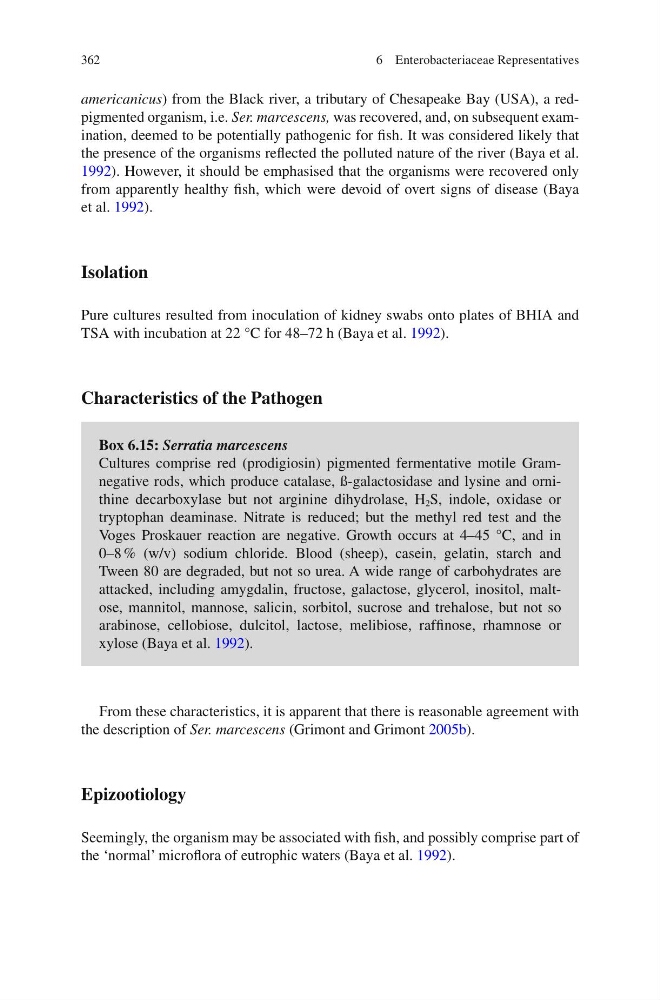
From these characteristics, it is apparent that there is reasonable agreement with
the description of Ser. marcescens (Grimont and Grimont 2005b ).
Epizootiology
Seemingly, the organism may be associated with fi sh, and possibly comprise part of
the ‘normal’ microfl ora of eutrophic waters (Baya et al. 1992 ).
Box 6.15: Serratia marcescens
Cultures comprise red (prodigiosin) pigmented fermentative motile Gramnegative rods, which produce catalase, ß-galactosidase and lysine and ornithine decarboxylase but not arginine dihydrolase, H 2 S, indole, oxidase or
tryptophan deaminase. Nitrate is reduced; but the methyl red test and the
Voges Proskauer reaction are negative. Growth occurs at 4–45 °C, and in
0–8 % (w/v) sodium chloride. Blood (sheep), casein, gelatin, starch and
Tween 80 are degraded, but not so urea. A wide range of carbohydrates are
attacked, including amygdalin, fructose, galactose, glycerol, inositol, maltose, mannitol, mannose, salicin, sorbitol, sucrose and trehalose, but not so
arabinose, cellobiose, dulcitol, lactose, melibiose, raffi nose, rhamnose or
xylose (Baya et al. 1992 ).
6 Enterobacteriaceae Representatives
americanicus ) from the Black river, a tributary of Chesapeake Bay (USA), a redpigmented organism, i.e. Ser. marcescens, was recovered, and, on subsequent examination, deemed to be potentially pathogenic for fi sh. It was considered likely that
the presence of the organisms refl ected the polluted nature of the river (Baya et al.
1992 ). However, it should be emphasised that the organisms were recovered only
from apparently healthy fi sh, which were devoid of overt signs of disease (Baya
et al. 1992 ).
Isolation
Pure cultures resulted from inoculation of kidney swabs onto plates of BHIA and
TSA with incubation at 22 °C for 48–72 h (Baya et al. 1992 ).
Characteristics of the Pathogen
From these characteristics, it is apparent that there is reasonable agreement with
the description of Ser. marcescens (Grimont and Grimont 2005b ).
Epizootiology
Seemingly, the organism may be associated with fi sh, and possibly comprise part of
the ‘normal’ microfl ora of eutrophic waters (Baya et al. 1992 ).
Box 6.15: Serratia marcescens
Cultures comprise red (prodigiosin) pigmented fermentative motile Gramnegative rods, which produce catalase, ß-galactosidase and lysine and ornithine decarboxylase but not arginine dihydrolase, H 2 S, indole, oxidase or
tryptophan deaminase. Nitrate is reduced; but the methyl red test and the
Voges Proskauer reaction are negative. Growth occurs at 4–45 °C, and in
0–8 % (w/v) sodium chloride. Blood (sheep), casein, gelatin, starch and
Tween 80 are degraded, but not so urea. A wide range of carbohydrates are
attacked, including amygdalin, fructose, galactose, glycerol, inositol, maltose, mannitol, mannose, salicin, sorbitol, sucrose and trehalose, but not so
arabinose, cellobiose, dulcitol, lactose, melibiose, raffi nose, rhamnose or
xylose (Baya et al. 1992 ).
6 Enterobacteriaceae Representatives