

258
monicida to penetrate fi sh tissues (invasiveness), a pre-requisite for the occurrence
of infection. Transmission by contaminated water was tested by McCarthy ( 1980 )
in laboratory-based experiments by seeding water in a tank containing six brown
trout with a suspension of Aer. salmonicida to a fi nal concentration of 10
6 cells/ml.
Five of the six fi sh died of furunculosis, and the sixth succumbed when given an
injection of prednisolone acetate. In a subsequent large-scale experiment using 50
brown trout placed in a pond on a fi sh farm experiencing a summer epizootic of
furunculosis, 41 fi sh had died within 28 days, and the remaining 9 succumbed after
injection with corticosteroid. McCarthy ( 1980 ) concluded from these experiments
that the disease is readily disseminated through water and also that brown trout
surviving infection probably become carriers. However, both Blake and Clark
( 1931 ) and McCarthy ( 1980 ) reported failure in attempts to infect rainbow trout by
co-habitation with infected brown trout or the addition of Aer. salmonicida, respectively. It is known that rainbow trout are more resistant to the disease than are brown
trout. In experiments, which examined different routes of exposure to Aer. salmonicida subsp. salmonicida in Atlantic salmon in seawater, Rose et al. ( 1989 ) noted that
a minimum dose of 10
4 colony forming units/ml by bath was required to initiate
infection.
Aeromonas salmonicida – Uptake Into Fish Another unresolved aspect of the
transmission of furunculosis is the uptake of Aer. salmonicida into a fi sh host. It is
possible that the pathogen may gain entry to a new host through the gills, lateral
line, mouth, anus or a surface injury (e.g. Effendi and Austin 1995b ). McCarthy
( 1980 ) demonstrated that rainbow trout that resisted the disease subsequently died
from furunculosis after their fl anks had been abraded with sandpaper. Also, Lund
( 1967 ) found that infection was acquired by fi sh, that had been scarifi ed and experimentally challenged with the pathogen. However, these injuries were artifi cially
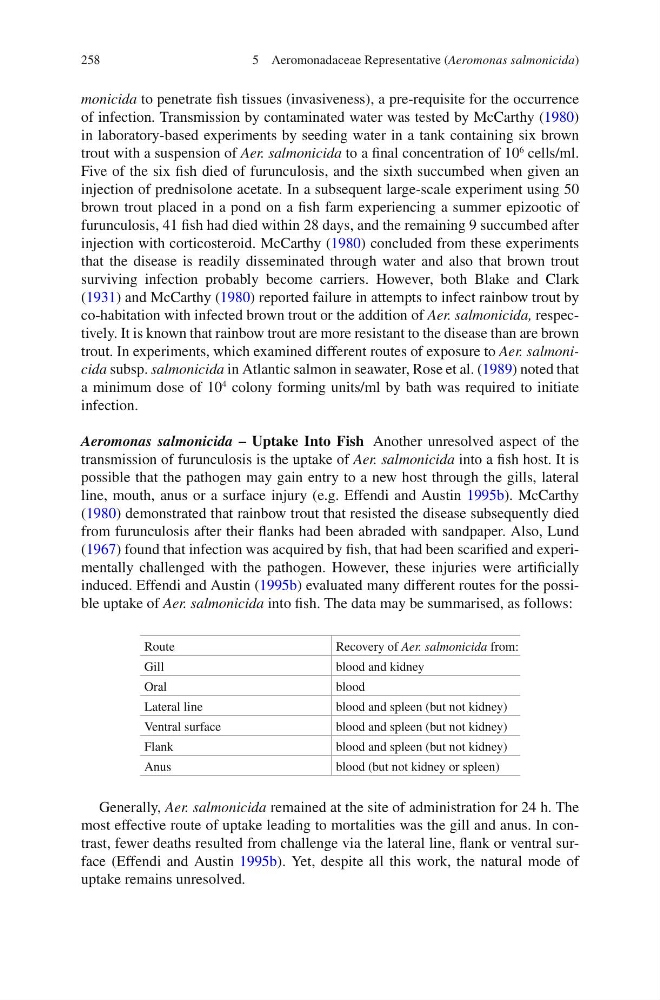
induced. Effendi and Austin ( 1995b ) evaluated many different routes for the possible uptake of Aer. salmonicida into fi sh. The data may be summarised, as follows:
Route
Recovery of Aer. salmonicida from:
Gill
blood and kidney
Oral
blood
Lateral line
blood and spleen (but not kidney)
Ventral surface
blood and spleen (but not kidney)
Flank
blood and spleen (but not kidney)
Anus
blood (but not kidney or spleen)
Generally, Aer. salmonicida remained at the site of administration for 24 h. The
most effective route of uptake leading to mortalities was the gill and anus. In contrast, fewer deaths resulted from challenge via the lateral line, fl ank or ventral surface (Effendi and Austin 1995b ). Yet, despite all this work, the natural mode of
uptake remains unresolved.
5 Aeromonadaceae Representative (Aeromonas salmonicida)
monicida to penetrate fi sh tissues (invasiveness), a pre-requisite for the occurrence
of infection. Transmission by contaminated water was tested by McCarthy ( 1980 )
in laboratory-based experiments by seeding water in a tank containing six brown
trout with a suspension of Aer. salmonicida to a fi nal concentration of 10
6 cells/ml.
Five of the six fi sh died of furunculosis, and the sixth succumbed when given an
injection of prednisolone acetate. In a subsequent large-scale experiment using 50
brown trout placed in a pond on a fi sh farm experiencing a summer epizootic of
furunculosis, 41 fi sh had died within 28 days, and the remaining 9 succumbed after
injection with corticosteroid. McCarthy ( 1980 ) concluded from these experiments
that the disease is readily disseminated through water and also that brown trout
surviving infection probably become carriers. However, both Blake and Clark
( 1931 ) and McCarthy ( 1980 ) reported failure in attempts to infect rainbow trout by
co-habitation with infected brown trout or the addition of Aer. salmonicida, respectively. It is known that rainbow trout are more resistant to the disease than are brown
trout. In experiments, which examined different routes of exposure to Aer. salmonicida subsp. salmonicida in Atlantic salmon in seawater, Rose et al. ( 1989 ) noted that
a minimum dose of 10
4 colony forming units/ml by bath was required to initiate
infection.
Aeromonas salmonicida – Uptake Into Fish Another unresolved aspect of the
transmission of furunculosis is the uptake of Aer. salmonicida into a fi sh host. It is
possible that the pathogen may gain entry to a new host through the gills, lateral
line, mouth, anus or a surface injury (e.g. Effendi and Austin 1995b ). McCarthy
( 1980 ) demonstrated that rainbow trout that resisted the disease subsequently died
from furunculosis after their fl anks had been abraded with sandpaper. Also, Lund
( 1967 ) found that infection was acquired by fi sh, that had been scarifi ed and experimentally challenged with the pathogen. However, these injuries were artifi cially
induced. Effendi and Austin ( 1995b ) evaluated many different routes for the possible uptake of Aer. salmonicida into fi sh. The data may be summarised, as follows:
Route
Recovery of Aer. salmonicida from:
Gill
blood and kidney
Oral
blood
Lateral line
blood and spleen (but not kidney)
Ventral surface
blood and spleen (but not kidney)
Flank
blood and spleen (but not kidney)
Anus
blood (but not kidney or spleen)
Generally, Aer. salmonicida remained at the site of administration for 24 h. The
most effective route of uptake leading to mortalities was the gill and anus. In contrast, fewer deaths resulted from challenge via the lateral line, fl ank or ventral surface (Effendi and Austin 1995b ). Yet, despite all this work, the natural mode of
uptake remains unresolved.
5 Aeromonadaceae Representative (Aeromonas salmonicida)