

232
atypical isolates ( Aer. salmonicida ) from non-salmonids, and the fourth group was
equated with Aer. hydrophila. Not surprisingly, the typical isolates of Aer. salmonicida formed an extremely compact group, which could not be readily differentiated
from the atypical strains. However, the results of numerical phenotypic analyses
were not unequivocally confi rmed by G + C ratio determinations or DNA:DNA
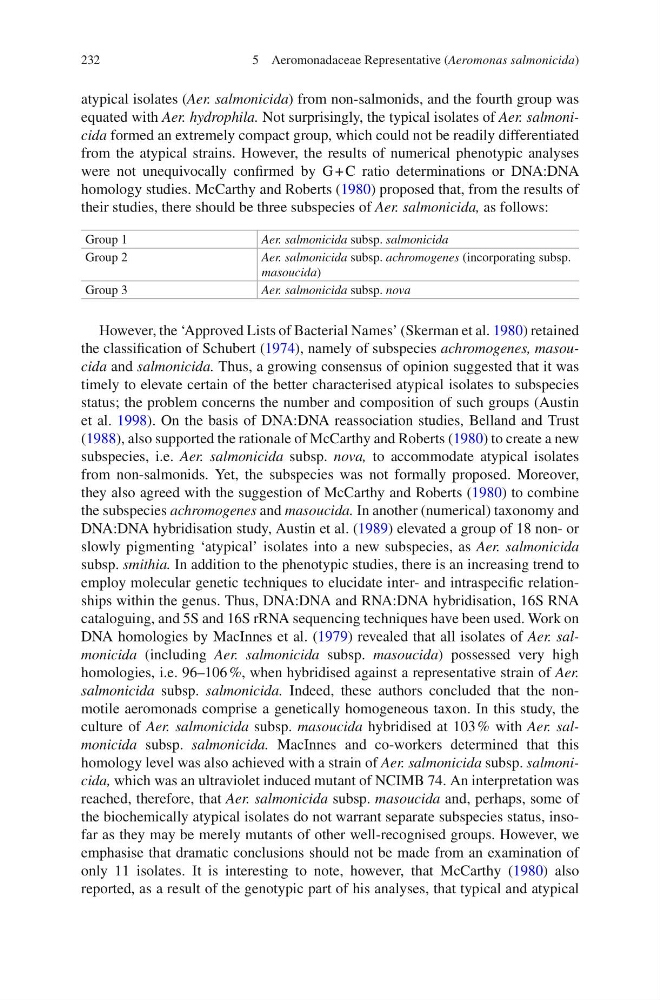
homology studies. McCarthy and Roberts ( 1980 ) proposed that, from the results of
their studies, there should be three subspecies of Aer. salmonicida, as follows:
Group 1
Aer. salmonicida subsp. salmonicida
Group 2
Aer. salmonicida subsp. achromogenes (incorporating subsp.
masoucida )
Group 3
Aer. salmonicida subsp. nova
However, the ‘Approved Lists of Bacterial Names’ (Skerman et al. 1980 ) retained
the classifi cation of Schubert ( 1974 ), namely of subspecies achromogenes, masoucida and salmonicida. Thus, a growing consensus of opinion suggested that it was
timely to elevate certain of the better characterised atypical isolates to subspecies
status; the problem concerns the number and composition of such groups (Austin
et al. 1998 ). On the basis of DNA:DNA reassociation studies, Belland and Trust
( 1988 ), also supported the rationale of McCarthy and Roberts ( 1980 ) to create a new
subspecies, i.e. Aer. salmonicida subsp. nova, to accommodate atypical isolates
from non-salmonids. Yet, the subspecies was not formally proposed. Moreover,
they also agreed with the suggestion of McCarthy and Roberts ( 1980 ) to combine
the subspecies achromogenes and masoucida. In another (numerical) taxonomy and
DNA:DNA hybridisation study, Austin et al. ( 1989 ) elevated a group of 18 non- or
slowly pigmenting ‘atypical’ isolates into a new subspecies, as Aer. salmonicida
subsp. smithia. In addition to the phenotypic studies, there is an increasing trend to
employ molecular genetic techniques to elucidate inter- and intraspecifi c relationships within the genus. Thus, DNA:DNA and RNA:DNA hybridisation, 16S RNA
cataloguing, and 5S and 16S rRNA sequencing techniques have been used. Work on
DNA homologies by MacInnes et al. ( 1979 ) revealed that all isolates of Aer. salmonicida (including Aer. salmonicida subsp. masoucida ) possessed very high
homologies, i.e. 96–106 %, when hybridised against a representative strain of Aer.
salmonicida subsp. salmonicida. Indeed, these authors concluded that the nonmotile aeromonads comprise a genetically homogeneous taxon. In this study, the
culture of Aer. salmonicida subsp. masoucida hybridised at 103 % with Aer. salmonicida subsp. salmonicida. MacInnes and co-workers determined that this
homology level was also achieved with a strain of Aer. salmonicida subsp. salmonicida, which was an ultraviolet induced mutant of NCIMB 74. An interpretation was
reached, therefore, that Aer. salmonicida subsp. masoucida and, perhaps, some of
the biochemically atypical isolates do not warrant separate subspecies status, insofar as they may be merely mutants of other well-recognised groups. However, we
emphasise that dramatic conclusions should not be made from an examination of
only 11 isolates. It is interesting to note, however, that McCarthy ( 1980 ) also
reported, as a result of the genotypic part of his analyses, that typical and atypical
5 Aeromonadaceae Representative (Aeromonas salmonicida)
atypical isolates ( Aer. salmonicida ) from non-salmonids, and the fourth group was
equated with Aer. hydrophila. Not surprisingly, the typical isolates of Aer. salmonicida formed an extremely compact group, which could not be readily differentiated
from the atypical strains. However, the results of numerical phenotypic analyses
were not unequivocally confi rmed by G + C ratio determinations or DNA:DNA
homology studies. McCarthy and Roberts ( 1980 ) proposed that, from the results of
their studies, there should be three subspecies of Aer. salmonicida, as follows:
Group 1
Aer. salmonicida subsp. salmonicida
Group 2
Aer. salmonicida subsp. achromogenes (incorporating subsp.
masoucida )
Group 3
Aer. salmonicida subsp. nova
However, the ‘Approved Lists of Bacterial Names’ (Skerman et al. 1980 ) retained
the classifi cation of Schubert ( 1974 ), namely of subspecies achromogenes, masoucida and salmonicida. Thus, a growing consensus of opinion suggested that it was
timely to elevate certain of the better characterised atypical isolates to subspecies
status; the problem concerns the number and composition of such groups (Austin
et al. 1998 ). On the basis of DNA:DNA reassociation studies, Belland and Trust
( 1988 ), also supported the rationale of McCarthy and Roberts ( 1980 ) to create a new
subspecies, i.e. Aer. salmonicida subsp. nova, to accommodate atypical isolates
from non-salmonids. Yet, the subspecies was not formally proposed. Moreover,
they also agreed with the suggestion of McCarthy and Roberts ( 1980 ) to combine
the subspecies achromogenes and masoucida. In another (numerical) taxonomy and
DNA:DNA hybridisation study, Austin et al. ( 1989 ) elevated a group of 18 non- or
slowly pigmenting ‘atypical’ isolates into a new subspecies, as Aer. salmonicida
subsp. smithia. In addition to the phenotypic studies, there is an increasing trend to
employ molecular genetic techniques to elucidate inter- and intraspecifi c relationships within the genus. Thus, DNA:DNA and RNA:DNA hybridisation, 16S RNA
cataloguing, and 5S and 16S rRNA sequencing techniques have been used. Work on
DNA homologies by MacInnes et al. ( 1979 ) revealed that all isolates of Aer. salmonicida (including Aer. salmonicida subsp. masoucida ) possessed very high
homologies, i.e. 96–106 %, when hybridised against a representative strain of Aer.
salmonicida subsp. salmonicida. Indeed, these authors concluded that the nonmotile aeromonads comprise a genetically homogeneous taxon. In this study, the
culture of Aer. salmonicida subsp. masoucida hybridised at 103 % with Aer. salmonicida subsp. salmonicida. MacInnes and co-workers determined that this
homology level was also achieved with a strain of Aer. salmonicida subsp. salmonicida, which was an ultraviolet induced mutant of NCIMB 74. An interpretation was
reached, therefore, that Aer. salmonicida subsp. masoucida and, perhaps, some of
the biochemically atypical isolates do not warrant separate subspecies status, insofar as they may be merely mutants of other well-recognised groups. However, we
emphasise that dramatic conclusions should not be made from an examination of
only 11 isolates. It is interesting to note, however, that McCarthy ( 1980 ) also
reported, as a result of the genotypic part of his analyses, that typical and atypical
5 Aeromonadaceae Representative (Aeromonas salmonicida)