

229
nostic feature of Aer. salmonicida (Martin-Carnahan and Joseph 2005 ), caution is
advised against relying too heavily on the presence of pigment, insofar as there are
variations among pigmented strains in the quantity of compound produced and of
the time needed for its appearance (Horne 1928 ; Mackie and Menzies 1938 ). In
addition, non-pigmented variants may arise (Wiklund et al. 1993 ), particularly upon
subculture (Duff and Stewart 1933 ; Evelyn 1971a ). It has also been observed that
other Aeromonas species, namely Aer. hydrophila and Aer. media, may produce
such pigments when grown on media containing tryptone (see Paterson 1974 ; Allen
et al. 1983a ). Obviously, this questions the reliability of using pigment production
as a differential characteristic. To further complicate the issue, the existence of
achromogenic or slowly pigmenting strains of Aer. salmonicida have been described.
Another intriguing trait of Aer. salmonicida is the ability to dissociate into different colony types, i.e. rough, smooth and G-phase (intermediate) colonies. This phenomenon was extensively studied by Duff ( 1937 ), and will be discussed further in
connection with its relevance to pathogenicity. Electron microscopy demonstrated
that ‘rough’ and ‘smooth’ forms were attributed to the presence or absence of an
extracellular layer (= the A-layer), respectively.
The notion of homogeneity could be dispelled by the results of PFGE of 44 isolates of Aer. salmonicida subsp. salmonicida, which generated 30 different profi les
and 40 distinct types (Chomarat et al. 1998 ). However, numerical analysis using the
S D coeffi cient revealed that all the isolates were genomically related (Chomarat
et al. 1998 ). Yet using 17 typical, 39 atypical and three type strains, RAPD and
PFGE analyses suggested heterogeneity across all the strain – notably atypical isolates-, but confi rmed that typical Aer. salmonicida (including the type strain of Aer.
salmonicida subsp. salmonicida ) was homogeneous (O’hici et al. 2000 ).
The genomes of two isolates, A449 (4.7 Mb) and 01-B526 (4.75 Mb), have been
sequenced, and the latter found to have a large plasmid, pAsa5, of 155 kb and three
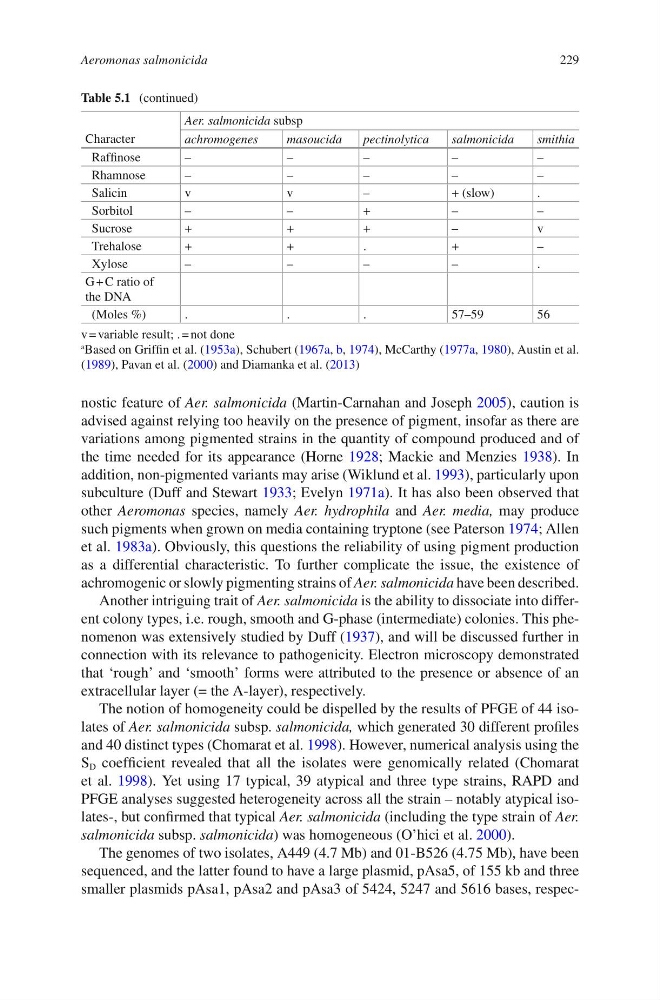
smaller plasmids pAsa1, pAsa2 and pAsa3 of 5424, 5247 and 5616 bases, respecTable 5.1 (continued)
Aer. salmonicida subsp
Character
achromogenes
masoucida
pectinolytica
salmonicida
smithia
Raffi nose
–
–
–
–
–
Rhamnose
–
–
–
–
–
Salicin
v
v
–
+ (slow)
.
Sorbitol
–
–
+
–
–
Sucrose
+
+
+
–
v
Trehalose
+
+
.
+
–
Xylose
–
–
–
–
.
G + C ratio of
the DNA
(Moles %)
.
.
.
57–59
56
v = variable result; . = not done
a
Based on Griffi n et al. ( 1953a ), Schubert ( 1967a , b , 1974 ), McCarthy ( 1977a , 1980 ), Austin et al.
( 1989 ), Pavan et al. ( 2000 ) and Diamanka et al. ( 2013 )
Aeromonas salmonicida
nostic feature of Aer. salmonicida (Martin-Carnahan and Joseph 2005 ), caution is
advised against relying too heavily on the presence of pigment, insofar as there are
variations among pigmented strains in the quantity of compound produced and of
the time needed for its appearance (Horne 1928 ; Mackie and Menzies 1938 ). In
addition, non-pigmented variants may arise (Wiklund et al. 1993 ), particularly upon
subculture (Duff and Stewart 1933 ; Evelyn 1971a ). It has also been observed that
other Aeromonas species, namely Aer. hydrophila and Aer. media, may produce
such pigments when grown on media containing tryptone (see Paterson 1974 ; Allen
et al. 1983a ). Obviously, this questions the reliability of using pigment production
as a differential characteristic. To further complicate the issue, the existence of
achromogenic or slowly pigmenting strains of Aer. salmonicida have been described.
Another intriguing trait of Aer. salmonicida is the ability to dissociate into different colony types, i.e. rough, smooth and G-phase (intermediate) colonies. This phenomenon was extensively studied by Duff ( 1937 ), and will be discussed further in
connection with its relevance to pathogenicity. Electron microscopy demonstrated
that ‘rough’ and ‘smooth’ forms were attributed to the presence or absence of an
extracellular layer (= the A-layer), respectively.
The notion of homogeneity could be dispelled by the results of PFGE of 44 isolates of Aer. salmonicida subsp. salmonicida, which generated 30 different profi les
and 40 distinct types (Chomarat et al. 1998 ). However, numerical analysis using the
S D coeffi cient revealed that all the isolates were genomically related (Chomarat
et al. 1998 ). Yet using 17 typical, 39 atypical and three type strains, RAPD and
PFGE analyses suggested heterogeneity across all the strain – notably atypical isolates-, but confi rmed that typical Aer. salmonicida (including the type strain of Aer.
salmonicida subsp. salmonicida ) was homogeneous (O’hici et al. 2000 ).
The genomes of two isolates, A449 (4.7 Mb) and 01-B526 (4.75 Mb), have been
sequenced, and the latter found to have a large plasmid, pAsa5, of 155 kb and three
smaller plasmids pAsa1, pAsa2 and pAsa3 of 5424, 5247 and 5616 bases, respecTable 5.1 (continued)
Aer. salmonicida subsp
Character
achromogenes
masoucida
pectinolytica
salmonicida
smithia
Raffi nose
–
–
–
–
–
Rhamnose
–
–
–
–
–
Salicin
v
v
–
+ (slow)
.
Sorbitol
–
–
+
–
–
Sucrose
+
+
+
–
v
Trehalose
+
+
.
+
–
Xylose
–
–
–
–
.
G + C ratio of
the DNA
(Moles %)
.
.
.
57–59
56
v = variable result; . = not done
a
Based on Griffi n et al. ( 1953a ), Schubert ( 1967a , b , 1974 ), McCarthy ( 1977a , 1980 ), Austin et al.
( 1989 ), Pavan et al. ( 2000 ) and Diamanka et al. ( 2013 )
Aeromonas salmonicida