

216
form to the classical furunculosis, and, the causal agent is often regarded as
‘atypical’.
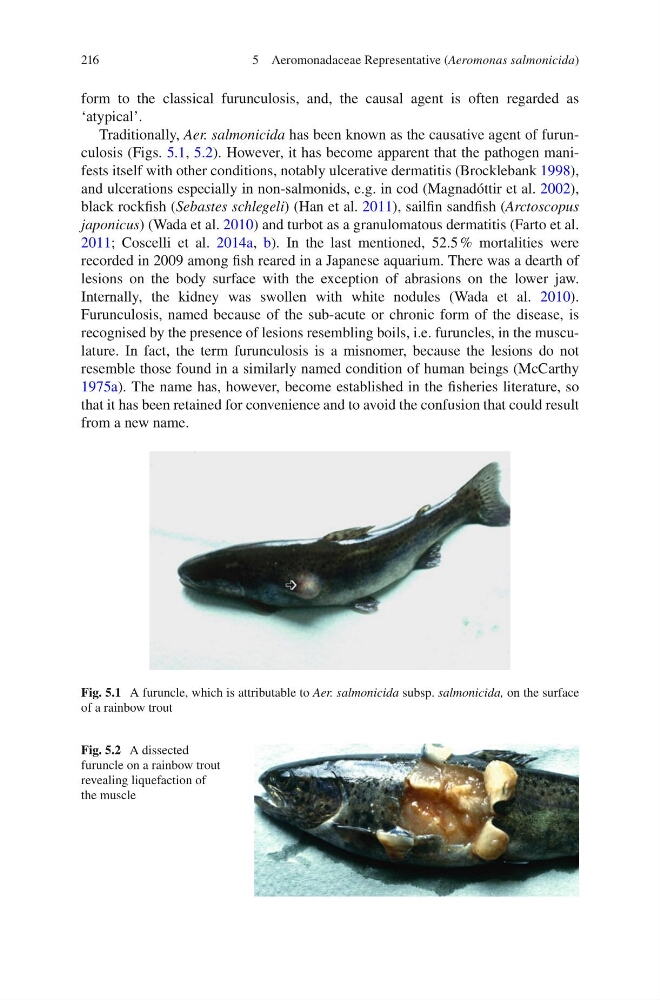
Traditionally, Aer. salmonicida has been known as the causative agent of furunculosis (Figs. 5.1 , 5.2 ). However, it has become apparent that the pathogen manifests itself with other conditions, notably ulcerative dermatitis (Brocklebank 1998 ),
and ulcerations especially in non-salmonids, e.g. in cod (Magnadóttir et al. 2002 ),
black rockfi sh ( Sebastes schlegeli ) (Han et al. 2011 ), sailfi n sandfi sh ( Arctoscopus
japonicus ) (Wada et al. 2010 ) and turbot as a granulomatous dermatitis (Farto et al.
2011 ; Coscelli et al. 2014a , b ). In the last mentioned, 52.5 % mortalities were
recorded in 2009 among fi sh reared in a Japanese aquarium. There was a dearth of
lesions on the body surface with the exception of abrasions on the lower jaw.
Internally, the kidney was swollen with white nodules (Wada et al. 2010 ).
Furunculosis, named because of the sub-acute or chronic form of the disease, is
recognised by the presence of lesions resembling boils, i.e. furuncles, in the musculature. In fact, the term furunculosis is a misnomer, because the lesions do not
resemble those found in a similarly named condition of human beings (McCarthy
1975a ). The name has, however, become established in the fi sheries literature, so
that it has been retained for convenience and to avoid the confusion that could result
from a new name.
Fig. 5.1 A furuncle, which is attributable to Aer. salmonicida subsp. salmonicida, on the surface
of a rainbow trout
Fig. 5.2 A dissected
furuncle on a rainbow trout
revealing liquefaction of
the muscle
5 Aeromonadaceae Representative (Aeromonas salmonicida)
form to the classical furunculosis, and, the causal agent is often regarded as
‘atypical’.
Traditionally, Aer. salmonicida has been known as the causative agent of furunculosis (Figs. 5.1 , 5.2 ). However, it has become apparent that the pathogen manifests itself with other conditions, notably ulcerative dermatitis (Brocklebank 1998 ),
and ulcerations especially in non-salmonids, e.g. in cod (Magnadóttir et al. 2002 ),
black rockfi sh ( Sebastes schlegeli ) (Han et al. 2011 ), sailfi n sandfi sh ( Arctoscopus
japonicus ) (Wada et al. 2010 ) and turbot as a granulomatous dermatitis (Farto et al.
2011 ; Coscelli et al. 2014a , b ). In the last mentioned, 52.5 % mortalities were
recorded in 2009 among fi sh reared in a Japanese aquarium. There was a dearth of
lesions on the body surface with the exception of abrasions on the lower jaw.
Internally, the kidney was swollen with white nodules (Wada et al. 2010 ).
Furunculosis, named because of the sub-acute or chronic form of the disease, is
recognised by the presence of lesions resembling boils, i.e. furuncles, in the musculature. In fact, the term furunculosis is a misnomer, because the lesions do not
resemble those found in a similarly named condition of human beings (McCarthy
1975a ). The name has, however, become established in the fi sheries literature, so
that it has been retained for convenience and to avoid the confusion that could result
from a new name.
Fig. 5.1 A furuncle, which is attributable to Aer. salmonicida subsp. salmonicida, on the surface
of a rainbow trout
Fig. 5.2 A dissected
furuncle on a rainbow trout
revealing liquefaction of
the muscle
5 Aeromonadaceae Representative (Aeromonas salmonicida)