

171
the improvements in aeromonad taxonomy may refl ect the sudden emergence of
other taxa as fi sh pathogens. Certainly, there is marked phenotypic, serological and
genotypic heterogeneity within the descriptions of fi sh pathogenic Aer. hydrophila
(MacInnes et al. 1979 ; Leblanc et al. 1981 ; Allen et al. 1983a ).
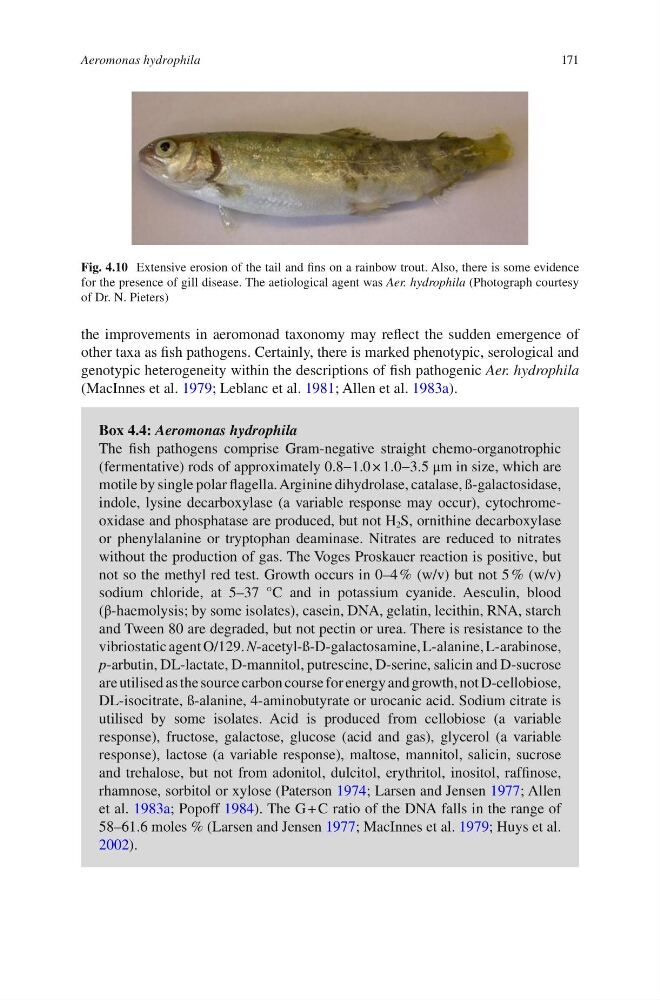
Fig. 4.10 Extensive erosion of the tail and fi ns on a rainbow trout. Also, there is some evidence
for the presence of gill disease. The aetiological agent was Aer. hydrophila (Photograph courtesy
of Dr. N. Pieters)
Box 4.4: Aeromonas hydrophila
The fi sh pathogens comprise Gram-negative straight chemo-organotrophic
(fermentative) rods of approximately 0.8−1.0 × 1.0−3.5 μm in size, which are
motile by single polar fl agella. Arginine dihydrolase, catalase, ß- galactosidase,
indole, lysine decarboxylase (a variable response may occur), cytochromeoxidase and phosphatase are produced, but not H 2 S, ornithine decarboxylase
or phenylalanine or tryptophan deaminase. Nitrates are reduced to nitrates
without the production of gas. The Voges Proskauer reaction is positive, but
not so the methyl red test. Growth occurs in 0–4 % (w/v) but not 5 % (w/v)
sodium chloride, at 5–37 °C and in potassium cyanide. Aesculin, blood
(β-haemolysis; by some isolates), casein, DNA, gelatin, lecithin, RNA, starch
and Tween 80 are degraded, but not pectin or urea. There is resistance to the
vibriostatic agent O/129. N -acetyl-ß-D-galactosamine, L-alanine, L-arabinose,
p -arbutin, DL-lactate, D-mannitol, putrescine, D-serine, salicin and D-sucrose
are utilised as the source carbon course for energy and growth, not D-cellobiose,
DL-isocitrate, ß-alanine, 4-aminobutyrate or urocanic acid. Sodium citrate is
utilised by some isolates. Acid is produced from cellobiose (a variable
response), fructose, galactose, glucose (acid and gas), glycerol (a variable
response), lactose (a variable response), maltose, mannitol, salicin, sucrose
and trehalose, but not from adonitol, dulcitol, erythritol, inositol, raffi nose,
rhamnose, sorbitol or xylose (Paterson 1974 ; Larsen and Jensen 1977 ; Allen
et al. 1983a ; Popoff 1984 ). The G + C ratio of the DNA falls in the range of
58–61.6 moles % (Larsen and Jensen 1977 ; MacInnes et al. 1979 ; Huys et al.
2002 ).
Aeromonas hydrophila
the improvements in aeromonad taxonomy may refl ect the sudden emergence of
other taxa as fi sh pathogens. Certainly, there is marked phenotypic, serological and
genotypic heterogeneity within the descriptions of fi sh pathogenic Aer. hydrophila
(MacInnes et al. 1979 ; Leblanc et al. 1981 ; Allen et al. 1983a ).
Fig. 4.10 Extensive erosion of the tail and fi ns on a rainbow trout. Also, there is some evidence
for the presence of gill disease. The aetiological agent was Aer. hydrophila (Photograph courtesy
of Dr. N. Pieters)
Box 4.4: Aeromonas hydrophila
The fi sh pathogens comprise Gram-negative straight chemo-organotrophic
(fermentative) rods of approximately 0.8−1.0 × 1.0−3.5 μm in size, which are
motile by single polar fl agella. Arginine dihydrolase, catalase, ß- galactosidase,
indole, lysine decarboxylase (a variable response may occur), cytochromeoxidase and phosphatase are produced, but not H 2 S, ornithine decarboxylase
or phenylalanine or tryptophan deaminase. Nitrates are reduced to nitrates
without the production of gas. The Voges Proskauer reaction is positive, but
not so the methyl red test. Growth occurs in 0–4 % (w/v) but not 5 % (w/v)
sodium chloride, at 5–37 °C and in potassium cyanide. Aesculin, blood
(β-haemolysis; by some isolates), casein, DNA, gelatin, lecithin, RNA, starch
and Tween 80 are degraded, but not pectin or urea. There is resistance to the
vibriostatic agent O/129. N -acetyl-ß-D-galactosamine, L-alanine, L-arabinose,
p -arbutin, DL-lactate, D-mannitol, putrescine, D-serine, salicin and D-sucrose
are utilised as the source carbon course for energy and growth, not D-cellobiose,
DL-isocitrate, ß-alanine, 4-aminobutyrate or urocanic acid. Sodium citrate is
utilised by some isolates. Acid is produced from cellobiose (a variable
response), fructose, galactose, glucose (acid and gas), glycerol (a variable
response), lactose (a variable response), maltose, mannitol, salicin, sucrose
and trehalose, but not from adonitol, dulcitol, erythritol, inositol, raffi nose,
rhamnose, sorbitol or xylose (Paterson 1974 ; Larsen and Jensen 1977 ; Allen
et al. 1983a ; Popoff 1984 ). The G + C ratio of the DNA falls in the range of
58–61.6 moles % (Larsen and Jensen 1977 ; MacInnes et al. 1979 ; Huys et al.
2002 ).
Aeromonas hydrophila