

126
month, with disease signs including yellow-white nodules of 0.1–0.2 cm in diameter
in the gills, heart, kidney, liver and spleen (Chen et al. 2000 ). In China, 35 % mortalities were reported within 30 days (Wang et al. 2007 ). The cumulative mortalities for
three striped tiger fi sh was 2.4 % within 2 months (Wang et al. 2009 ).
There has been some confusion between distinguishing infections caused by
Mycobacterium and Nocardia , the latter leading to nocardiosis. Thus it is often diffi cult to determine from largely histological reports the genus to which an acid-fast
pathogen belongs. Conroy and Valdez ( 1962 ) isolated tubercle bacilli from neon
fi sh ( Paracheirodon innesi), which were also pathogenic to paradise fi sh
( Macropodus opercularis) and three-spot gouramis ( Trichogaster trichopterus), but
not to goldfi sh. These organisms were subsequently identifi ed by Dr. R.E. Gordon
as Nocardia asteroides. A second species, Noc. kampachi, was described as a causal
agent of nocardiosis, in yellowtail farmed in Japan, by Kariya et al. ( 1968 ) and
Kubota et al. ( 1968 ). However, the name was not validated. Instead, Noc. seriolae
was formally proposed, as a causal agent of fi sh nocardiosis (Kudo et al. 1988 ).
Nocardia spp. (including Noc. asteroides) occur in freshwater and soil. With the
observation that Noc. kampachi grows in up to 4.5 % (w/v) sodium chloride, it was
suggested that the normal habitat is terrestrial or limnetic. Moreover, in survival
experiments, the organism remained viable in clean seawater for only a few days,
although in polluted conditions viability was considerably extended (Kariya et al.
1968 ). The inference, therefore, is that fi sh become infected from the natural environment. Presumably these diseased animals serve as a reservoir for further infection.
Isolation
Essentially, the same isolation methods as for mycobacteria, e.g. use of LöwensteinJensen medium, have been employed with Nocardia. The initial development of
colonies usually occurs within 21 days at 18–37 °C (Valdez and Conroy 1963 ;
Conroy 1964 ; Snieszko et al. 1964 ; Heuschmann-Brunner 1965; Campbell and
MacKelvie 1968 ; Ghittino and Penna 1968 ).
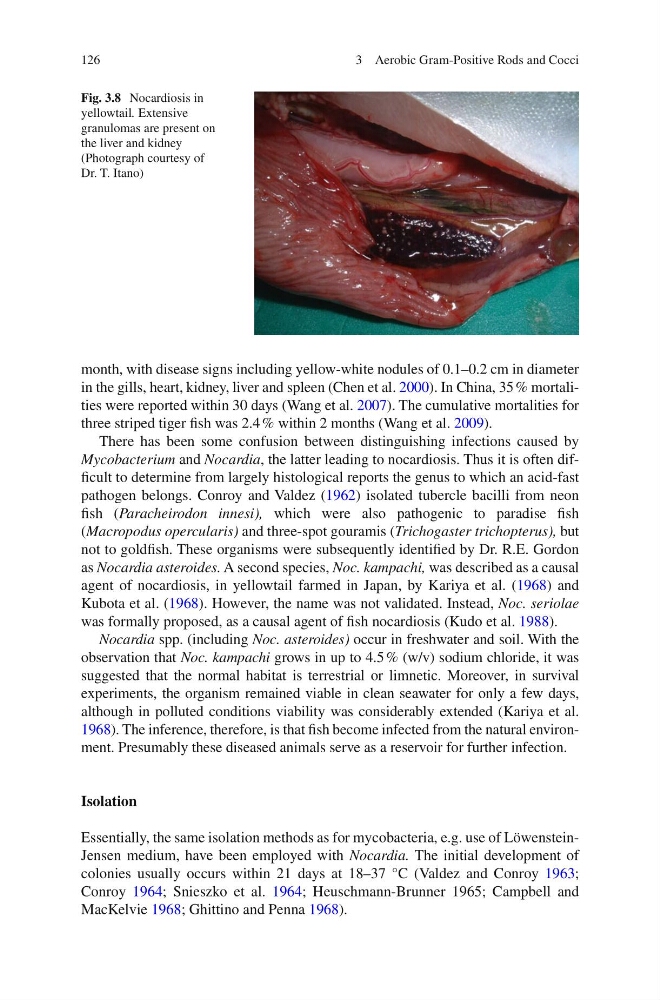
Fig. 3.8 Nocardiosis in
yellowtail . Extensive
granulomas are present on
the liver and kidney
(Photograph courtesy of
Dr. T. Itano)
3 Aerobic Gram-Positive Rods and Cocci
month, with disease signs including yellow-white nodules of 0.1–0.2 cm in diameter
in the gills, heart, kidney, liver and spleen (Chen et al. 2000 ). In China, 35 % mortalities were reported within 30 days (Wang et al. 2007 ). The cumulative mortalities for
three striped tiger fi sh was 2.4 % within 2 months (Wang et al. 2009 ).
There has been some confusion between distinguishing infections caused by
Mycobacterium and Nocardia , the latter leading to nocardiosis. Thus it is often diffi cult to determine from largely histological reports the genus to which an acid-fast
pathogen belongs. Conroy and Valdez ( 1962 ) isolated tubercle bacilli from neon
fi sh ( Paracheirodon innesi), which were also pathogenic to paradise fi sh
( Macropodus opercularis) and three-spot gouramis ( Trichogaster trichopterus), but
not to goldfi sh. These organisms were subsequently identifi ed by Dr. R.E. Gordon
as Nocardia asteroides. A second species, Noc. kampachi, was described as a causal
agent of nocardiosis, in yellowtail farmed in Japan, by Kariya et al. ( 1968 ) and
Kubota et al. ( 1968 ). However, the name was not validated. Instead, Noc. seriolae
was formally proposed, as a causal agent of fi sh nocardiosis (Kudo et al. 1988 ).
Nocardia spp. (including Noc. asteroides) occur in freshwater and soil. With the
observation that Noc. kampachi grows in up to 4.5 % (w/v) sodium chloride, it was
suggested that the normal habitat is terrestrial or limnetic. Moreover, in survival
experiments, the organism remained viable in clean seawater for only a few days,
although in polluted conditions viability was considerably extended (Kariya et al.
1968 ). The inference, therefore, is that fi sh become infected from the natural environment. Presumably these diseased animals serve as a reservoir for further infection.
Isolation
Essentially, the same isolation methods as for mycobacteria, e.g. use of LöwensteinJensen medium, have been employed with Nocardia. The initial development of
colonies usually occurs within 21 days at 18–37 °C (Valdez and Conroy 1963 ;
Conroy 1964 ; Snieszko et al. 1964 ; Heuschmann-Brunner 1965; Campbell and
MacKelvie 1968 ; Ghittino and Penna 1968 ).
Fig. 3.8 Nocardiosis in
yellowtail . Extensive
granulomas are present on
the liver and kidney
(Photograph courtesy of
Dr. T. Itano)
3 Aerobic Gram-Positive Rods and Cocci