

119
neoaurum has been recovered as mixed culture growth from Atlantic salmon with
ocular lesions (Backman et al. 1990 ). Additional groups have been found in granulomatous ornamental fi sh, and include Myc. gordonae, Myc. triviale and Myc. avium
subsp. hominissuis (Novotny et al. 2010 ). Myc. fortuitum, Myc. gordonae and Myc.
chelonae were identifi ed from granulomatous ornamental fi sh in India (Shukla et al.
2013 ). Myc. fortuitum, Myc. marinum and Myc. smegmatis were found in diseased
ornamental fi sh in Iran (Nofouzi et al. 2013 ). Myc. avium was associated with granulomas in a captive epaulette shark ( Hemiscyllium ocellatum ) (Janse and Kik 2012 ).
Unspeciated Mycobacterium have also been reported by Kusuda et al. ( 1987 ;
Gauthier et al. 2011b ). Also, possible new species have been found (e.g. Heckert
et al. 2001 ).
Historically, the descriptions of fi sh pathogenic mycobacteria have been often
poor (e.g. Gomez et al. 1993 ; Hatai et al. 1993 ), with many publications based on
purely morphological descriptions, which have resulted from the examination of
histological sections. It has been established that the pathogens are Gram-positive,
acid-fast, non-motile, pleomorphic rods of approximately 1.5–2.0 × 0.25–0.35 μm
in size (Dulin 1979 ). They produce pale-cream to yellow/orange colonies on solid
media. The optimum temperature for growth is 25 °C, although some isolates grow
well at 37 °C. From these descriptions and a lack of molecular genetic data, it is
diffi cult to determine whether the isolates belong in Mycobacterium or Nocardia.
Conceivably the problem arises from the inherent diffi culty in isolating the organisms, and a lack of interest among workers. Of the nomenspecies listed above, it is
relevant to note that the taxonomic validity of Myc. piscium is in doubt (Van Duijn
1981 ), Myc. anabanti and Myc. platypoecilus are regarded as synonyms of Myc.
marinum (Van Duijn 1981 ), and the slow-growing Myc. salmoniphilum was regarded
as synonymous with Myc. fortuitum (Gordon and Mihm 1959 ), although the name
has been subsequently revived, and is regarded as closely related to Myc. chelonae
(Whipps et al. 2007 ). Therefore, from the early literature, it would appear that Myc.
fortuitum and Myc. marinum were the only bona fi de species of fi sh pathogenic
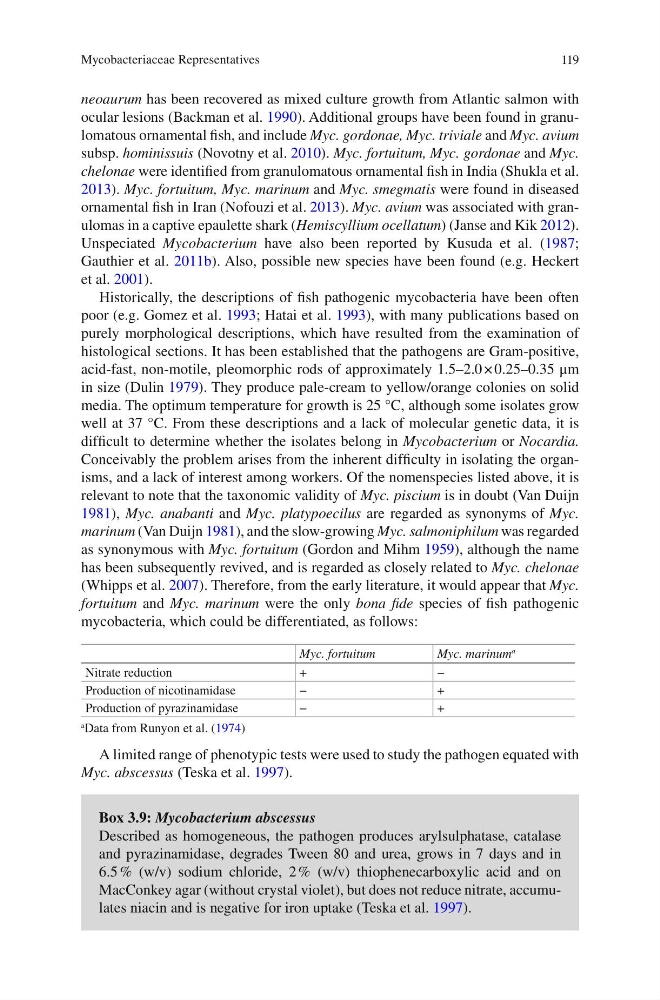
mycobacteria, which could be differentiated, as follows:
Myc. fortuitum
Myc. marinum
a
Nitrate reduction
+
−
Production of nicotinamidase
−
+
Production of pyrazinamidase
−
+
a
Data from Runyon et al. ( 1974 )
A limited range of phenotypic tests were used to study the pathogen equated with
Myc. abscessus (Teska et al. 1997 ).
Box 3.9: Mycobacterium abscessus
Described as homogeneous, the pathogen produces arylsulphatase, catalase
and pyrazinamidase, degrades Tween 80 and urea, grows in 7 days and in
6.5 % (w/v) sodium chloride, 2 % (w/v) thiophenecarboxylic acid and on
MacConkey agar (without crystal violet), but does not reduce nitrate, accumulates niacin and is negative for iron uptake (Teska et al. 1997 ).
Mycobacteriaceae Representatives
neoaurum has been recovered as mixed culture growth from Atlantic salmon with
ocular lesions (Backman et al. 1990 ). Additional groups have been found in granulomatous ornamental fi sh, and include Myc. gordonae, Myc. triviale and Myc. avium
subsp. hominissuis (Novotny et al. 2010 ). Myc. fortuitum, Myc. gordonae and Myc.
chelonae were identifi ed from granulomatous ornamental fi sh in India (Shukla et al.
2013 ). Myc. fortuitum, Myc. marinum and Myc. smegmatis were found in diseased
ornamental fi sh in Iran (Nofouzi et al. 2013 ). Myc. avium was associated with granulomas in a captive epaulette shark ( Hemiscyllium ocellatum ) (Janse and Kik 2012 ).
Unspeciated Mycobacterium have also been reported by Kusuda et al. ( 1987 ;
Gauthier et al. 2011b ). Also, possible new species have been found (e.g. Heckert
et al. 2001 ).
Historically, the descriptions of fi sh pathogenic mycobacteria have been often
poor (e.g. Gomez et al. 1993 ; Hatai et al. 1993 ), with many publications based on
purely morphological descriptions, which have resulted from the examination of
histological sections. It has been established that the pathogens are Gram-positive,
acid-fast, non-motile, pleomorphic rods of approximately 1.5–2.0 × 0.25–0.35 μm
in size (Dulin 1979 ). They produce pale-cream to yellow/orange colonies on solid
media. The optimum temperature for growth is 25 °C, although some isolates grow
well at 37 °C. From these descriptions and a lack of molecular genetic data, it is
diffi cult to determine whether the isolates belong in Mycobacterium or Nocardia.
Conceivably the problem arises from the inherent diffi culty in isolating the organisms, and a lack of interest among workers. Of the nomenspecies listed above, it is
relevant to note that the taxonomic validity of Myc. piscium is in doubt (Van Duijn
1981 ), Myc. anabanti and Myc. platypoecilus are regarded as synonyms of Myc.
marinum (Van Duijn 1981 ), and the slow-growing Myc. salmoniphilum was regarded
as synonymous with Myc. fortuitum (Gordon and Mihm 1959 ), although the name
has been subsequently revived, and is regarded as closely related to Myc. chelonae
(Whipps et al. 2007 ). Therefore, from the early literature, it would appear that Myc.
fortuitum and Myc. marinum were the only bona fi de species of fi sh pathogenic
mycobacteria, which could be differentiated, as follows:
Myc. fortuitum
Myc. marinum
a
Nitrate reduction
+
−
Production of nicotinamidase
−
+
Production of pyrazinamidase
−
+
a
Data from Runyon et al. ( 1974 )
A limited range of phenotypic tests were used to study the pathogen equated with
Myc. abscessus (Teska et al. 1997 ).
Box 3.9: Mycobacterium abscessus
Described as homogeneous, the pathogen produces arylsulphatase, catalase
and pyrazinamidase, degrades Tween 80 and urea, grows in 7 days and in
6.5 % (w/v) sodium chloride, 2 % (w/v) thiophenecarboxylic acid and on
MacConkey agar (without crystal violet), but does not reduce nitrate, accumulates niacin and is negative for iron uptake (Teska et al. 1997 ).
Mycobacteriaceae Representatives