

88
of spent (KDM2) broth that was previously used for growing the pathogen. In both
cases, it seems that an unknown metabolite serves as a growth stimulant (Evelyn
et al. 1989 , 1990 ). This was substantiated by Matsui et al. ( 2009 ), who substituted
the serum component of KDM2 with spent medium, and found better recovery of
Ren. salmoninarum from dilute suspensions, i.e. ≤300 CFU.
Until the advent of selective isolation techniques, initial isolation of the pathogen
from fi sh tissues was an uncertain affair, prone to contamination by fast-growing
aerobic heterotrophs. With this in mind, a selective isolation medium, SKDM
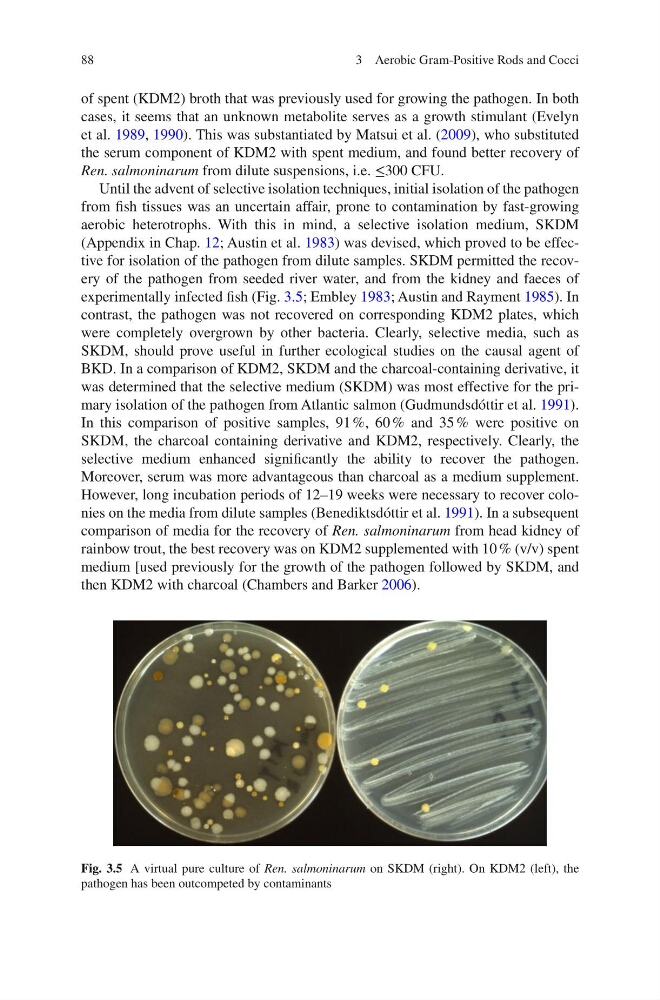
(Appendix in Chap. 12 ; Austin et al. 1983 ) was devised, which proved to be effective for isolation of the pathogen from dilute samples. SKDM permitted the recovery of the pathogen from seeded river water, and from the kidney and faeces of
experimentally infected fi sh (Fig. 3.5 ; Embley 1983 ; Austin and Rayment 1985 ). In
contrast, the pathogen was not recovered on corresponding KDM2 plates, which
were completely overgrown by other bacteria. Clearly, selective media, such as
SKDM, should prove useful in further ecological studies on the causal agent of
BKD. In a comparison of KDM2, SKDM and the charcoal-containing derivative, it
was determined that the selective medium (SKDM) was most effective for the primary isolation of the pathogen from Atlantic salmon (Gudmundsdóttir et al. 1991 ).
In this comparison of positive samples, 91 %, 60 % and 35 % were positive on
SKDM, the charcoal containing derivative and KDM2, respectively. Clearly, the
selective medium enhanced signifi cantly the ability to recover the pathogen.
Moreover, serum was more advantageous than charcoal as a medium supplement.
However, long incubation periods of 12–19 weeks were necessary to recover colonies on the media from dilute samples (Benediktsdóttir et al. 1991 ). In a subsequent
comparison of media for the recovery of Ren. salmoninarum from head kidney of
rainbow trout, the best recovery was on KDM2 supplemented with 10 % (v/v) spent
medium [used previously for the growth of the pathogen followed by SKDM, and
then KDM2 with charcoal (Chambers and Barker 2006 ).
Fig. 3.5 A virtual pure culture of Ren. salmoninarum on SKDM (right). On KDM2 (left), the
pathogen has been outcompeted by contaminants
3 Aerobic Gram-Positive Rods and Cocci
of spent (KDM2) broth that was previously used for growing the pathogen. In both
cases, it seems that an unknown metabolite serves as a growth stimulant (Evelyn
et al. 1989 , 1990 ). This was substantiated by Matsui et al. ( 2009 ), who substituted
the serum component of KDM2 with spent medium, and found better recovery of
Ren. salmoninarum from dilute suspensions, i.e. ≤300 CFU.
Until the advent of selective isolation techniques, initial isolation of the pathogen
from fi sh tissues was an uncertain affair, prone to contamination by fast-growing
aerobic heterotrophs. With this in mind, a selective isolation medium, SKDM
(Appendix in Chap. 12 ; Austin et al. 1983 ) was devised, which proved to be effective for isolation of the pathogen from dilute samples. SKDM permitted the recovery of the pathogen from seeded river water, and from the kidney and faeces of
experimentally infected fi sh (Fig. 3.5 ; Embley 1983 ; Austin and Rayment 1985 ). In
contrast, the pathogen was not recovered on corresponding KDM2 plates, which
were completely overgrown by other bacteria. Clearly, selective media, such as
SKDM, should prove useful in further ecological studies on the causal agent of
BKD. In a comparison of KDM2, SKDM and the charcoal-containing derivative, it
was determined that the selective medium (SKDM) was most effective for the primary isolation of the pathogen from Atlantic salmon (Gudmundsdóttir et al. 1991 ).
In this comparison of positive samples, 91 %, 60 % and 35 % were positive on
SKDM, the charcoal containing derivative and KDM2, respectively. Clearly, the
selective medium enhanced signifi cantly the ability to recover the pathogen.
Moreover, serum was more advantageous than charcoal as a medium supplement.
However, long incubation periods of 12–19 weeks were necessary to recover colonies on the media from dilute samples (Benediktsdóttir et al. 1991 ). In a subsequent
comparison of media for the recovery of Ren. salmoninarum from head kidney of
rainbow trout, the best recovery was on KDM2 supplemented with 10 % (v/v) spent
medium [used previously for the growth of the pathogen followed by SKDM, and
then KDM2 with charcoal (Chambers and Barker 2006 ).
Fig. 3.5 A virtual pure culture of Ren. salmoninarum on SKDM (right). On KDM2 (left), the
pathogen has been outcompeted by contaminants
3 Aerobic Gram-Positive Rods and Cocci