

This and similar interventions further disrupt longshore
sediment transport, as has occurred on Fongafale, on
Funafuti Atoll in Tuvalu (Yamano et al., 2007).
The scarcity of building materials has led to people
extracting beach sand and aggregates in large quantities
for construction on atolls with a large population. These
demands represent a further disruption to the sediment
budget causing detrimental impacts such as coastal erosion. On Majuro, chronic erosion has been experienced
along lagoonal shores due largely to beach mining
(Xue, 2001). Similarly in Vaitipu, Tuvalu, increased sand
mining activities in the intertidal zone have reduced
beach berm levels, increasing the island’s vulnerability
to cyclones.
Perhaps the most serious impacts of human activities are
yet to be experienced. The impacts of climate change, and
in particular sea-level rise, appear particularly ominous for
atolls (McLean and Tysban, 2001; Nicholls et al., 2007).
There have been several assessments of the vulnerability
of atoll reef islands to sea-level rise (e.g., Roy and Connell,
1989, 1991; Lewis, 1989, 1990). Studies of the regional
pattern of sea-level rise indicate that the sea is rising with
respect to most atolls (Church et al., 2006). The principal
impacts anticipated fall into three categories: shoreline erosion, inundation and flooding, and saline intrusion into the
water table (Mimura, 1999). Widespread flooding in the
interior of Fongafale on Funafuti Atoll in Tuvalu is often
cited as evidence of the effects of sea-level rise, or confirmation that the “islands are sinking” (Pittock, 2005; Patel,
2006). However, Yamano et al. (2007) reconstructed historical conditions showing that the interior of this island
was already subject to flooding at the time of the Royal
Society expedition in the 1890s. They indicate that construction of an airstrip over former mangrove wetlands further increased the area subject to inundation, and that
a considerable degree of human modification, including
urbanization, has exacerbated the problem in this instance.
Settlement in this densely populated part of the administrative center has encroached on low-lying areas or depressions excavated during military operations (Yamano
et al., 2007).
Reef islands are particularly low-lying, although there
is considerable geomorphological variability around the
margin of any one atoll (Woodroffe, 2008). Islands exhibit
a degree of physical resilience, and many may be continuing to build as further sediment is produced through the
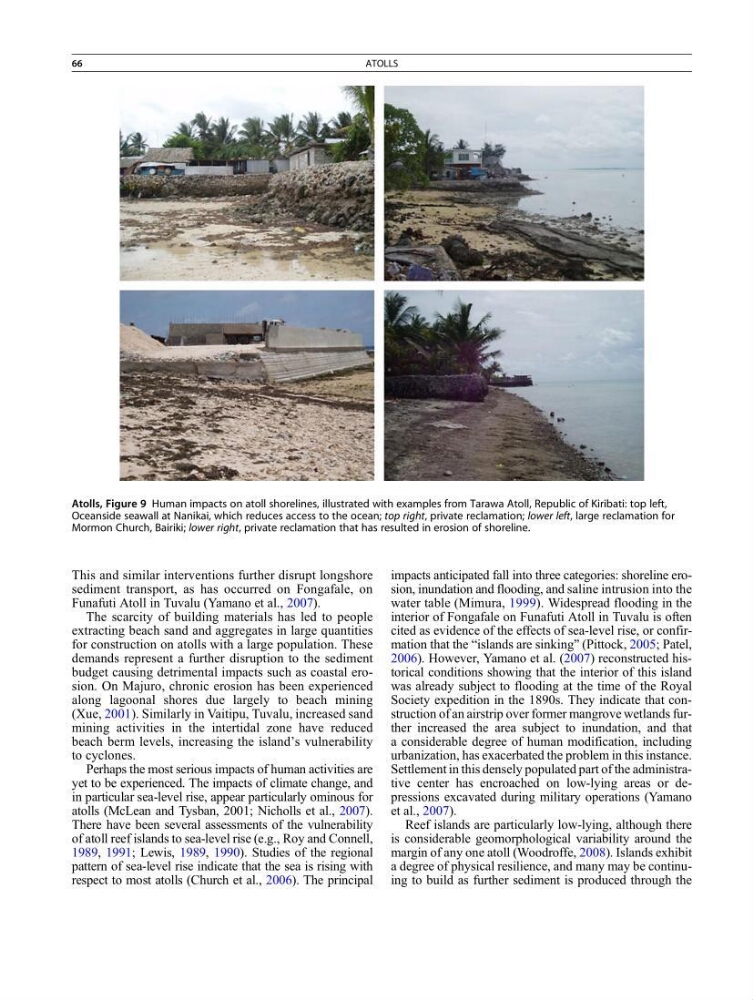
Atolls, Figure 9 Human impacts on atoll shorelines, illustrated with examples from Tarawa Atoll, Republic of Kiribati: top left,
Oceanside seawall at Nanikai, which reduces access to the ocean; top right, private reclamation; lower left, large reclamation for
Mormon Church, Bairiki; lower right, private reclamation that has resulted in erosion of shoreline.
66
ATOLLS
sediment transport, as has occurred on Fongafale, on
Funafuti Atoll in Tuvalu (Yamano et al., 2007).
The scarcity of building materials has led to people
extracting beach sand and aggregates in large quantities
for construction on atolls with a large population. These
demands represent a further disruption to the sediment
budget causing detrimental impacts such as coastal erosion. On Majuro, chronic erosion has been experienced
along lagoonal shores due largely to beach mining
(Xue, 2001). Similarly in Vaitipu, Tuvalu, increased sand
mining activities in the intertidal zone have reduced
beach berm levels, increasing the island’s vulnerability
to cyclones.
Perhaps the most serious impacts of human activities are
yet to be experienced. The impacts of climate change, and
in particular sea-level rise, appear particularly ominous for
atolls (McLean and Tysban, 2001; Nicholls et al., 2007).
There have been several assessments of the vulnerability
of atoll reef islands to sea-level rise (e.g., Roy and Connell,
1989, 1991; Lewis, 1989, 1990). Studies of the regional
pattern of sea-level rise indicate that the sea is rising with
respect to most atolls (Church et al., 2006). The principal
impacts anticipated fall into three categories: shoreline erosion, inundation and flooding, and saline intrusion into the
water table (Mimura, 1999). Widespread flooding in the
interior of Fongafale on Funafuti Atoll in Tuvalu is often
cited as evidence of the effects of sea-level rise, or confirmation that the “islands are sinking” (Pittock, 2005; Patel,
2006). However, Yamano et al. (2007) reconstructed historical conditions showing that the interior of this island
was already subject to flooding at the time of the Royal
Society expedition in the 1890s. They indicate that construction of an airstrip over former mangrove wetlands further increased the area subject to inundation, and that
a considerable degree of human modification, including
urbanization, has exacerbated the problem in this instance.
Settlement in this densely populated part of the administrative center has encroached on low-lying areas or depressions excavated during military operations (Yamano
et al., 2007).
Reef islands are particularly low-lying, although there
is considerable geomorphological variability around the
margin of any one atoll (Woodroffe, 2008). Islands exhibit
a degree of physical resilience, and many may be continuing to build as further sediment is produced through the
Atolls, Figure 9 Human impacts on atoll shorelines, illustrated with examples from Tarawa Atoll, Republic of Kiribati: top left,
Oceanside seawall at Nanikai, which reduces access to the ocean; top right, private reclamation; lower left, large reclamation for
Mormon Church, Bairiki; lower right, private reclamation that has resulted in erosion of shoreline.
66
ATOLLS