

100s of meters (up to a 1,000 m or more), and can have very
thick oil columns. The most common depositional pore
types in reefs and reef associated beds include interparticle,
intraparticle, and growth-framework shelter porosity (see
Choquette and Pray, 1970; Lucia, 1999; Lǿnǿy, 2006 for
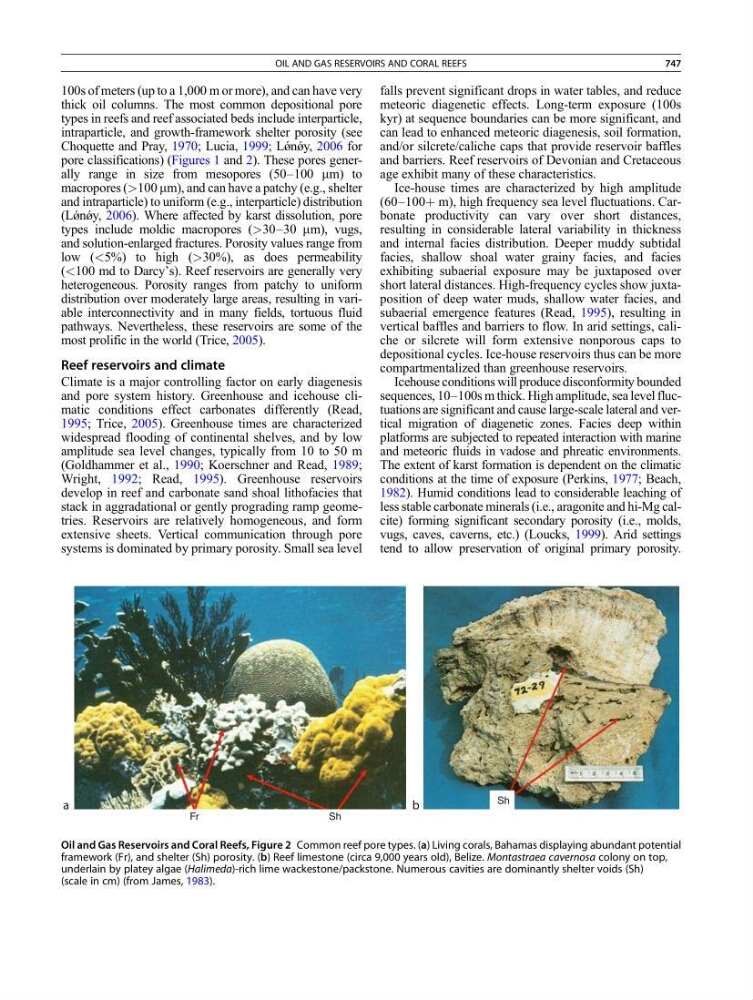
pore classifications) (Figures 1 and 2). These pores generally range in size from mesopores (50–100 mm) to
macropores (>100 mm), and can have a patchy (e.g., shelter
and intraparticle) to uniform (e.g., interparticle) distribution
(Lǿnǿy, 2006). Where affected by karst dissolution, pore
types include moldic macropores (>30–30 mm), vugs,
and solution-enlarged fractures. Porosity values range from
low (<5%) to high (>30%), as does permeability
(<100 md to Darcy’s). Reef reservoirs are generally very
heterogeneous. Porosity ranges from patchy to uniform
distribution over moderately large areas, resulting in variable interconnectivity and in many fields, tortuous fluid
pathways. Nevertheless, these reservoirs are some of the
most prolific in the world (Trice, 2005).
Reef reservoirs and climate
Climate is a major controlling factor on early diagenesis
and pore system history. Greenhouse and icehouse climatic conditions effect carbonates differently (Read,
1995; Trice, 2005). Greenhouse times are characterized
widespread flooding of continental shelves, and by low
amplitude sea level changes, typically from 10 to 50 m
(Goldhammer et al., 1990; Koerschner and Read, 1989;
Wright, 1992; Read, 1995). Greenhouse reservoirs
develop in reef and carbonate sand shoal lithofacies that
stack in aggradational or gently prograding ramp geometries. Reservoirs are relatively homogeneous, and form
extensive sheets. Vertical communication through pore
systems is dominated by primary porosity. Small sea level
falls prevent significant drops in water tables, and reduce
meteoric diagenetic effects. Long-term exposure (100s
kyr) at sequence boundaries can be more significant, and
can lead to enhanced meteoric diagenesis, soil formation,
and/or silcrete/caliche caps that provide reservoir baffles
and barriers. Reef reservoirs of Devonian and Cretaceous
age exhibit many of these characteristics.
Ice-house times are characterized by high amplitude
(60–100þ m), high frequency sea level fluctuations. Carbonate productivity can vary over short distances,
resulting in considerable lateral variability in thickness
and internal facies distribution. Deeper muddy subtidal
facies, shallow shoal water grainy facies, and facies
exhibiting subaerial exposure may be juxtaposed over
short lateral distances. High-frequency cycles show juxtaposition of deep water muds, shallow water facies, and
subaerial emergence features (Read, 1995), resulting in
vertical baffles and barriers to flow. In arid settings, caliche or silcrete will form extensive nonporous caps to
depositional cycles. Ice-house reservoirs thus can be more
compartmentalized than greenhouse reservoirs.
Icehouse conditions will produce disconformity bounded
sequences, 10–100s m thick. High amplitude, sea level fluctuations are significant and cause large-scale lateral and vertical migration of diagenetic zones. Facies deep within
platforms are subjected to repeated interaction with marine
and meteoric fluids in vadose and phreatic environments.
The extent of karst formation is dependent on the climatic
conditions at the time of exposure (Perkins, 1977; Beach,
1982). Humid conditions lead to considerable leaching of
less stable carbonate minerals (i.e., aragonite and hi-Mg calcite) forming significant secondary porosity (i.e., molds,
vugs, caves, caverns, etc.) (Loucks, 1999). Arid settings
tend to allow preservation of original primary porosity.
a
Fr
Sh
Sh
b
Oil and Gas Reservoirs and Coral Reefs, Figure 2 Common reef pore types. (a) Living corals, Bahamas displaying abundant potential
framework (Fr), and shelter (Sh) porosity. (b) Reef limestone (circa 9,000 years old), Belize. Montastraea cavernosa colony on top,
underlain by platey algae (Halimeda)-rich lime wackestone/packstone. Numerous cavities are dominantly shelter voids (Sh)
(scale in cm) (from James, 1983).
OIL AND GAS RESERVOIRS AND CORAL REEFS
747