

regenerative volcanism to combat erosion, they subsequently erode as they cool and subside to form fringing
reefs and atolls. With time, they eventually sink below
the surface of the sea to form a seamount. Wave action will
often flatten the top of such seamounts, leading to the classical truncated guyot (Hess, 1946). As long as the mantle
plume supplies heat and magma, new active volcanoes
will form directly above the mantle plume and the process
continues. Mantle plumes may stay active from a few tens
to a few hundred million years.
The relative motion between plates and plumes causes
the formation of lines of extinct volcanoes; these exhibit
monotonic age progressions and reflect the history of past
plate motions. Since the early formulation of the hotspot
hypothesis, numerous hotspots have been proposed for
sites of unusual volcanic activity (e.g., Burke and Wilson,
1976; Clouard and Bonneville, 2001; Sleep, 1990) yet conclusive imaging of the underlying mantle plumes using
seismic tomography remains elusive (Nataf, 2000), perhaps
with Iceland (Wolfe et al., 1997) as an exception. For
instance, the archetypal strong plume that many believe
has formed the Hawaii-Emperor seamount chain and currently thought to underlie the southeast end of the Big
Island of Hawaii is not well resolved, whereas other, less
productive hotspots (e.g., Easter, Ascension, Azores)
appear more dominant in the tomographic images (Montelli
et al., 2004). However, recent three-dimensional seismic
imaging beneath the Hawaiian Islands now seem to require
an upwelling mantle plume (Wolfe et al., 2009). Although
the simple age progressions predicted by the hotspot
hypothesis are borne out by observations for several seamount chains (such as the Hawaii-Emperor and Louisville
chains), others exhibit a more complex age pattern which
casts some doubt on the hotspot theory being the only
explanation for such volcanism (e.g., McNutt et al., 1997).
Mantle plumes and hotspot swells
Large bathymetric swells may form around and downstream from the site of active hotspots (e.g., McNutt,
1998). While seamount chains are usually confined within
a relatively narrow zone ($100–200 km), the broader
effect of plumes on the lithosphere and upper mantle can
extend for $1,000 km or more. Again, the most wellknown case of a hotspot swell is associated with the
Hawaiian chain where the seamounts are centrally
arranged on top of a broad ($1,200 km) swell extending
for $3,000 km (e.g., Van Ark and Lin, 2004). Despite this
classic example, similar thermal swells are found in all
oceans and always associated with hotspot chains. The
amplitude and extent of such swells correlate strongly
with the age of the underlying lithosphere; hence Hawaii
(located in an area with seafloor of around 100 Ma) is
more elevated than similar swells found in French Polynesia where the seafloor is only half that age (Cazenave et al.,
1988). The earliest studies of hotspot swells concluded
that the shallow bathymetry simply reflected reheating of
the entire lithosphere (Detrick and Crough, 1978). However, others have pointed out the likely effect of compositional buoyancy (e.g., Jordan, 1979; Phipps Morgan et al.,
1995) and dynamical uplift (e.g., Olson, 1990). In summary, hotspot swells appear to require the presence of a
deep-seated upwelling plume as such features can explain
both a broad swell and narrowly focused volcanism (e.g.,
Ribe and Christensen, 1999).
Intraplate seamounts produced at oceanic
hotspots
Seamounts formed by hotspot volcanism can accumulate
into the largest seamounts present in the oceans. Specifically, intraplate seamounts built on old (and hence thick
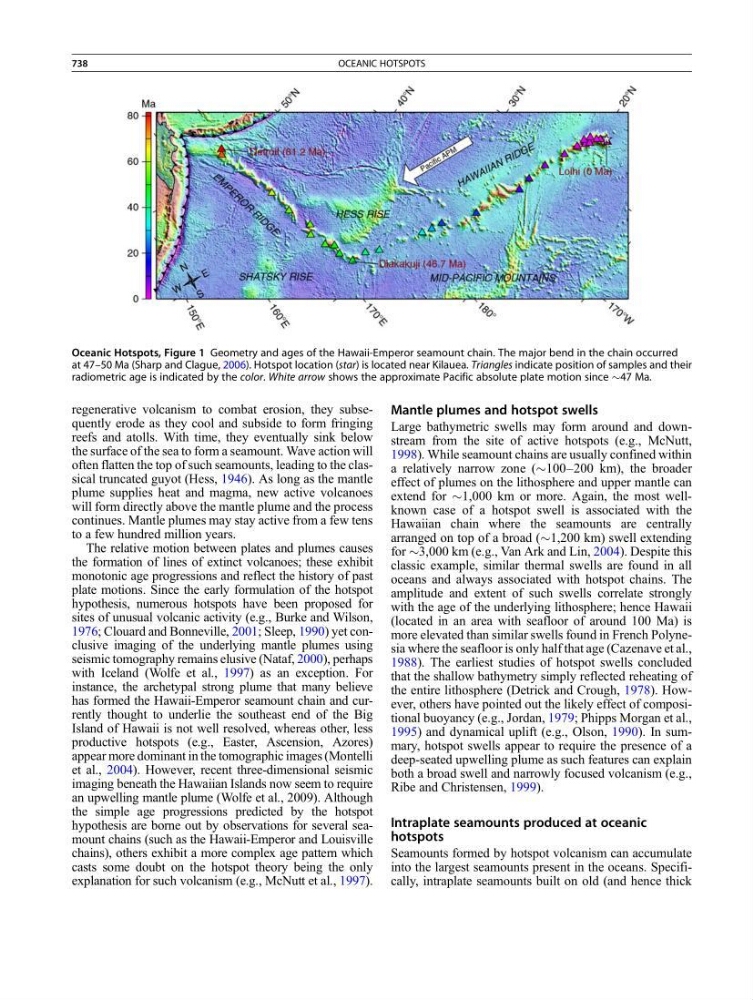
Oceanic Hotspots, Figure 1 Geometry and ages of the Hawaii-Emperor seamount chain. The major bend in the chain occurred
at 47–50 Ma (Sharp and Clague, 2006). Hotspot location (star) is located near Kilauea. Triangles indicate position of samples and their
radiometric age is indicated by the color. White arrow shows the approximate Pacific absolute plate motion since $47 Ma.
738
OCEANIC HOTSPOTS