

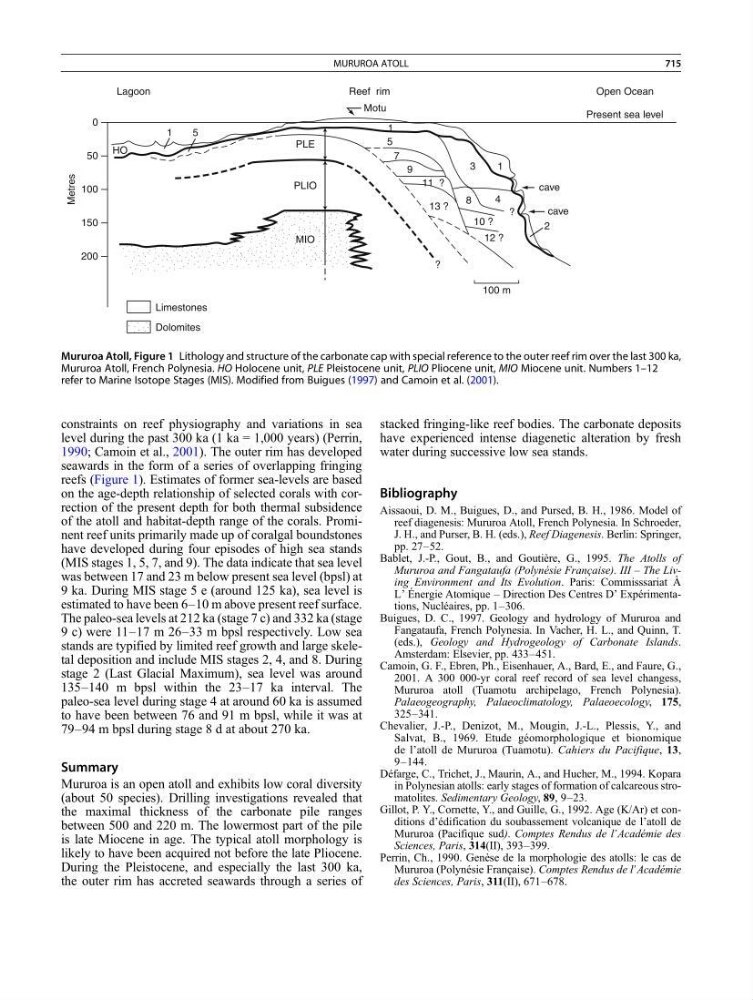
constraints on reef physiography and variations in sea
level during the past 300 ka (1 ka = 1,000 years) (Perrin,
1990; Camoin et al., 2001). The outer rim has developed
seawards in the form of a series of overlapping fringing
reefs (Figure 1). Estimates of former sea-levels are based
on the age-depth relationship of selected corals with correction of the present depth for both thermal subsidence
of the atoll and habitat-depth range of the corals. Prominent reef units primarily made up of coralgal boundstones
have developed during four episodes of high sea stands
(MIS stages 1, 5, 7, and 9). The data indicate that sea level
was between 17 and 23 m below present sea level (bpsl) at
9 ka. During MIS stage 5 e (around 125 ka), sea level is
estimated to have been 6–10 m above present reef surface.
The paleo-sea levels at 212 ka (stage 7 c) and 332 ka (stage
9 c) were 11–17 m 26–33 m bpsl respectively. Low sea
stands are typified by limited reef growth and large skeletal deposition and include MIS stages 2, 4, and 8. During
stage 2 (Last Glacial Maximum), sea level was around
135–140 m bpsl within the 23–17 ka interval. The
paleo-sea level during stage 4 at around 60 ka is assumed
to have been between 76 and 91 m bpsl, while it was at
79–94 m bpsl during stage 8 d at about 270 ka.
Summary
Mururoa is an open atoll and exhibits low coral diversity
(about 50 species). Drilling investigations revealed that
the maximal thickness of the carbonate pile ranges
between 500 and 220 m. The lowermost part of the pile
is late Miocene in age. The typical atoll morphology is
likely to have been acquired not before the late Pliocene.
During the Pleistocene, and especially the last 300 ka,
the outer rim has accreted seawards through a series of
stacked fringing-like reef bodies. The carbonate deposits
have experienced intense diagenetic alteration by fresh
water during successive low sea stands.
Bibliography
Aissaoui, D. M., Buigues, D., and Pursed, B. H., 1986. Model of
reef diagenesis: Mururoa Atoll, French Polynesia. In Schroeder,
J. H., and Purser, B. H. (eds.), Reef Diagenesis. Berlin: Springer,
pp. 27–52.
Bablet, J.-P., Gout, B., and Goutière, G., 1995. The Atolls of
Mururoa and Fangataufa (Polynésie Française). III – The Living Environment and Its Evolution. Paris: Commisssariat À
L’ Énergie Atomique – Direction Des Centres D’ Expérimentations, Nucléaires, pp. 1–306.
Buigues, D. C., 1997. Geology and hydrology of Mururoa and
Fangataufa, French Polynesia. In Vacher, H. L., and Quinn, T.
(eds.), Geology and Hydrogeology of Carbonate Islands.
Amsterdam: Elsevier, pp. 433–451.
Camoin, G. F., Ebren, Ph., Eisenhauer, A., Bard, E., and Faure, G.,
2001. A 300 000-yr coral reef record of sea level changess,
Mururoa atoll (Tuamotu archipelago, French Polynesia).
Palaeogeography, Palaeoclimatology, Palaeoecology, 175,
325–341.
Chevalier, J.-P., Denizot, M., Mougin, J.-L., Plessis, Y., and
Salvat, B., 1969. Etude géomorphologique et bionomique
de l’atoll de Mururoa (Tuamotu). Cahiers du Pacifique, 13,
9–144.
Défarge, C., Trichet, J., Maurin, A., and Hucher, M., 1994. Kopara
in Polynesian atolls: early stages of formation of calcareous stromatolites. Sedimentary Geology, 89, 9–23.
Gillot, P. Y., Cornette, Y., and Guille, G., 1992. Age (K/Ar) et conditions d’édification du soubassement volcanique de l’atoll de
Mururoa (Pacifique sud). Comptes Rendus de l’Académie des
Sciences, Paris, 314(II), 393–399.
Perrin, Ch., 1990. Genèse de la morphologie des atolls: le cas de
Mururoa (Polynésie Française). Comptes Rendus de l’Académie
des Sciences, Paris, 311(II), 671–678.
Lagoon
Metres
Reef rim
Open Ocean
Present sea level
1
5
PLE
PLIO
MIO
100 m
cave
cave
2
1
1
5
7
9
11 ?
13 ?
3
4
8
10 ?
12 ?
?
50
100
0
200
150
Limestones
Dolomites
?
HO
Motu
Mururoa Atoll, Figure 1 Lithology and structure of the carbonate cap with special reference to the outer reef rim over the last 300 ka,
Mururoa Atoll, French Polynesia. HO Holocene unit, PLE Pleistocene unit, PLIO Pliocene unit, MIO Miocene unit. Numbers 1–12
refer to Marine Isotope Stages (MIS). Modified from Buigues (1997) and Camoin et al. (2001).
MURUROA ATOLL
715