

solution is directly related to the age of the limestones, that
is, depressions in the 120 k reef are only 1 m deep, while in
the >480 k reef, they are 12 m deep. Clearly, any karstic
solution is cumulative, and Purdy (1974) recognized this,
repeating again in 2001 (Purdy and Winterer) that in terms
of gross morphology, the dissolution process is cumulative.
Most now agree on this. However, an important question is
still the extent to which the previous reef (usually the
125,000 years old reef ) has affected the growth pattern of
the modern reef, and this will depend on the amount and
degree of erosion of the previous reef. Purdy himself was
unsure about this, noting the work by Land et al. (1967)
again on Bermuda and concluding that a net reduction of
the exposed surface by up to about 4.5 m was likely. However, as a general conclusion, this is at odds with the facts,
that is, beneath Belize and the Great Barrier Reef, the depth
to the 125 k antecedent surface can be anything from À10
to À25 m below present sea level. Assuming the 125 k reef
grew to sea level, then the present depth indicates 10–25 m
of erosion plus subsidence in the intervening period,
clearly at odds with the Bermuda conclusions. It is however
in agreement with conclusions in Purdy and Winterer
(2001) for gross surface erosion rates on Pacific atolls. In
addition, if one uses the vertical erosion rates for coral and
coralline algae published by Trudgill (1976) for Aldabra,
then vertical erosion of the coral flat and algal flats in the
Great Barrier Reef and exposure for around 95,000 years
out of the last 125,000 years, then the surface of the 129 k
reef is eroded only about 10 m. Coupled with estimated
subsidence in the same time frame (5 m or so), the preHolocene surface would be at À10 m prior to the growth
of the Holocene reef. This is in fact the depth that it is at
on a number of reefs in the Great Barrier Reef (Davies
and Hopley, 1983). While this solution/erosion is enough
to produce small-scale features, some of which may be
inherited by the modern reef, it is clearly insufficient to have
produced the large-scale features on the scale of barrier reef
systems or reef tracts. Such features, Purdy says are the
result of repetitive cumulative karstification. In the Great
Barrier Reef, the idea of a karst marginal plain is no longer
in favor (Hopley et al., 2007).
Since the seminal 1974 paper, Purdy has become more
sure of his ground although even in 1974, he showed the
direction in which his thoughts were moving – “Thus
the major premise of the subsidence theory (Darwin’s)
has been confirmed. It would be dangerous, however, to
assume that this subsidence necessarily proves the genetic
succession of reef types advocated by Darwin” (Purdy,
1974, p. 10). Further, quoting Vaughan’s warning in
1919 (p. 325) – “although the theoretical possibility of
the conversion of a fringing reef into a barrier reef and
a barrier reef into an atoll may not be denied, no instance
of such a conversion has yet been discovered,” Purdy
makes it clear that the evolution of reef types proposed
by Darwin is open to question. In 2006, he states that
“there are no examples of the subsidence-predicted transition of fringing reefs to barrier reefs to atolls. Moreover,
the common occurrence of fringing reefs within barrier
reefs negates subsidence as a causal factor in their presumed progressive evolutionary development” (Purdy
and Winterer, 2006, p. 143). Instead, Purdy advocates
a solution morphology template accentuated by reef construction particularly for barrier reefs.
Growth antecedence
This was first proposed by Bloom (1974) and states quite
simply that original reef facies exerts a fundamental control
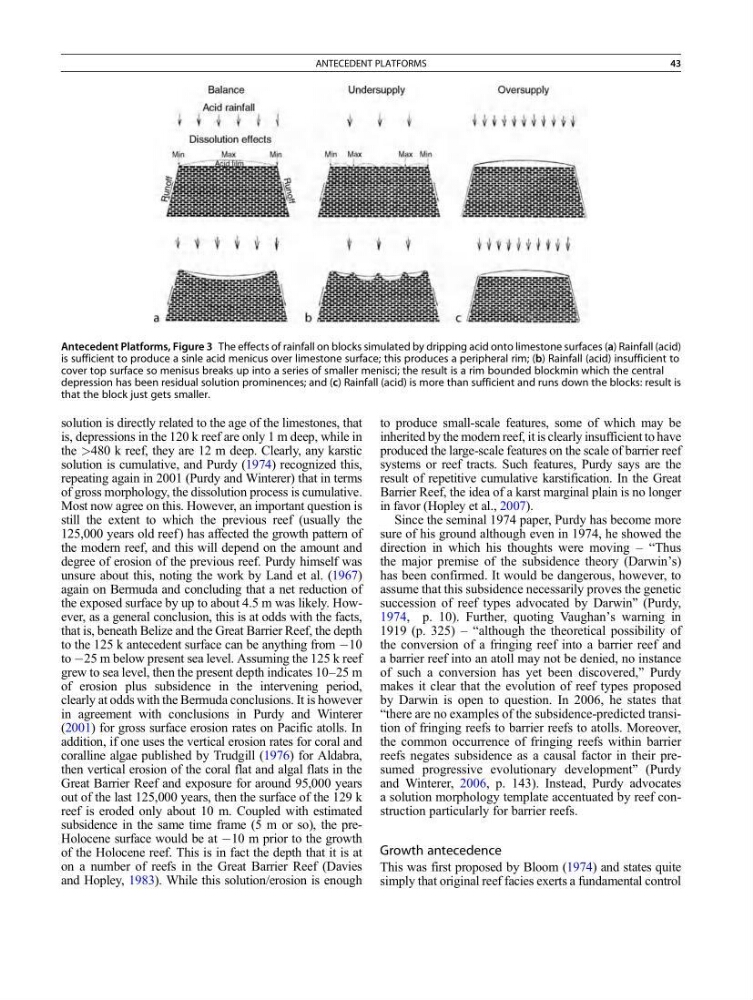
Antecedent Platforms, Figure 3 The effects of rainfall on blocks simulated by dripping acid onto limestone surfaces (a) Rainfall (acid)
is sufficient to produce a sinle acid menicus over limestone surface; this produces a peripheral rim; (b) Rainfall (acid) insufficient to
cover top surface so menisus breaks up into a series of smaller menisci; the result is a rim bounded blockmin which the central
depression has been residual solution prominences; and (c) Rainfall (acid) is more than sufficient and runs down the blocks: result is
that the block just gets smaller.
ANTECEDENT PLATFORMS
43
is, depressions in the 120 k reef are only 1 m deep, while in
the >480 k reef, they are 12 m deep. Clearly, any karstic
solution is cumulative, and Purdy (1974) recognized this,
repeating again in 2001 (Purdy and Winterer) that in terms
of gross morphology, the dissolution process is cumulative.
Most now agree on this. However, an important question is
still the extent to which the previous reef (usually the
125,000 years old reef ) has affected the growth pattern of
the modern reef, and this will depend on the amount and
degree of erosion of the previous reef. Purdy himself was
unsure about this, noting the work by Land et al. (1967)
again on Bermuda and concluding that a net reduction of
the exposed surface by up to about 4.5 m was likely. However, as a general conclusion, this is at odds with the facts,
that is, beneath Belize and the Great Barrier Reef, the depth
to the 125 k antecedent surface can be anything from À10
to À25 m below present sea level. Assuming the 125 k reef
grew to sea level, then the present depth indicates 10–25 m
of erosion plus subsidence in the intervening period,
clearly at odds with the Bermuda conclusions. It is however
in agreement with conclusions in Purdy and Winterer
(2001) for gross surface erosion rates on Pacific atolls. In
addition, if one uses the vertical erosion rates for coral and
coralline algae published by Trudgill (1976) for Aldabra,
then vertical erosion of the coral flat and algal flats in the
Great Barrier Reef and exposure for around 95,000 years
out of the last 125,000 years, then the surface of the 129 k
reef is eroded only about 10 m. Coupled with estimated
subsidence in the same time frame (5 m or so), the preHolocene surface would be at À10 m prior to the growth
of the Holocene reef. This is in fact the depth that it is at
on a number of reefs in the Great Barrier Reef (Davies
and Hopley, 1983). While this solution/erosion is enough
to produce small-scale features, some of which may be
inherited by the modern reef, it is clearly insufficient to have
produced the large-scale features on the scale of barrier reef
systems or reef tracts. Such features, Purdy says are the
result of repetitive cumulative karstification. In the Great
Barrier Reef, the idea of a karst marginal plain is no longer
in favor (Hopley et al., 2007).
Since the seminal 1974 paper, Purdy has become more
sure of his ground although even in 1974, he showed the
direction in which his thoughts were moving – “Thus
the major premise of the subsidence theory (Darwin’s)
has been confirmed. It would be dangerous, however, to
assume that this subsidence necessarily proves the genetic
succession of reef types advocated by Darwin” (Purdy,
1974, p. 10). Further, quoting Vaughan’s warning in
1919 (p. 325) – “although the theoretical possibility of
the conversion of a fringing reef into a barrier reef and
a barrier reef into an atoll may not be denied, no instance
of such a conversion has yet been discovered,” Purdy
makes it clear that the evolution of reef types proposed
by Darwin is open to question. In 2006, he states that
“there are no examples of the subsidence-predicted transition of fringing reefs to barrier reefs to atolls. Moreover,
the common occurrence of fringing reefs within barrier
reefs negates subsidence as a causal factor in their presumed progressive evolutionary development” (Purdy
and Winterer, 2006, p. 143). Instead, Purdy advocates
a solution morphology template accentuated by reef construction particularly for barrier reefs.
Growth antecedence
This was first proposed by Bloom (1974) and states quite
simply that original reef facies exerts a fundamental control
Antecedent Platforms, Figure 3 The effects of rainfall on blocks simulated by dripping acid onto limestone surfaces (a) Rainfall (acid)
is sufficient to produce a sinle acid menicus over limestone surface; this produces a peripheral rim; (b) Rainfall (acid) insufficient to
cover top surface so menisus breaks up into a series of smaller menisci; the result is a rim bounded blockmin which the central
depression has been residual solution prominences; and (c) Rainfall (acid) is more than sufficient and runs down the blocks: result is
that the block just gets smaller.
ANTECEDENT PLATFORMS
43