

elevation of living microatolls at the same location with
a known relationship to a tidal datum; and/or (b) records
of interannual or decadal sea-level change reconstructed
from detailed analyses of the surface topography of
long-lived microatolls or microatolls with overlapping
lifespans. Both assume that the tidal datum that is the confining water level is unchanged and as sea level varies the
absolute elevation of this tidal datum fluctuates.
In many locations, fossil microatolls, often 5,000–
6,000 years old, can be readily identified and compared
directly with nearby living counterparts that can be surveyed to a tidal datum. Where the tidal curve has not significantly changed, the relative elevations of microatoll
tops document the heights of former constraining water
levels. Radiometric dating of the fossil microatolls at different heights assigns a chronology to these water levels
(see Chapter Uranium Series Dating). Where it is confirmed that fossil microatolls were not moated, these histories of water-level change are also excellent records of sealevel change. This approach has been applied to establish
mid-late Holocene sea-level histories on the Central GBR
(Chappell et al., 1983), in Torres Strait (Woodroffe et al.,
2000), the Pacific (e.g., Nunn, 2000; Goodwin and Harvey, 2008), and Indian Oceans (e.g., Woodroffe and
McLean, 1990; Kench et al., 2009).
Microtopographic undulations over the upper surfaces
of well-preserved microatolls track interannual variations
in the elevation of the confining water level (Woodroffe
and McLean, 1990; Smithers and Woodroffe, 2001). The
internal skeletal structure of massive microatolls contain
annual density bands (see Chapter Sclerochronology) that
can be used to age the upper limit to coral growth over the
microatoll’s lifetime (preserved as the topography of the
microatoll plane), usually by counting back the density
bands from the living edge at the time of sampling. Rapid
rises that exceed maximum coral growth rates will not be
fully recorded, but microatoll microtopographies may
yield detailed sea-level records extending back decades
and centuries in modern corals (Woodroffe and McLean,
1990; Smithers and Woodroffe, 2001; Spencer et al.,
1997), and also in well-preserved fossil microatolls of
mid-Holocene age (Yu et al., 2009).
Microatoll records of ENSOs, earthquakes, and
other environmental conditions
Microatolls are also excellent archives of a range of other
environmental conditions. These include the following:
(a) El-Nino Southern Oscillation (ENSO) events: Sealevel changes accompany shifts from El Nino to La
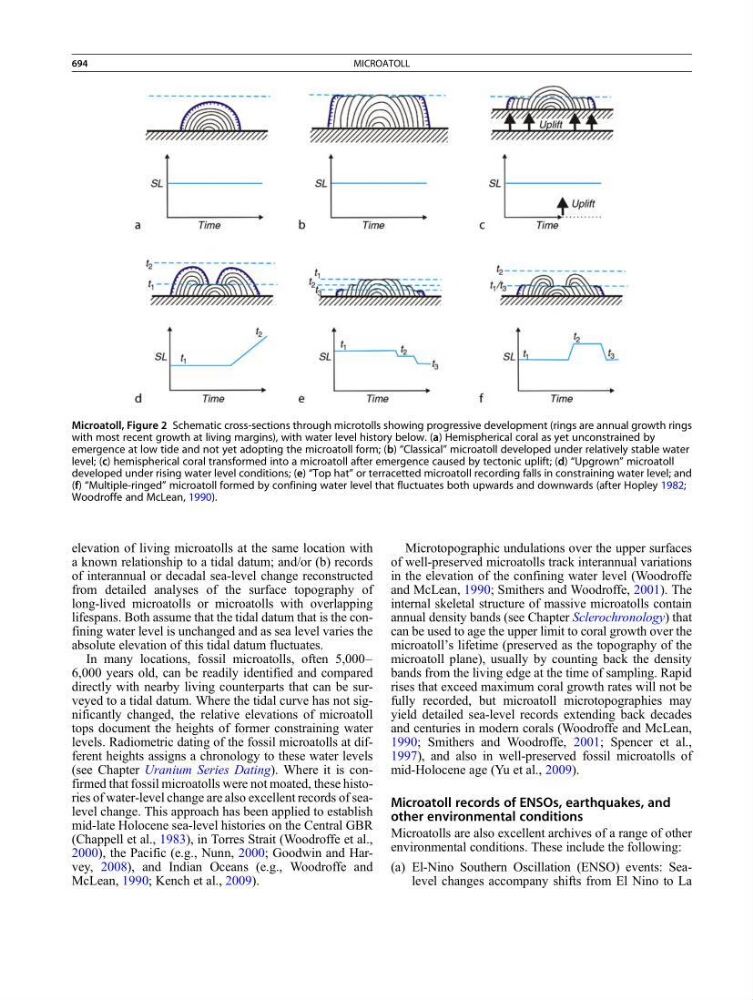
Microatoll, Figure 2 Schematic cross-sections through microtolls showing progressive development (rings are annual growth rings
with most recent growth at living margins), with water level history below. (a) Hemispherical coral as yet unconstrained by
emergence at low tide and not yet adopting the microatoll form; (b) “Classical” microatoll developed under relatively stable water
level; (c) hemispherical coral transformed into a microatoll after emergence caused by tectonic uplift; (d) “Upgrown” microatoll
developed under rising water level conditions; (e) “Top hat” or terracetted microatoll recording falls in constraining water level; and
(f) “Multiple-ringed” microatoll formed by confining water level that fluctuates both upwards and downwards (after Hopley 1982;
Woodroffe and McLean, 1990).
694
MICROATOLL