

Introduction
Darwin (1842) first described coral microatolls, with further accounts by various other early reef scientists (e.g.,
Dana, 1872; Semper, 1880). Guppy’s (1889) description
of “miniature atolls” from the Cocos (Keeling) Islands
first compared the living coral annulus on microatolls to
the circular reef rim of coral atolls, followed by Agassiz
(1895) and Krempf (1927) who referred to microatolls
as “diminutive atolls” and “dwarf atolls” respectively.
The specific term microatoll was coined by Wood-Jones
(1910) who argued that microatolls resemble coral atolls
and form because sedimentation restricts coral growth
to their peripheral rim, as he proposed in his largely
discounted theory of atoll formation. Abe (1937) referred
to microatolls as “table-forming corals”, emphasizing
their flat dead tops.
Patch reefs composed of multiple coral colonies with
raised rims and sand-filled centres have been referred to
as microatolls (e.g., Kornicker and Boyd, 1962; Larkum
and Steven, 1994), but are better described as “mini-atolls”
(Scheer, 1971). Thirty years ago, Scoffin and Stoddart
reviewed “the nature and significance of microatolls” and
recommended that only single coral colonies be described
as microatolls (Scoffin and Stoddart, 1978; Stoddart and
Scoffin, 1979). This has been applied with only rare exceptions. The focus of these earlier investigations was almost
entirely on microatolls as high quality sea-level indicators
(see Chapter Sea-Level Indicators), an application
improved further by recent technological advances that
have increased the resolution of elevation survey and radiometric dating. Further, exceptional palaeoenvironmental
records preserved in the geochemistry and structure of
microatoll skeletons are being discovered, and represent
exciting new areas for research.
Microatoll description
Most microatolls develop from massive corals; however,
branching and foliaceous corals may also adopt this morphology. Porites microatolls are particularly common,
and intertidal Goniastrea and Platygyra colonies also
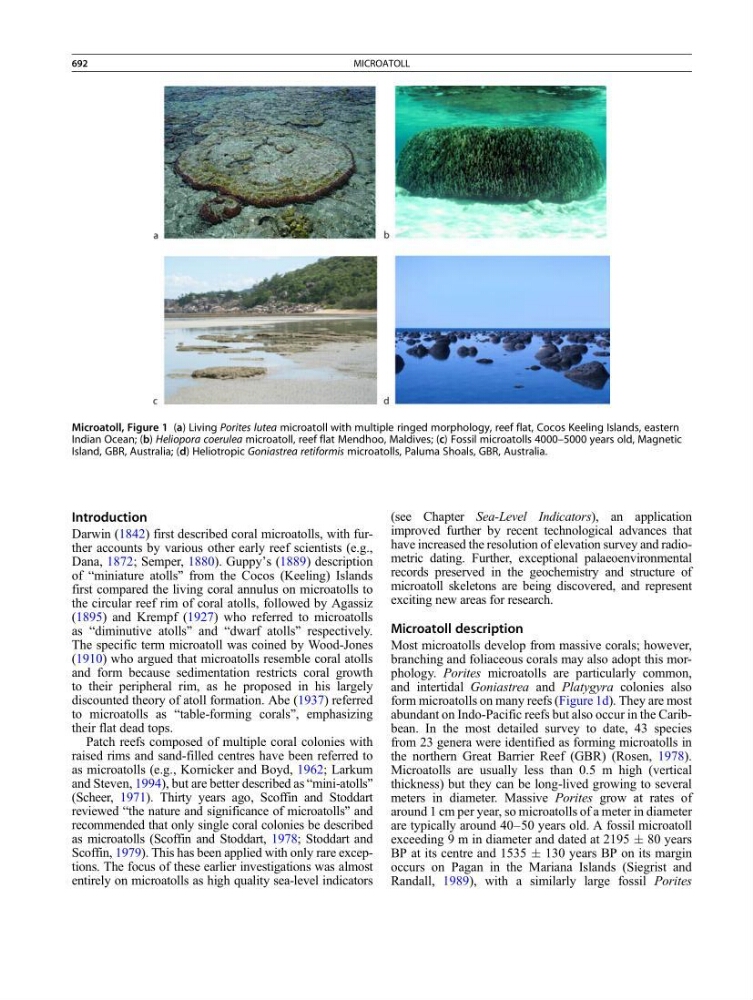
form microatolls on many reefs (Figure 1d). They are most
abundant on Indo-Pacific reefs but also occur in the Caribbean. In the most detailed survey to date, 43 species
from 23 genera were identified as forming microatolls in
the northern Great Barrier Reef (GBR) (Rosen, 1978).
Microatolls are usually less than 0.5 m high (vertical
thickness) but they can be long-lived growing to several
meters in diameter. Massive Porites grow at rates of
around 1 cm per year, so microatolls of a meter in diameter
are typically around 40–50 years old. A fossil microatoll
exceeding 9 m in diameter and dated at 2195 Æ 80 years
BP at its centre and 1535 Æ 130 years BP on its margin
occurs on Pagan in the Mariana Islands (Siegrist and
Randall, 1989), with a similarly large fossil Porites
Microatoll, Figure 1 (a) Living Porites lutea microatoll with multiple ringed morphology, reef flat, Cocos Keeling Islands, eastern
Indian Ocean; (b) Heliopora coerulea microatoll, reef flat Mendhoo, Maldives; (c) Fossil microatolls 4000–5000 years old, Magnetic
Island, GBR, Australia; (d) Heliotropic Goniastrea retiformis microatolls, Paluma Shoals, GBR, Australia.
692
MICROATOLL