

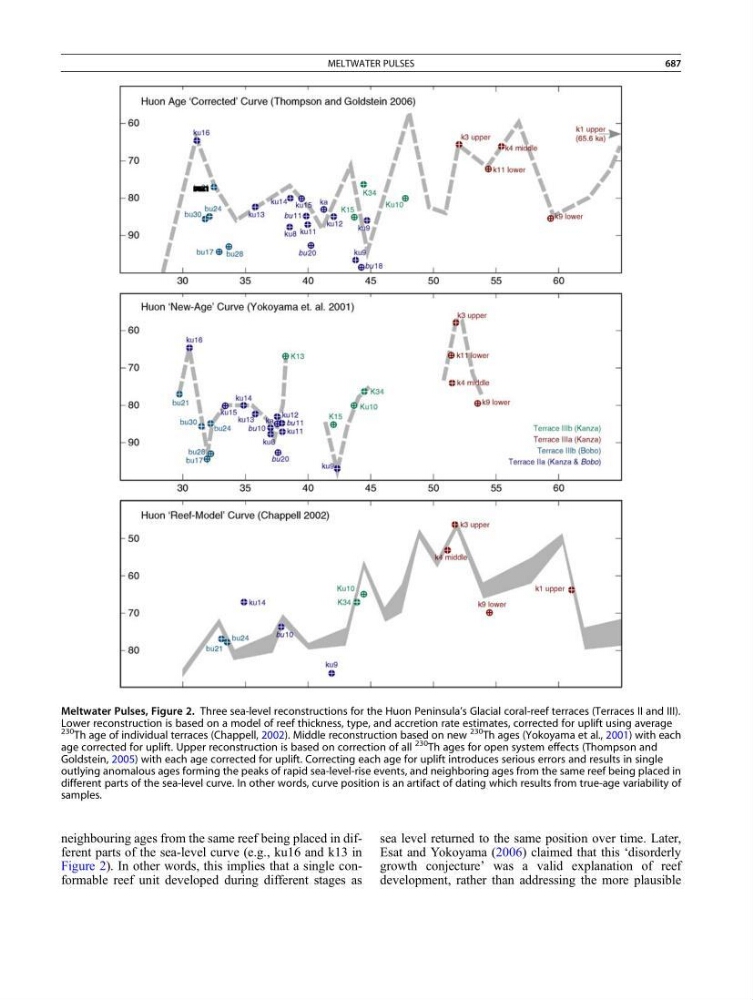
neighbouring ages from the same reef being placed in different parts of the sea-level curve (e.g., ku16 and k13 in
Figure 2). In other words, this implies that a single conformable reef unit developed during different stages as
sea level returned to the same position over time. Later,
Esat and Yokoyama (2006) claimed that this ‘disorderly
growth conjecture’ was a valid explanation of reef
development, rather than addressing the more plausible
Meltwater Pulses, Figure 2. Three sea-level reconstructions for the Huon Peninsula’s Glacial coral-reef terraces (Terraces II and III).
Lower reconstruction is based on a model of reef thickness, type, and accretion rate estimates, corrected for uplift using average
230 Th age of individual terraces (Chappell, 2002). Middle reconstruction based on new
230 Th ages (Yokoyama et al., 2001) with each
age corrected for uplift. Upper reconstruction is based on correction of all
230 Th ages for open system effects (Thompson and
Goldstein, 2005) with each age corrected for uplift. Correcting each age for uplift introduces serious errors and results in single
outlying anomalous ages forming the peaks of rapid sea-level-rise events, and neighboring ages from the same reef being placed in
different parts of the sea-level curve. In other words, curve position is an artifact of dating which results from true-age variability of
samples.
MELTWATER PULSES
687