

A third well-studied historical example of megablock
emplacement is on the island of Ishigaki, in the Okinawa
group, offshore Japan. Here in April 1771, a tsunami
accompanying an earthquake killed some 12,000 island
residents and also displaced numerous coral boulders,
some with dimension $5 m (Imamura et al., 2008). Controversies surrounding this incident concern (1) whether
an earthquake rupture on any regional fault was alone
sufficient to generate the tsunami, or whether the earthquake triggered an undersea landslide (Nakamura,
2006); (2) the height of the tsunami, variously reported
as 30–85 m, and the geographic extent of its runup;
and (3) whether the 1771 tsunami alone emplaced the
megablocks, or instead they were emplaced by previous
storms or tsunamis and simply moved again in 1771
(Suzuki et al., 2008).
There are no historical records of emplacement for
many megablocks. Frohlich et al. (2009) studied coral
megaboulders along the western coastline of Tongatapu
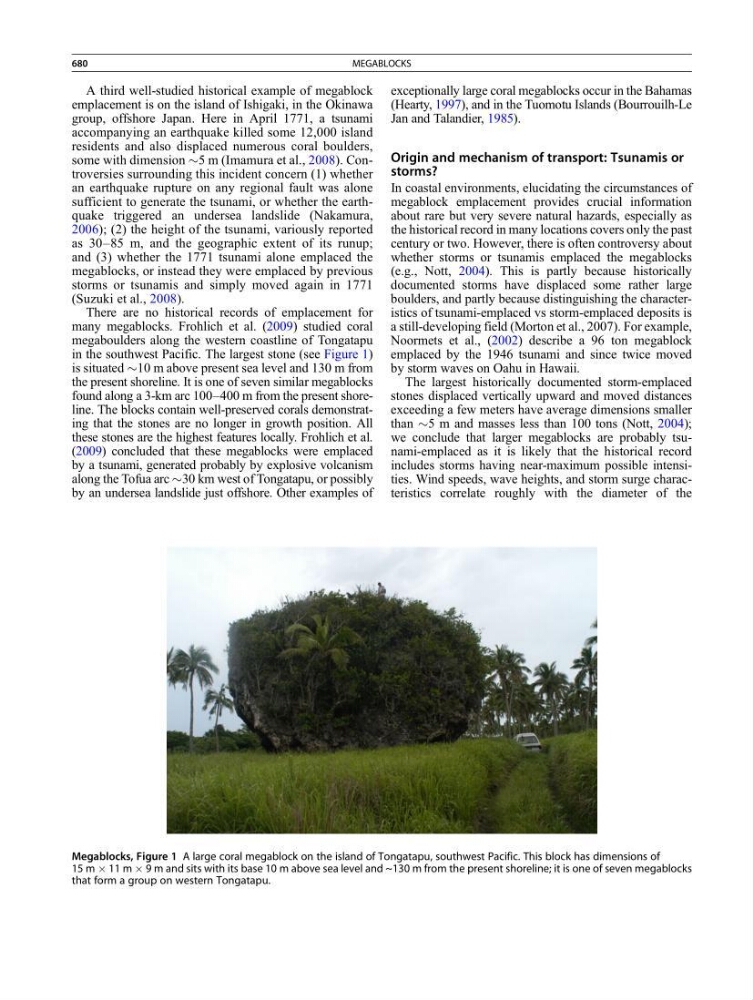
in the southwest Pacific. The largest stone (see Figure 1)
is situated $10 m above present sea level and 130 m from
the present shoreline. It is one of seven similar megablocks
found along a 3-km arc 100–400 m from the present shoreline. The blocks contain well-preserved corals demonstrating that the stones are no longer in growth position. All
these stones are the highest features locally. Frohlich et al.
(2009) concluded that these megablocks were emplaced
by a tsunami, generated probably by explosive volcanism
along the Tofua arc $30 km west of Tongatapu, or possibly
by an undersea landslide just offshore. Other examples of
exceptionally large coral megablocks occur in the Bahamas
(Hearty, 1997), and in the Tuomotu Islands (Bourrouilh-Le
Jan and Talandier, 1985).
Origin and mechanism of transport: Tsunamis or
storms?
In coastal environments, elucidating the circumstances of
megablock emplacement provides crucial information
about rare but very severe natural hazards, especially as
the historical record in many locations covers only the past
century or two. However, there is often controversy about
whether storms or tsunamis emplaced the megablocks
(e.g., Nott, 2004). This is partly because historically
documented storms have displaced some rather large
boulders, and partly because distinguishing the characteristics of tsunami-emplaced vs storm-emplaced deposits is
a still-developing field (Morton et al., 2007). For example,
Noormets et al., (2002) describe a 96 ton megablock
emplaced by the 1946 tsunami and since twice moved
by storm waves on Oahu in Hawaii.
The largest historically documented storm-emplaced
stones displaced vertically upward and moved distances
exceeding a few meters have average dimensions smaller
than $5 m and masses less than 100 tons (Nott, 2004);
we conclude that larger megablocks are probably tsunami-emplaced as it is likely that the historical record
includes storms having near-maximum possible intensities. Wind speeds, wave heights, and storm surge characteristics correlate roughly with the diameter of the
Megablocks, Figure 1 A large coral megablock on the island of Tongatapu, southwest Pacific. This block has dimensions of
15 m  11 m  9 m and sits with its base 10 m above sea level and ~130 m from the present shoreline; it is one of seven megablocks
that form a group on western Tongatapu.
680
MEGABLOCKS